The 2026 Business Evolution: Why AI Automation is Your Next Growth Engine
Imagine running a rapidly growing digital agency where scaling feels like a heavy burden. Fortunately, modern ai automation agencies have emerged to rescue struggling businesses from this operational weight. Just a few years ago, solo founders faced a difficult paradox. Scaling meant hiring more people, managing larger payrolls, and dealing with manual administrative tasks. Consequently, today the landscape has completely shifted.
Indeed, AI automation agencies have stepped into the spotlight to transform how modern companies operate. Instead of throwing human labor at repetitive problems, these specialized experts redesign your business. Consequently, they dramatically multiply your daily output without expanding your payroll. Therefore, business transformation now relies on intelligent system design and strategic foresight. Embracing this shift is no longer just about staying ahead of the curve. Rather, it unlocks operational freedom that founders only dreamed of a decade ago. Ultimately, replacing human bottlenecks with digital workers provides a massive competitive advantage.
Unleashing Agentic Architectures with AI Automation Agencies
To thrive in the current market, businesses are rapidly adopting agentic architectures. Specifically, these advanced systems go far beyond simple rule-based triggers. They deploy autonomous AI agents capable of handling complex decision-making tasks in real time. For example, these digital agents analyze context and execute the best action instantly. Consequently, they offer three massive operational benefits to any organization:
- Instant and highly accurate processing of vast data sets
- Autonomous, logic-based decision making that adapts to new information
- Continuous 24/7 operational uptime without the need for breaks or shifts
Furthermore, modern AI automation agencies build these sophisticated workflows using a blend of powerful platforms. For instance, tools like Make, n8n, Zapier, and LangChain serve as foundational infrastructure. Additionally, agencies enrich these platforms by weaving in advanced APIs from industry giants. Recently, a 2026 report by The JADA Squad highlighted how this combination creates a seamless web of productivity.

As a result, businesses implementing these architectures experience a breathtaking increase in operational speed. For example, generative AI allows autonomous agents to draft highly personalized client emails. They can also resolve complex support tickets and generate financial reports. Consequently, human employees are finally liberated from the daily grind. This allows them to focus purely on high-level strategy and creative problem-solving. If you want to select the right foundation, read our comprehensive Zapier vs Make vs n8n: Automation Guide. Ultimately, workflow automation is the key to eliminating organizational friction entirely.
How AI Automation Agencies Master Workflow Automation
Indeed, diving deeper into process automation reveals a fascinating journey of organizational discovery. When you partner with an agency, the first step is rarely about writing code. Instead, the engagement begins with a meticulous mapping of your entire business flow. For example, consultants sit down with your team to trace the lifecycle of a customer. Finally, they identify the critical operational bottlenecks where human intervention slows down progress.
Subsequently, once the map is clear, the agency deploys targeted AI solutions to bridge the gaps. For instance, manual data entry becomes a relic of the past. Intelligent parsers extract and route information automatically. Additionally, customer support queries are now resolved in mere seconds by trained AI assistants. Consequently, your operational capacity skyrockets almost overnight. These automated workflows run continuously in the background to ensure flawless operations. Therefore, adopting these architectures provides a foundation for limitless scaling.
Software Integration and Operational Design by AI Automation Agencies
In addition to automating isolated tasks, top-tier agencies excel at holistic software integration. Specifically, AI automation experts specialize in connecting the disparate technologies within your company. They build invisible, seamless bridges between enterprise software solutions like CRMs and ERPs. Consequently, data and decisions flow automatically across your entire organization. This process successfully breaks down traditional departmental silos. To explore these connections further, read The Ultimate Guide to API and System Integration.

Importantly, the rise of no-code platforms has made this integration incredibly fast and accessible. For example, innovative firms like Automation House utilize pre-built modules to deploy solutions quickly. This modern approach completely bypasses complex, multi-year software development cycles. According to recent insights from DevsData, companies now see massive returns on investment within weeks.
Furthermore, operational design ensures that these rapidly deployed systems scale safely and securely. For instance, HatchWorks AI provides an excellent example of this methodology in action. They are a prominent agency founded in 2016 in Atlanta, GA. Operating with approximately 120 employees, they specialize deeply in backend operational AI automation. Ultimately, their approach proves that intentional systems can handle ten times their normal volume easily.
Building Internal Capabilities
However, deploying cutting-edge technology is only half the battle for true digital transformation. Therefore, AI automation agencies increasingly recognize that long-term success requires a strong human element. Consequently, they are shifting their focus to offer comprehensive consulting engagements. For example, extensive team training programs are now a standard part of the package.
Indeed, these educational initiatives help organizations build robust internal capabilities. As a result, employees learn to interact with AI agents and optimize workflows. This ensures that companies can govern their AI systems responsibly and ethically. Consequently, your team learns to manage these tools effectively. Ultimately, maintaining control over your infrastructure empowers your workforce and serves your grander vision.
The ROI of Partnering with AI Automation Agencies
Undeniably, the financial impact of integrating AI automation into a modern business is massive. For instance, companies utilizing advanced AI agents report a staggering 300% increase in output. Additionally, operational costs drop by an average of 45% as manual labor needs disappear. Recently, a landmark 2025 study highlighted these efficiency gains across multiple sectors.
Furthermore, automated customer service platforms resolve up to 80% of tier-one tickets instantly. Consequently, human agents are freed up to handle only high-value interactions. To see real-world examples, read How Process Automation and AI Save Millions. Additionally, error rates plummet by up to 95% when utilizing integrated data pipelines. As a result, businesses routinely recover an average of 20 hours per week per employee. Therefore, partnering with an automation agency delivers transformative financial returns.
Traditional vs. AI-Automated Workflows
To grasp the magnitude of this shift, we must compare traditional and modern workflows. Historically, the traditional approach relied on human endurance and manual data transfer. In contrast, the modern approach leverages speed, precision, and exponential scalability.
| Metric | Traditional Workflows | AI-Automated Workflows |
|---|---|---|
| Processing Speed | Days to weeks | Seconds to minutes |
| Error Rate | High (human error) | Near zero |
| Scalability | Linear (requires hiring) | Exponential |
| Integration | Manual data entry | Seamless API connections |
Clearly, reviewing these metrics makes it obvious why legacy systems are rapidly becoming obsolete. Companies clinging to traditional workflows simply cannot compete with the speed and accuracy of an AI-automated competitor.
The AI Automation Ecosystem
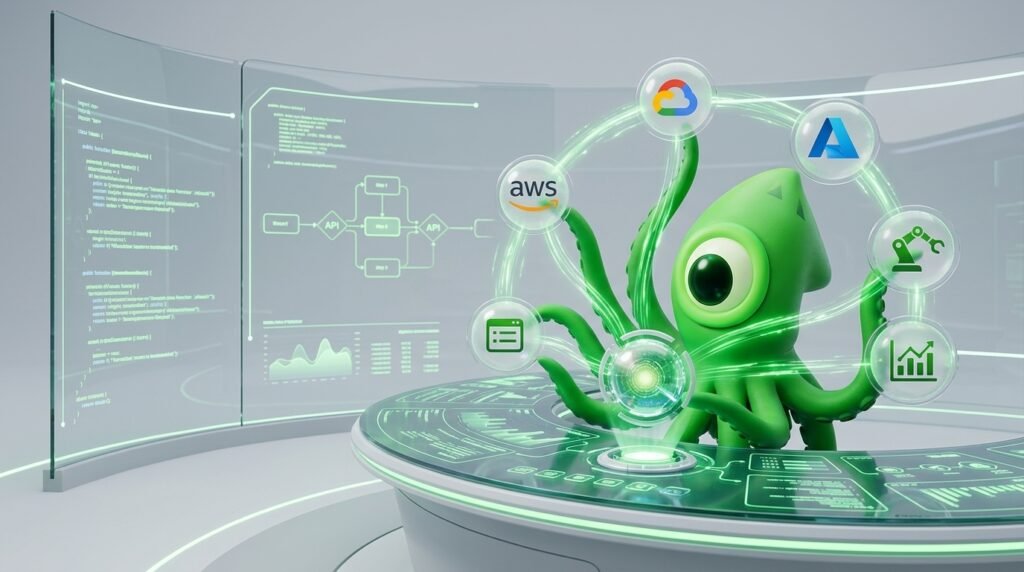
Clearly, understanding the infrastructure of an automated business requires a visual model. Therefore, imagine a central, highly intelligent hub powering your entire organization.

Essentially, the core of this ecosystem represents the generative AI engine. Branching pathways connect this central hub to various enterprise software nodes. Specifically, these pathways represent seamless API integrations that allow continuous data flow. For example, a customer inquiry instantly triggers a CRM update and alerts fulfillment. Consequently, no piece of information is ever lost in transit. Ultimately, this visual model proves how modern systems eliminate operational silos.
Conclusion
In conclusion, AI automation agencies are fundamentally revolutionizing business operations in 2026. By deploying powerful agentic architectures, they help companies break through growth ceilings. Consequently, businesses can easily multiply their output while slashing overhead costs. Indeed, the narrative has shifted into an exciting journey of operational mastery. Therefore, embracing process automation today allows you to build a resilient organization. Ultimately, investing in intelligent system design will secure your place at the forefront of your industry.
What exactly do AI automation agencies do?
Essentially, they act as strategic architects for your business operations. By building sophisticated AI workflows, they automate repetitive manual tasks. Consequently, this streamlines your entire operation and allows your company to scale efficiently.
How fast can I see ROI from these systems?
Fortunately, deployment is incredibly rapid thanks to modern no-code platforms. As a result, most businesses see significant financial returns within just a few weeks.
Do I need to fire my existing staff?
Absolutely not. Instead, the goal of AI automation is to augment your workforce. Specifically, automation handles the repetitive administrative tasks that drain energy. Consequently, your team is freed up to focus purely on high-level strategy.