

The Survival Imperative of Digital Transformation
As we navigate the competitive business landscape of July 21, 2026, implementing ai workflow automation is a survival imperative. Consequently, businesses relying on purely manual workflows are rapidly losing ground to agile, tech-enabled competitors.
According to a 2026 report by The JADA Squad, failing to automate means facing imminent operational death. Therefore, digital transformation is no longer an optional upgrade. Indeed, it stands as a strict survival imperative today.
Escaping the Legacy Trap with AI Workflow Automation
Frequently, growing companies find themselves crushed by scaling bottlenecks. This happens because manual tasks drain valuable resources. Moreover, talented employees bogged down by repetitive tasks cannot focus on strategic growth.
Fortunately, modern organizations can easily break free from this debilitating cycle. Specifically, sophisticated systems no longer require the multi-year, multi-million-dollar deployments of the past. Instead, businesses can deploy customized solutions in weeks using highly accessible APIs and modular cloud architectures.
Thus, the path forward is clear if you want to scale fast. Subsequently, we reveal six actionable tips to transform your operations. As a result, you will escape the legacy trap and dominate your market.

Foundations of Agentic AI Workflow Automation
First, you must build an incredibly solid digital foundation to survive. Therefore, you should map your existing business processes meticulously before writing code. Understanding your specific operational bottlenecks is the only way to ensure success.
Additionally, take the time to identify repetitive, low-value tasks. These tasks are currently draining your team’s energy. Consequently, they slow down your delivery pipelines.
Connecting Systems for AI Workflow Automation
Tip 1: Audit and Connect Your Tech Stack. A core competency of leading agencies is connecting disparate technology stacks. According to insights from The JADA Squad, linking CRMs, ERPs, and data warehouses is critical. Indeed, seamless software integration actively prevents the formation of data silos.
If your systems cannot communicate, your initiatives will inevitably fail. For deeper insights into building a unified digital ecosystem, check out The Ultimate Guide to API and System Integration.
Tip 2: Embrace Agentic Architecture. Once your systems communicate, you should deploy autonomous agents. This architecture represents a massive leap forward from traditional Robotic Process Automation. Rather than following rigid scripts, agentic systems make contextual decisions based on real-time data. If you want to learn more, read about 5 Secrets to Agentic AI Workflow Automation.
Deploying Intelligent Systems for AI Workflow Automation
Tip 3: Leverage RAG Integrations. To maximize value, you must enhance your agents with Retrieval-Augmented Generation. RAG integrations serve to ground your agents in proprietary data. By referencing internal documents, these systems provide highly accurate, context-aware responses.
As of 2026, forward-thinking companies like Unico Connect successfully build sophisticated systems. According to industry reviews on DesignRush, these systems brilliantly manage multi-step processes. Therefore, injecting custom knowledge directly into your workflows guarantees high-quality, reliable outputs.

Optimizing Custom AI Workflow Automation
Once your foundational architecture is in place, optimization must become your primary focus. However, the technological landscape evolves at a breakneck pace. Therefore, you must refine and upgrade your automated systems continuously to maintain your edge.
Tip 4: Build Custom Software Solutions. While off-the-shelf SaaS tools are useful, they often fall short for complex enterprise needs. Consequently, investing in custom software ensures that your infrastructure fits your unique operations perfectly.
For example, industry leaders like ELEKS specialize in delivering bespoke enterprise automation. According to DesignRush, ELEKS backs their solutions with a massive 2000-person team. This profound technical knowledge drives superior results. You can explore more strategies in 7 Enterprise Workflow Automation Hacks.
Human Oversight in AI Workflow Automation
Tip 5: Implement Human-in-the-Loop Checkpoints. Despite rapid advancements, total unsupervised automation remains a dangerous myth. Therefore, strategic human oversight is still absolutely necessary for complex operations.
Experts at Unico Connect emphasize building systems with deliberate human checkpoints. In this hybrid model, the technology handles the heavy lifting. Meanwhile, human experts review and approve all critical, high-stakes decisions. Consequently, this collaborative approach effectively mitigates operational risk.
Continuous Machine Learning Refinement
Tip 6: Continuously Train Your Machine Learning Models. An automated system is not a static tool. Instead, it must evolve over time to remain effective. Indeed, machine learning models naturally degrade if they are left stagnant.
To combat this, you must feed your systems new data regularly. Additionally, you should conduct routine audits of their decision-making processes. By closely monitoring key performance metrics, you ensure your systems remain sharp. Discover how proactive maintenance impacts your bottom line in How Process Automation and AI Save Millions.
The Real ROI of AI Workflow Automation
The financial data emerging in 2026 paints a stark reality. Specifically, companies embracing ai workflow automation are seeing massive, undeniable returns. According to recent data, early adopters have reduced core operational costs by up to 45%.
Furthermore, these businesses have accelerated their time-to-market for new products by nearly 60%. Conversely, firms relying on manual processes face a grim future. The JADA Squad notes that manual companies are losing market share at an unprecedented rate.
Additionally, the barrier to entry has never been lower. Modern systems deploy 70% faster than traditional enterprise software. Because of highly accessible APIs, integrating advanced machine learning takes mere weeks. Therefore, the financial incentive to automate is clear.
Traditional vs. AI-Automated Workflows
Understanding this technological shift requires a direct comparison of operational models. By breaking down the differences, the advantages of modern systems become glaringly obvious.
| Feature | Traditional Workflow | AI-Automated Workflow |
|---|---|---|
| Execution Speed | Days or weeks due to manual handoffs | Seconds or minutes via instant processing |
| Decision Making | Manual, rigid, and prone to fatigue | Agentic architecture with contextual awareness |
| Error Rate | High risk of human data entry errors | Incredibly low, continuously optimized by ML |
| Integration | Siloed data requiring manual porting | Seamless software integration across all platforms |
As the table illustrates, modern systems completely dominate traditional methods. Consequently, sticking to old ways of working is a guaranteed formula for falling behind.
Visualizing the AI Workflow Automation Pipeline
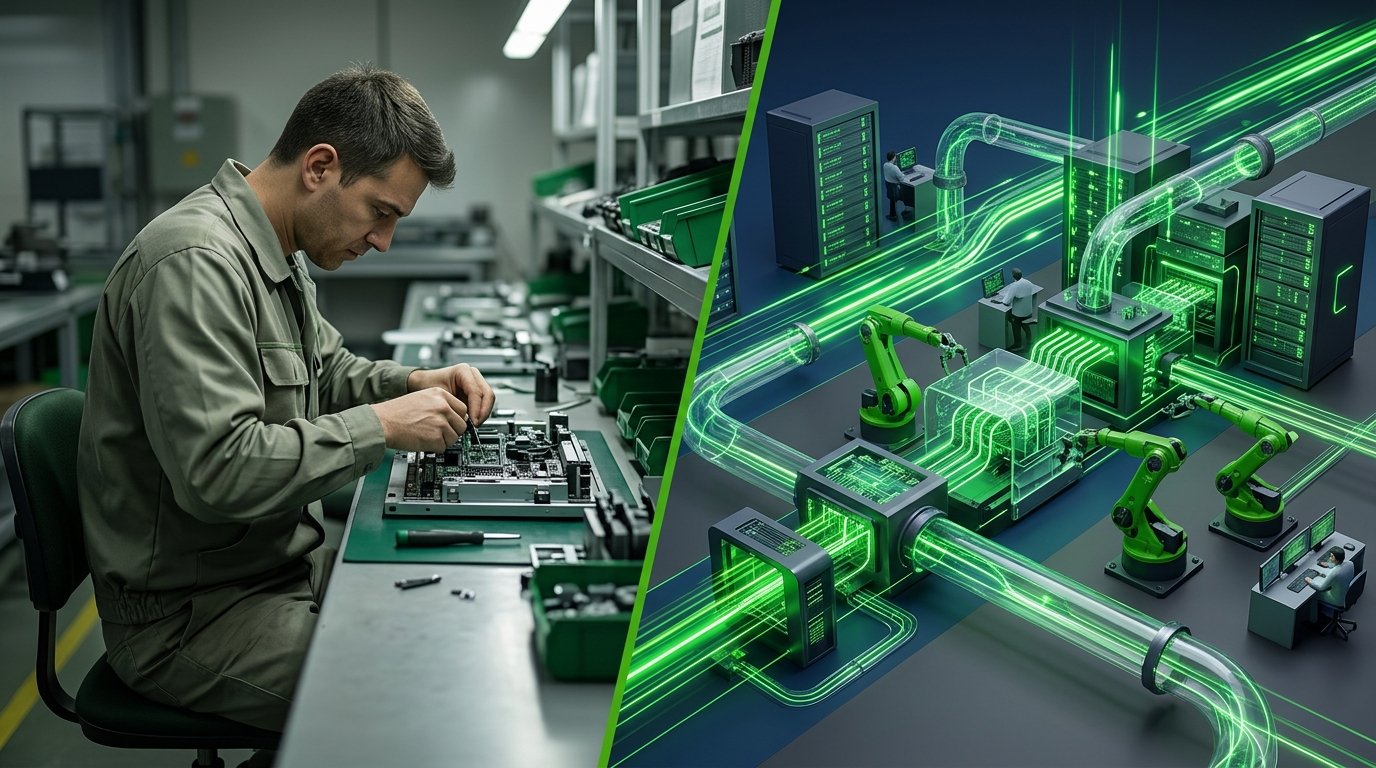
To grasp the power of these systems, imagine a dynamic, interconnected pipeline. The journey begins as raw data flows seamlessly into a secure central processing hub. Almost instantly, RAG integrations activate, pulling relevant company knowledge to provide deep context.
From there, the workflow splits into multiple autonomous branches. Here, specialized agents handle specific micro-tasks simultaneously. Meanwhile, green glowing lines represent seamless software integration connecting your CRMs and ERPs in real-time.
Just before final execution, a distinct human checkpoint flashes on the dashboard. This critical juncture indicates where managers step in to review high-stakes decisions. Ultimately, this visual concept proves that modern automation is a fluid, intelligent augmentation of your workforce.
Conclusion: Scale Fast or Fall Behind
As we push further into 2026, digital transformation dictates market survival. Escaping the legacy trap requires immediate, decisive action. To summarize the critical path forward, you must implement these foundational steps:
- Connect your tech stack thoroughly to eliminate data silos.
- Embrace agentic architecture to enable smart, contextual decisions.
- Deploy RAG integrations to ensure absolute data accuracy and relevance.
- Build reliable custom software solutions tailored to your unique enterprise needs.
- Maintain human-in-the-loop checkpoints to mitigate risk and ensure quality.
- Continuously train your machine learning models to prevent degradation.
Applying these six tips will fundamentally supercharge your daily operations. Therefore, do not wait for your competitors to outpace you. Integrate these intelligent systems today, start auditing your existing workflows immediately, and build a highly scalable future.
Frequently Asked Questions
What is agentic architecture in AI automation?
Agentic architecture refers to advanced AI systems that act autonomously to achieve specific goals. Instead of following rigid, pre-programmed rules like traditional bots, these AI agents can assess their environment, make contextual decisions, and execute complex, multi-step processes independently to solve problems.
Why are human-in-the-loop checkpoints necessary?
While AI is incredibly powerful, total unsupervised automation carries significant operational and reputational risks. Human-in-the-loop checkpoints ensure that experienced human managers review and approve critical, high-stakes decisions. This hybrid approach maintains top-tier quality, ensures ethical compliance, and prevents costly algorithmic errors.
How long does it take to deploy AI workflows?
In 2026, deploying sophisticated AI workflows no longer requires the multi-year timelines associated with older enterprise software. Thanks to modern, highly accessible APIs and modular cloud platforms, businesses can design, test, and deploy robust automation solutions in just a few weeks.
What are RAG integrations?
Retrieval-Augmented Generation (RAG) integrations are systems that connect large language models directly to your private, proprietary company data. By referencing your specific documents and databases, the AI provides highly accurate, context-specific answers rather than relying on generic information, thereby eliminating hallucinations and improving reliability.