
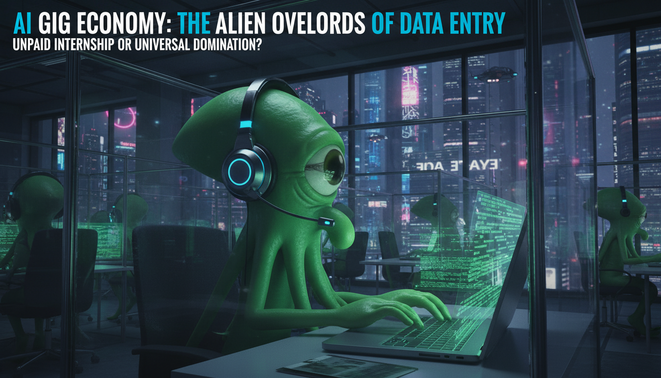
The Invisible Workforce: Surviving the AI Training Gig Economy
Ruth Fowler once wrote for giants like Paramount. Jonathan spent years crafting scripts for Hulu. Today, these creative minds face a different reality. They have joined the growing AI Training Gig Economy to survive. Both experts are now moving from creative writing to training Large Language Models.
Instead of writing scripts, they now label data for machines. This shift signals a big change in how we value human labor. Many experts now view this labor as a modern survival tactic.
Ruth Fowler famously stated that AI gig work is the new waiting tables. This quote captures the struggle of very skilled workers today. They provide the logic that powers complex systems.
However, they do so under tough conditions. These creators once shaped culture. Now they teach algorithms how to speak. This transition is not always easy for these writers.
Many struggle with low pay and repetitive tasks. They often work through platforms like Outlier or Mercor. These companies manage thousands of contractors at once.
As a result, the human element often feels lost in the process. Writers find themselves competing for tiny tasks in a crowded digital space. This trend fits into broader shifts seen in AI industry trends 2026.
Similarly, we see these patterns among overseas gig workers who also train complex systems. Both groups face similar challenges because job security is low.
This deep look explores how this invisible workforce survives. It also examines the technical costs of building modern systems.
Investigative Analysis of Labor Practices
The AI Training Gig Economy relies on a massive scale of human input. Companies like Mercor and Outlier manage thousands of workers across the globe. However, these platforms often treat human labor as a simple technical resource.
One worker noted that these are not jobs but they are tasks and we are taskers. They often refer to themselves as taskers rather than employees. As a result, the human element disappears behind a digital interface.
Mercor illustrates this massive gap between management and labor. The company employs roughly 300 full time staff members. In contrast, they utilize about 30,000 independent contractors for data annotation.
Furthermore, this ratio shows how little oversight exists for the average worker. Therefore, many contractors feel isolated in their daily work. One contractor said it feels like they are all in a fishbowl waiting for food. This imagery highlights the power imbalance in the system.
Specific projects reveal even more troubling patterns in labor practices. In November 2025, Mercor ended a project called Project Musen. They immediately moved thousands of workers to an identical project named Nova.
Moreover, the pay rate dropped significantly during this shift. Workers previously earned $21 per hour on Musen. The new Nova project paid only $16 per hour for the same work. Consequently, many workers felt forced to accept lower wages to stay active.
This cycle of firing and rehiring is common in the industry. It allows platforms to slash costs without traditional negotiations. Platforms like Turing and Handshake also use similar high pressure tactics.
Such practices raise serious questions about the ethics of data training. You can learn more about how AI platform integration and data training impacts costs in our related guide. This approach ensures that the systems remain profitable for the companies involved.
The system thrives on the vulnerability of its participants. Many workers are former professionals who lost stable jobs. Because they need income, they tolerate these declining standards.
Thus, the dehumanization of the workforce becomes a feature of the business model. To make the machine more human, they will make us more like the machine. This reality defines the current state of the industry today.

The Mechanics of Data Annotation: Optimizing the AI Training Gig Economy
Modern machine learning systems require high quality data to function properly. Therefore, developers often use PyTorch to build these complex architectures. One specific area of interest involves OCR CAPTCHA solving models. Because these models demonstrate the power of refined data annotation, they are very useful in real world applications.
Architecting for Accuracy
Technical OCR models can achieve 100 percent accuracy today. Consequently, engineers often utilize a shared CNN backbone for this specific purpose. An eca nfnet l0 backbone provides a strong foundation for image feature extraction. This architecture handles various visual distortions with great ease.
Furthermore, multi head classification allows the system to identify multiple characters at once. You only need approximately 4,000 training samples to reach peak performance. This efficiency comes from the high quality labels provided by human workers. For instance, without these labels, the system would fail.
Because accuracy is critical, developers focus on specific label categories. One common saying in the industry is that specificity wins on training stability. Highly detailed labels improve sample efficiency and inference speed. As a result, debugging becomes much easier for the entire technical team.
Hardware Optimization and RLHF
However, training these models requires significant computational power from clusters. Teams rely on Nvidia hardware to accelerate the learning process. Specifically, CUDA cores enable massive parallel processing of data batches. Full details on this hardware are at the Nvidia CUDA zone.
This setup reduces total training time from weeks to days. Moreover, Reinforcement Learning from Human Feedback or RLHF plays a vital role. This process refines the output of Large Language Models effectively. Human annotators rank different responses based on helpfulness and safety.
Consequently, the model learns to better mimic human reasoning. Therefore, the AI Training Gig Economy provides the essential feedback loop. While the work seems simple, the technical impact is profound. It bridges the gap between raw data and intelligent behavior. Additionally, every task completed by a human improves the final machine output.
The State of the AI Training Market 2025 to 2026
The following data summarizes the current landscape for major platforms in the industry. As the demand for data grows, these companies manage vast networks of workers. However, wages for highly skilled experts have seen a sharp decline over the past year.
| Company | Primary Function | Estimated Contractor Count | Average Expert Wage Trend (High 2025 vs Low 2026) |
|---|---|---|---|
| Mercor | Data Annotation | 30,000 | $150 per hour vs $50 per hour |
| Outlier | Red Teaming | Thousands | $150 per hour vs $50 per hour |
| Taskify | Data Annotation | Thousands | $150 per hour vs $50 per hour |
| Micro1 | RLHF Training | Thousands | $150 per hour vs $50 per hour |
This shift highlights the volatility within the AI Training Gig Economy. While the workload remains high, the financial rewards for experts are shrinking rapidly. Therefore, many professionals must decide if the task based nature of the work remains sustainable. Because the market continues to evolve, these trends may shift further in the coming months.
CONCLUSION
The shift in the creative landscape is clear. Writers no longer just create stories for the screen. Instead, they now train the logic of complex software. This transition creates a fishbowl effect for many workers. Therefore, they wait for tasks like fish waiting for food in an aquarium.
The industry prioritizes efficiency over human agency. Consequently, this trend has a lasting impact on how we define work. One quote summarizes this situation perfectly. To make the machine more human, they will make us more like the machine. This reality defines the AI Training Gig Economy today.
Businesses need a better way to scale their growth. However, most companies struggle with finding skilled labor. EMP0 (Employee Number Zero, LLC) offers a modern solution for these challenges. They provide full stack and brand trained AI workers. These systems help businesses reach their goals faster.
Furthermore, EMP0 specializes in growth systems and custom automation. They offer powerful tools like the Content Engine. This tool streamlines the creation of digital assets efficiently. They also provide Sales Automation to improve lead conversion rates. These tools ensure that your brand stays ahead in a competitive market.
Because efficiency matters, businesses must choose the right partners. Therefore, you can find more resources on the Employee Number Zero blog. This platform shares insights on automation and technical growth. You can also explore how AI infrastructure and context engineering lower costs for modern brands.
Moreover, the founder shares workflows on the n8n creator page. These resources help companies build sustainable systems. Additionally, by focusing on quality, brands can avoid the pitfalls of the gig economy. Thus, they ensure a better future for their human and digital teams alike. This approach builds a bridge between human creativity and machine scale.
Frequently Asked Questions (FAQs)
Why are Hollywood writers joining the AI Training Gig Economy?
Many Hollywood writers face financial pressure after the industry strikes in 2023. Consequently, they look for new ways to use their creative skills. They often transition from writing scripts to labeling complex datasets for machines. This work provides a steady source of income during slow periods in the film industry. Because they understand nuance, these writers are valuable for training high quality language models.
How much have wages dropped for AI experts?
The market for AI experts has seen a sharp decline in pay recently. In early 2025, top experts could earn as much as 150 dollars per hour. However, this rate fell to just 50 dollars per hour by early 2026. This drop occurred because the supply of available workers increased significantly. Therefore, many professionals feel that the financial rewards are shrinking quickly.
How do technical OCR models achieve 100 percent accuracy?
Engineers achieve peak accuracy by using a shared CNN backbone for feature extraction. Specifically, they often use the eca nfnet l0 architecture to handle image distortions. Furthermore, a multi head classification system allows the model to identify many characters simultaneously. This setup only requires about 4,000 training samples to reach perfect results. As a result, the model becomes both efficient and extremely reliable.
What is the difference between Mercor staff and its contractors?
Mercor maintains a very small internal team compared to its vast external workforce. The company employs approximately 300 full time staff members for core operations. In contrast, they manage roughly 30,000 independent contractors for data annotation tasks. This gap shows how heavily the platform relies on external labor. Consequently, contractors often feel like they lack direct support from the management team.
What does RLHF involve in the AI Training Gig Economy?
RLHF stands for Reinforcement Learning from Human Feedback. This process involves human workers who rank different model responses based on quality and safety. Because the model receives this feedback, it learns to mimic human reasoning more effectively. Human input ensures that the final output is helpful and easy to understand. Therefore, RLHF bridges the gap between raw data and natural conversation.