

Surviving the Storm: A Startup’s Playbook for Tough Markets
The glamour of startup life often fades when economic headwinds begin to blow. Suddenly, the primary focus shifts from rapid expansion to pure survival. For founders, understanding how startups survive downturns is not just another skill; it is the most critical challenge they will face. The era of easy money and chasing growth at any cost has decisively ended. Because of this, a new reality demands a different approach. As the saying goes, “When markets tighten, hype stops working.” This environment consequently requires a fundamental shift in strategy, moving from burning cash to building a truly resilient business.
This article provides a practical playbook for navigating these tough markets. We will explore the core principles that separate the startups that fail from those that emerge stronger on the other side. As a result, we will delve into the profound importance of rigorous cash discipline. We will also examine how focusing on a Minimum Viable Product (MVP) can save precious resources and validate ideas efficiently. Finally, we will outline a clear path to sustainable growth that prioritizes long term viability over fleeting short term gains. This guide offers actionable advice for founders ready to adapt, pivot, and ultimately thrive.
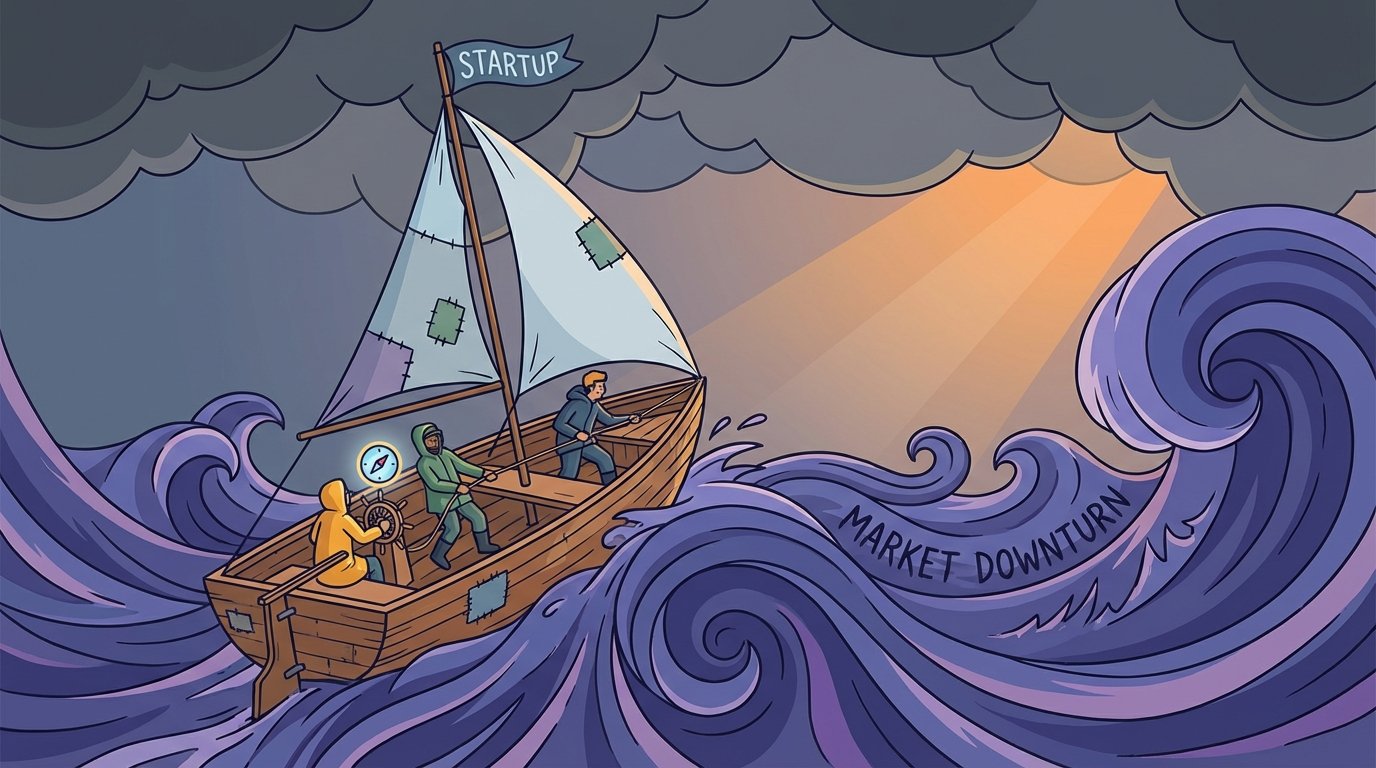
Cash Discipline and Focus: Key to Startups Survive Downturns
During a market downturn, the rules of the game change entirely. Access to capital becomes scarce, and investors shift their focus from aggressive growth to profitability. Consequently, the single most important factor determining which startups survive downturns is a relentless commitment to cash discipline and focus. Without these, even the most promising ventures can collapse. As one expert noted, “Downturns reward a different playbook: operate lean, stay flexible and make decisions that extend runway without sacrificing long term viability.” Therefore, founders must pivot their mindset from spending to preservation.
Excellent execution of a focused strategy is what separates survivors from casualties. This means every dollar spent must be justified by a clear return on investment. The goal is to extend runway, giving the company enough time to navigate the uncertainty. To achieve this, startups must operate lean, cutting non essential costs and optimizing every process. Furthermore, maintaining a sharp focus on the core product and the most valuable customers prevents the wasteful allocation of resources on unproven ideas. Many startups fail not from a lack of ambition, but from a breakdown in financial management.
Here are some effective cash management tactics to implement:
- Scrutinize All Expenses: Conduct a thorough review of all recurring costs, from software subscriptions to office space. As a result, you can identify and eliminate anything that is not absolutely critical to operations.
- Renegotiate with Vendors: Many suppliers are willing to offer more flexible payment terms or discounts during tough economic times. Therefore, it is always worth opening a conversation to improve your cash flow.
- Leverage Modern Tools: Instead of hiring large teams, operate lean by using technology. For example, AI tools can automate tasks traditionally done by full teams, helping to avoid costly mistakes. Exploring how AI bubble risk and education AI policy can shield schools reveals ways to use tech wisely.
- Focus on High ROI Activities: Prioritize sales and marketing efforts that generate immediate revenue. This means concentrating on channels and customer segments that have proven to be profitable and have shorter sales cycles.
| Strategy | Description | Advantages | Considerations |
|---|---|---|---|
| Cash Discipline | Strict control over all spending to maximize cash reserves and extend the company’s operational runway. | Increases financial stability, reduces burn rate, and provides more time to navigate uncertainty. | Can stifle innovation if too restrictive and requires constant monitoring and difficult decisions. |
| MVP Development | Focusing on building a Minimum Viable Product with only core features to validate market demand before heavy investment. | Reduces development costs, accelerates time to market, and gathers essential customer feedback early. | May not be feature rich enough to attract a wide audience initially; risk of competitors building a more complete product. |
| Sustainable Growth | Prioritizing long term profitability and customer retention over rapid, cash intensive expansion. | Builds a resilient business model, fosters customer loyalty, and creates a clear path to profitability. | Growth may be slower compared to venture backed competitors; requires a deep understanding of unit economics. |
| Bootstrapping | Funding the startup using personal finances or revenue generated from the business itself, without external investment. | The founder retains full ownership and control of the company; enforces fiscal discipline from the very beginning. | Growth can be limited by available cash flow; personal financial risk for the founder is significantly higher. |
| Raising Capital | Securing funding from external investors like venture capitalists or angel investors to finance growth. | Provides significant capital to scale the business, hire top talent, and potentially outpace competitors. | Extremely difficult during a downturn; involves giving up equity and control; investor expectations can be very demanding. |
| Use of AI Tools | Leveraging artificial intelligence to automate repetitive tasks, reduce operational overhead, and improve overall efficiency. | Lowers headcount requirements, optimizes critical business processes, and can provide a substantial competitive edge. | Requires an initial investment in technology and employee training; potential data privacy and security concerns. |
| Freelancers & Contractors | Hiring temporary or project based workers instead of full time employees to maintain a flexible and lean workforce. | Reduces fixed payroll costs and employee benefits; provides access to specialized skills exactly when needed. | Can be challenging to build a cohesive company culture; knowledge transfer can become an issue when projects end. |
MVPs, Sustainable Growth, and AI Tools to Help Startups Survive Downturns
In tough markets, the “grow at all costs” mantra becomes a recipe for disaster. Instead, successful startups pivot to smarter, more resilient strategies. This involves a deep focus on Minimum Viable Products (MVPs), a commitment to sustainable growth, and the strategic use of technology. Consequently, these elements form the foundation of a durable business that can weather any economic storm.
The concept of an MVP is more critical than ever during a downturn. An MVP is the most basic version of a product that can be released to the market. Its purpose is to test a business hypothesis and gather user feedback with minimal investment. By launching MVPs, startups avoid pouring vast sums of money into developing features that customers may not want. Therefore, this lean approach conserves cash and allows for rapid iteration based on real world data, ensuring that resources are only allocated to validated ideas.
Parallel to using MVPs is the pursuit of sustainable growth. This strategy prioritizes long term health over short term vanity metrics. Sustainable growth focuses on achieving profitability and positive cash flow. It means acquiring customers at a reasonable cost and maximizing their lifetime value. As a result, the business builds a solid financial foundation and is not reliant on constant fundraising to stay afloat, a crucial advantage when investors are cautious.
Technology plays a vital role in enabling these lean strategies. Specifically, AI tools can replace work traditionally done by full teams. Modern AI applications can handle tasks ranging from customer support and content creation to data analysis and code generation. This allows startups to operate with a smaller core team, significantly reducing payroll expenses. For specialized needs, companies can supplement their team with freelancers and contractors, providing flexibility without the long term cost of full time employees. This combination of AI tools and a flexible workforce is a powerful formula for survival.
Thriving, Not Just Surviving
Navigating a market downturn is the ultimate test of a startup’s resilience and strategic clarity. The path to survival is not paved with hype, but with deliberate, disciplined action. As we have explored, the startups that survive downturns are those that master cash discipline, ensuring every dollar is spent with purpose. They embrace the lean methodology of Minimum Viable Products to validate ideas without wasting precious resources. Furthermore, they shift their focus from reckless expansion to sustainable growth, building a business with a solid financial foundation. These principles are not just defensive measures; they are the building blocks of a stronger, more adaptable company.
Adopting technology, particularly artificial intelligence, is a critical enabler of this modern playbook. AI powered solutions allow startups to operate with greater efficiency, automating tasks and unlocking new opportunities for growth. For companies looking to leverage these advantages, turning to experts can make all the difference. EMP0 is a leader in AI and automation, helping startups multiply revenue through secure, AI driven growth systems. By deploying these solutions within a company’s own infrastructure, they provide a powerful and safe way to scale. To learn more, explore their insights at articles.emp0.com.
Frequently Asked Questions (FAQs)
What is the most critical first step for a startup facing a market downturn?
The immediate priority is to enforce rigorous cash discipline. This means conducting a thorough audit of all expenses and cutting everything that is not absolutely essential to core operations. The primary goal is to extend your financial runway as much as possible. Consequently, this provides you with the time needed to make strategic adjustments, focus on your most valuable customers, and navigate the uncertain economic climate without running out of money. Survival depends on managing cash flow effectively above all else.
Is it a mistake to try raising capital during a downturn?
It is not necessarily a mistake, but it is significantly more challenging. Investors become more risk averse and shift their focus from high growth potential to clear paths to profitability. Therefore, if you do decide to raise capital, you must have a compelling case that demonstrates strong unit economics, a loyal customer base, and a lean operational model. Bootstrapping or focusing on generating revenue internally are often more viable alternatives until market conditions improve for fundraising.
How does building a Minimum Viable Product (MVP) help with survival?
An MVP is a powerful tool for conserving resources in a tough market. Instead of investing heavily in a feature rich product, you build only the core functionalities needed to solve a key problem for your target audience. This approach drastically reduces initial development costs and allows you to get to market faster. As a result, you can gather real world feedback from early users, validate your business idea, and ensure you are building something people actually want before committing more capital.
What does “sustainable growth” mean for a startup in a tough market?
Sustainable growth means prioritizing long term viability over short term, cash intensive expansion. It involves a shift in focus from simply acquiring new users to acquiring them profitably. This requires a deep understanding of your customer acquisition cost and lifetime value. The goal is to build a business model that can generate positive cash flow and does not depend on constant external funding to operate. It is about building a resilient company, not just a fast growing one.
How can AI tools practically help a small startup save money?
AI tools offer significant cost savings by automating tasks that would traditionally require hiring staff. For instance, AI powered chatbots can handle a large volume of customer service inquiries, reducing the need for a big support team. AI can also automate marketing efforts, generate content, and analyze data to find efficiencies. By leveraging these tools, a startup can operate much leaner, keeping its fixed costs low while maintaining high productivity. This allows a small team to achieve results that once required a much larger workforce.