Strategic AI Integration: Your Leadership Playbook for Demographic Change
We are facing a monumental demographic shift that leaders can no longer ignore. Globally, populations are aging rapidly while birth rates have fallen below sustainable levels. In fact, by 2035, older adults will outnumber children for the first time ever. This trend creates a critical challenge for businesses everywhere. As experienced workers retire, who will fill their roles? More importantly, how can we preserve the invaluable institutional knowledge they possess?
This situation forces us to ask a fundamental question: “What makes us human?” The solution is not to fear the future, but to shape it with powerful tools. Therefore, strategic AI integration becomes essential. It provides a clear path to enhance productivity, secure vital expertise, and future proof your organization. This playbook offers a guide to leading that change.
The Strategic Imperative of AI Integration
For decades, leaders have observed the slow march of demographic change. However, the consequences of an aging population and declining birth rates are no longer distant concerns. They are immediate threats to productivity, continuity, and growth. As your most experienced employees head toward retirement, they take with them a lifetime of institutional knowledge that is difficult to replace. Facing a shrinking talent pool, the old ways of operating are simply unsustainable. Therefore, inaction is now the greatest risk. The strategic imperative is clear: businesses must innovate to survive, and intelligent automation is the key.
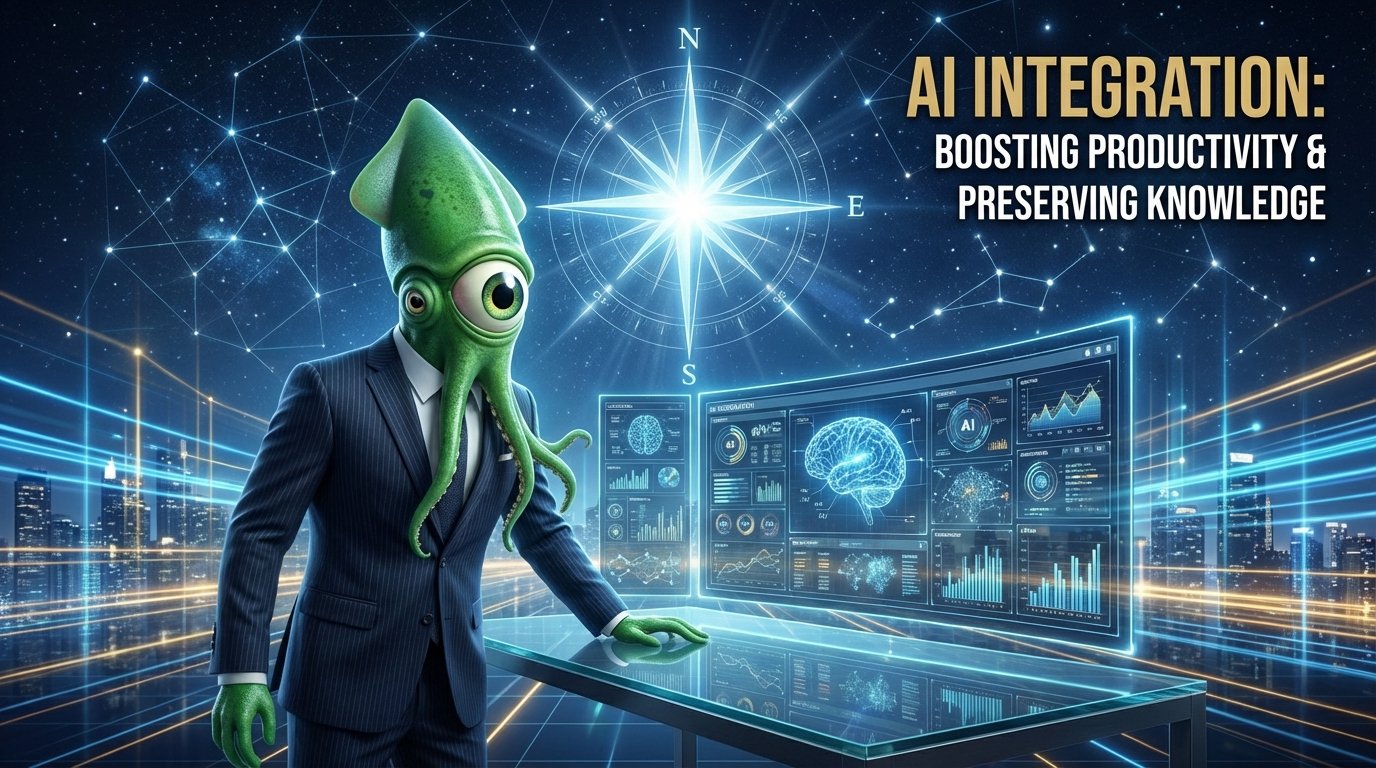
Your North Star: AI Integration
In this challenging environment, AI integration serves as a leadership North Star. It provides a clear direction for navigating workforce shortages and preserving critical expertise. Instead of simply filling gaps, intelligent automation enhances the capabilities of your existing team. Consequently, it boosts productivity by automating repetitive tasks, allowing employees to focus on higher value work. Furthermore, AI systems can be trained on the knowledge of your veteran employees, creating a digital alter ego that captures their decision making processes. This ensures that their expertise remains long after they have retired, securing your company’s competitive edge for years to come.
Four Key Actions for AI Integration
A successful strategy requires a clear plan. This playbook outlines four essential actions for leaders to champion effective AI integration. These steps are designed to build momentum, demonstrate value quickly, and foster a culture of innovation. As you implement these systems, establishing clear rules becomes critical, which is why understanding how to govern these new tools is so important. For more on this, you can explore Why Deploying AI agents in business workflows Requires Governance? The core actions include:
- Launching an internal competition for AI ideas with a measurable ROI.
- Creating a voluntary retiree extension plan to transfer knowledge.
- Developing education and training programs for new AI tools.
- Communicating a clear vision to all stakeholders to ensure alignment.

The Unmistakable Signs: A Look at the Data
The call to action is not based on speculation but on clear, measurable trends. For over half a century, the consequences of declining birth rates and an aging population have been largely ignored. However, the data now paints an undeniable picture of the challenges ahead. These are not distant doomsday scenarios; they are present day realities that demand a strategic response. Leaders must ground their decisions in this evidence to fully grasp the scale of the workforce transformation required.
| Metric | Key Statistic | Implication for Leadership |
|---|---|---|
| Aging Population | By 2035, adults over 65 will outnumber children under 18 for the first time in U.S. history, according to the U.S. Census Bureau. | A smaller pool of younger workers will be available to replace a large wave of retirees. |
| Birth Rates | Fertility rates in many developed nations have fallen below the replacement level needed to sustain the population. | The future workforce is shrinking, intensifying competition for talent and driving up labor costs. |
| Economic Precedent | During the Great Depression (1929 – 1933), U.S. GDP shrank by nearly 30%. | Ignoring major structural shifts can lead to severe economic downturns and business failures. |
These figures collectively signal a profound shift in the labor market. The comparison to the Great Depression is not meant to inspire fear, but to serve as a powerful reminder of what happens when structural economic problems are not addressed proactively. The combination of fewer young people entering the workforce and a mass exit of experienced employees creates a perfect storm for knowledge loss and productivity decline. Therefore, the urgency for adopting solutions like AI integration cannot be overstated. It is a necessary evolution to maintain economic stability and growth in the face of these demographic headwinds.
Responding to Trends with AI Integration
To better visualize the direct relationship between these challenges and the solutions AI offers, the following table breaks down the strategic response to each major trend. This comparison highlights why AI integration is not just an option but a necessary component of modern leadership.
| Trend | Defining Fact | Implication for Business | Strategic AI Response |
|---|---|---|---|
| Aging Workforce | By 2035, adults over 65 will outnumber younger generations. | Massive loss of institutional knowledge as experienced employees retire. | Deploy AI systems to capture and digitize expert knowledge, creating a lasting resource. |
| Declining Birth Rates | Population growth has fallen below the replacement level. | A shrinking talent pool leads to intense competition for skilled workers. | Use intelligent automation to amplify the productivity of your current team. |
| Economic Volatility | The Great Depression saw a GDP decline of nearly 30% due to unaddressed structural issues. | Ignoring demographic shifts risks severe economic consequences. | Proactively adopt AI to drive efficiency, innovate, and secure a competitive advantage. |
CONCLUSION
The demographic shifts on the horizon present a defining challenge for modern leadership. However, they also offer a unique opportunity to redefine work and create more resilient, productive organizations. Strategic AI integration is the essential tool for this transformation. By embracing intelligent automation, leaders can not only overcome workforce shortages but also preserve decades of invaluable institutional knowledge. This is not about replacing human expertise but augmenting it, creating a powerful synergy between people and technology. The path forward is one of action, not apprehension.
At EMP0, we provide the tools to lead this change with confidence. We specialize in full stack, brand trained AI worker solutions that multiply your revenue securely within your own infrastructure. Our sales and marketing automation tools, built on proprietary AI technology, are designed to boost your team’s capabilities and drive growth. The future is bright for those who choose to innovate. Let us help you build your digitally augmented workforce.
Connect with us to learn more:
- Website: emp0.com
- Blog: articles.emp0.com
- Twitter/X: @Emp0_com
- Medium: medium.com/@jharilela
- n8n: n8n.io/creators/jay-emp0
Frequently Asked Questions (FAQs)
Why is strategic AI integration crucial for businesses today?
With aging populations and declining birth rates, businesses face a critical shortage of experienced workers. Strategic AI integration helps bridge this gap by boosting the productivity of the existing workforce and preserving vital institutional knowledge that would otherwise be lost to retirement.
How does AI preserve institutional knowledge?
AI systems can be trained on the processes and decision patterns of veteran employees. This creates a lasting digital knowledge base that captures their expertise, making it accessible to the entire organization long after those employees have retired.
What is a good first step for starting AI integration?
A practical first step is to launch an internal competition for AI ideas that can deliver a measurable return on investment (ROI) within 12 months. This approach helps identify high impact opportunities and builds momentum for broader AI adoption.