
7 Agentic AI Tools with Advanced Autonomous Features
Why Businesses Need Agentic AI Tools
The business landscape is undergoing a seismic transformation. Consequently, relying on basic, rule-based automation is no longer sufficient to maintain a competitive edge. If your systems still require constant manual oversight, you are steering toward an operational doomsday. Therefore, we have officially entered the era of agentic ai tools.
These advanced platforms go far beyond simply following pre-programmed scripts. Instead of waiting for human input, these sophisticated systems evaluate complex environments. Additionally, they make independent decisions in real time. Business leaders are facing a stark reality: adapt to this new paradigm or risk obsolescence.
Indeed, a massive, industry-wide shift toward fully autonomous systems is currently underway. As of September 3, 2026, new automation tools are launching at a breakneck pace. These cutting-edge platforms are designed to handle intricate, multi-step tasks entirely without human intervention. Consequently, they effectively separate industry leaders from the laggards who refuse to evolve.
In this comprehensive guide, we will explore seven revolutionary systems. These options offer advanced autonomous features that can help you scale your operations effortlessly. Thus, you can future-proof your organization. Let us dive deep into the mechanics of the future of autonomous workflows.
Enterprise and Cloud Solutions Leading the Charge
Managing enterprise data has historically been a notoriously difficult endeavor. Typically, it is fraught with silos and inefficiencies. However, new platforms are stepping up to solve this persistent chaos. They do this by introducing unprecedented levels of autonomy.
Specifically, Tealium recently made a massive leap forward in this space. They announced Configuration MCP powered by Agentic.ai. This groundbreaking feature introduces a highly sophisticated natural-language interface. Consequently, various AI tools can securely and intuitively interact with sensitive customer data. This happens without requiring complex coding or manual API configurations.
You can learn more about how this transforms data management in our detailed breakdown, Tealium Studio: Solving Enterprise Data Chaos. Additionally, businesses can now automate complex data workflows instantly. They can do this while maintaining strict compliance and security standards.

Powering these intelligent systems requires massive infrastructure. Therefore, companies are investing heavily in physical assets and cloud computing capabilities. For example, Alpha Compute recently made headlines in September 2026. They announced a major expansion to Reuters, detailing their land purchase plan in Pennsylvania.
This ambitious $55 million deal will fund a state-of-the-art data center campus. Specifically, it is designed to power the next generation of autonomous cloud services. Building this robust infrastructure is absolutely critical. Consequently, it allows companies to scale the heavy, continuous workloads that modern enterprises demand.
How n8n Powers Autonomous Workflows
On the integration front, n8n remains an absolute powerhouse. It orchestrates autonomous workflows across disparate systems. Unlike basic platforms that only handle linear triggers, n8n supports deep technical integrations. Furthermore, it empowers developers to build custom agentic loops that can self-correct and iterate.
Therefore, it is the perfect engine for scaling complex enterprise operations where flexibility is paramount. Developers can easily script logic that allows the system to evaluate its own confidence before proceeding:
// Example of a basic autonomous decision loop in n8n
if (agent.confidenceScore > 0.85) {
    executeWorkflow('deploy_campaign');
} else {
    requestHumanReview(agent.gatheredData);
}
If you want to compare the top platforms in this space, check out our comprehensive guide. Read our comparison on Zapier vs n8n vs Make: Best Workflow Automation. Together, these three solutions provide the critical backbone for modern autonomous enterprises. Consequently, they eliminate manual bottlenecks and streamline high-level operations.
Marketing and Development Agentic AI Tools
The ad-tech industry is evolving just as rapidly as enterprise data management. Specifically, marketing platforms are integrating profound levels of artificial intelligence to optimize campaign performance. For instance, The Trade Desk executed a major software launch with the release of Kokai Zuma.
This updated platform features advanced agentic AI capabilities. Additionally, it offers a completely redesigned user interface that prioritizes autonomous decision-making. Marketers can now deploy highly targeted, autonomous ad campaigns. These campaigns adjust bidding strategies and audience targeting in real time. Consequently, they require zero manual tweaking.

Building personalized AI models has traditionally been a highly complex and resource-intensive process. Usually, it was reserved for massive tech conglomerates. However, River AI is actively changing the game. They are democratizing access to bespoke machine learning.
This ambitious startup was founded by xAI co-founder Igor Babuschkin. Currently, it is making significant waves across the tech landscape. In September 2026, River AI successfully raised a staggering $1.1 billion. Consequently, they will expand their suite of tools for building custom AI models.
Therefore, businesses of all sizes can now create tailored machine learning solutions faster. This marks a massive leap forward for autonomous software development.
Developer Tools and Email Optimization
Developer tools are also becoming incredibly autonomous. Thus, they are fundamentally altering how software engineers write, test, and deploy code. However, this immense computational power comes with notable energy costs. The industry is just beginning to understand these impacts.
For example, researcher Zeke Hausfather recently tracked 1,138 Claude Code prompts over an eight-week period. He meticulously analyzed the specific energy costs associated with utilizing developer AI tools at scale. Despite the substantial energy use, the efficiency gains are undeniable. For more insights, read our breakdown of 5 Agentic AI Tools for Software Engineering.
Similarly, email marketing requires absolute precision to ensure messages reach the inbox. Resend leverages advanced autonomous features to optimize email routing dynamically. It does this based on real-time network conditions and sender reputation metrics. Therefore, the platform ensures maximum deliverability without requiring human intervention.
If you are curious about the nuances of email automation, explore our comparison. Read Klaviyo vs Resend: The Email Deliverability King. Together, these tools prove that Agentic AI is dominating every sector.
The Numbers Behind the Autonomous Revolution
Hard data clearly supports this massive technological shift toward autonomous systems. Indeed, it proves that these tools are no longer optional for businesses. If you want to survive the decade, adoption is mandatory. Industry metrics from late 2026 paint a vivid picture of a rapidly changing corporate landscape:
- Over 78% of enterprise companies now use Agentic AI in production environments to handle mission-critical tasks.
- Businesses ignoring these advanced tools report a staggering 40% drop in operational efficiency compared to their AI-enabled competitors.
- Global infrastructure spending dedicated to supporting AI workloads increased by 65% year-over-year.
“The companies that survive the next decade will be those that successfully transition from automated to autonomous operations. Manual oversight is rapidly becoming a liability rather than a safeguard.” – Global Tech Insights, 2026
This data strongly reinforces the warning that modern businesses must evolve. Otherwise, they face extinction. Furthermore, infrastructure spending is skyrocketing. This happens as organizations realize the computational demands of true autonomy.
For instance, Alpha Compute’s $55 million investment in physical data centers perfectly illustrates this trend. It shows how rapidly the underlying hardware requirements are expanding. Additionally, the massive $1.1 billion raised by River AI highlights overwhelming investor confidence. The market is voting decisively with its wallet.
Consequently, companies are pouring billions into autonomous platforms. If your organization is not actively adopting these tools today, you are already falling behind. Therefore, the statistics mandate immediate, decisive action from leadership teams across all industries.
Comparing the Top 7 Agentic AI Tools
To help you navigate this complex ecosystem, we have compiled a detailed comparison. This table outlines the core autonomous features of each platform. Additionally, it highlights their primary use cases to guide your implementation strategy.
| Tool Name | Core Autonomous Feature | Primary Use Case |
|---|---|---|
| Tealium | Natural-Language Interface | Enterprise Data Management |
| Alpha Compute | Autonomous Cloud Scaling | Data Center Infrastructure |
| n8n | Agentic Workflow Loops | System Integration |
| The Trade Desk | Agentic AI Bidding | Ad-Tech Campaigns |
| River AI | Personalized Model Generation | Custom AI Models |
| Claude Code | Autonomous Code Generation | Software Development |
| Resend | Dynamic Email Routing | Marketing Deliverability |
Visualizing the Agentic Workflow
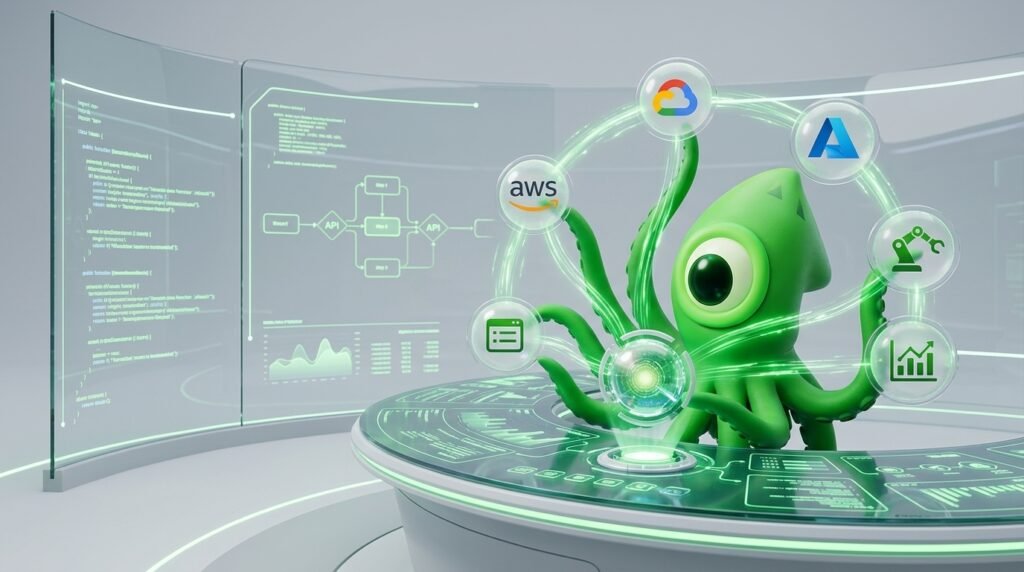
Fully understanding the mechanics of Agentic AI often requires a clear visual map. Therefore, our design team is currently finalizing a comprehensive infographic. This asset will illustrate the complete lifecycle of an autonomous workflow from start to finish.
Initially, the visual asset will show data ingestion through a natural-language interface. This demonstrates how unstructured human requests are translated into actionable system commands. Next, it will map the intricate decision-making process that occurs within custom AI models. Consequently, you can see how they evaluate variables and determine the optimal path forward.
Finally, the flowchart will conclude by displaying the automated execution of these decisions. This occurs across various cloud platforms and integrated applications. Thus, this detailed infographic will clearly demonstrate how these seven tools work in tandem.
Furthermore, business leaders will see exactly where to implement these automation tools. Keep an eye out for this upcoming visual guide. It will serve as an invaluable resource for your digital transformation journey.

Conclusion: Adopt Agentic AI Tools or Face Extinction
The era of constant manual oversight and rigid, rule-based automation is officially over. Instead, advanced automation tools equipped with true autonomous capabilities are actively driving the future of business operations. Platforms like Tealium and River AI prove that agentic ai tools are scaling rapidly. Consequently, they are becoming more accessible to organizations of all sizes.
Additionally, massive investments in data center infrastructure guarantee that this technological trend will only accelerate. Therefore, companies must evolve their operational strategies. Otherwise, they face inevitable decline as faster, more efficient competitors capture market share.
Now is the perfect time to conduct a thorough audit of your current tech stack. Specifically, identify areas where manual processes are slowing you down. Start integrating these autonomous features immediately to streamline your workflows. Thus, you can reduce overhead and position your business to scale to unprecedented heights.
What is Agentic AI?
Agentic AI refers to advanced artificial intelligence systems that can make independent decisions. Unlike basic automation, these tools do not require strict, predefined rules to operate effectively. They evaluate their environment and determine the best course of action to achieve a specific goal.
Why are Data Centers important for these tools?
Autonomous tools require massive computational power to process complex algorithms in real time. Expanded data center infrastructure, like Alpha Compute’s new Pennsylvania campus, is absolutely essential to support the heavy machine learning workloads that these AI systems generate.
How does a Natural-Language Interface help?
A natural-language interface allows users to control complex systems using plain text rather than code. For example, Tealium’s Configuration MCP lets AI securely manage enterprise data by simply interpreting conversational commands, vastly reducing the technical barrier to entry.
Are these Automation Tools secure?
Yes, modern autonomous platforms prioritize enterprise-grade security. They feature strict access controls, robust encryption protocols, and secure data pipelines to ensure that autonomous operations can run safely across your entire business without exposing sensitive information.


One Comment