

weight-loss drugs and AI economics: The tech-health market collision
The rise of weight-loss drugs and AI economics is reshaping healthcare, capital flows, and everyday choices. For example, GLP-1 therapies such as Mounjaro, Wegovy, and Ozempic have driven record valuations in pharma, and therefore investors now view drugs as platform plays. At the same time, advances in machine learning have created new pricing models and automated market signals, so tech firms and insurers adjust forecasts faster.
However, this shift raises urgent questions about access, safety, and long-term costs because pregnancy risks and postpartum use remain poorly understood. As a result, regulators must balance innovation with caution, while analysts watch valuation spikes closely.
Meanwhile, tools like SWE-Bench and model audits are changing how we measure AI performance, and thus how markets value models. The convergence of biology and algorithms creates both opportunity and risk, so stakeholders must act wisely. In this article, we map key players, explain economic mechanisms, and highlight practical implications for investors and policymakers.
Market dynamics: weight-loss drugs and AI economics
The market for GLP-1 agonists and metabolic therapies has shifted rapidly. Demand surged as Mounjaro, Zepbound, Wegovy, and Ozempic reached mass adoption. As a result, investors re-priced entire drug portfolios and firms like Eli Lilly rose to historic valuations.
Demand trends and patient adoption
Demand grew for both diabetes care and elective weight management. However, access remains uneven and clinical risks persist, especially around pregnancy and postpartum use.
- Estimated global market growth is large and accelerating, driven by chronic obesity prevalence and new indications
- Adoption rose in multiple age groups and demographics, changing payer forecasting and insurer decisions
- Some patients stop therapy during pregnancy and then experience rapid weight gain, which affects long term demand patterns
For further reading on AI and drug development trends, see this deep dive: AI and Drug Development Trends.
Key players and recent drug discoveries
Pharma leaders include Eli Lilly and Novo Nordisk, among others. Recent trial data showed differing cardiovascular signals between drugs.
- Leading products include Mounjaro, Zepbound, Wegovy, and Ozempic
- Clinical studies continue to shape market share and prescribing norms
- Real world evidence now informs provider choices and payer coverage rules
Economic drivers and pricing pressure
Rising demand changed pricing dynamics and supply chains. Manufacturers scaled production. Meanwhile, insurers reassessed formularies.
- Manufacturers raised capacity and negotiated debt and partnerships to fund growth
- Payers introduced utilization controls and prior authorization requirements
- Competition raised downward pressure on net prices over time
How AI reshapes the sector’s economics
AI shortens drug discovery and optimizes supply forecasts. Consequently, development costs fall and time to market decreases. In addition, AI tools influence investor expectations and valuation models.
- AI platforms speed target discovery and molecular design
- Predictive models improve demand forecasting and inventory planning
- Model evaluation tools such as SWE-Bench influence tech valuations in adjacent markets
For global health context and prevalence, consult authoritative sources such as the CDC and WHO. For broader coverage and market reporting, see BBC.
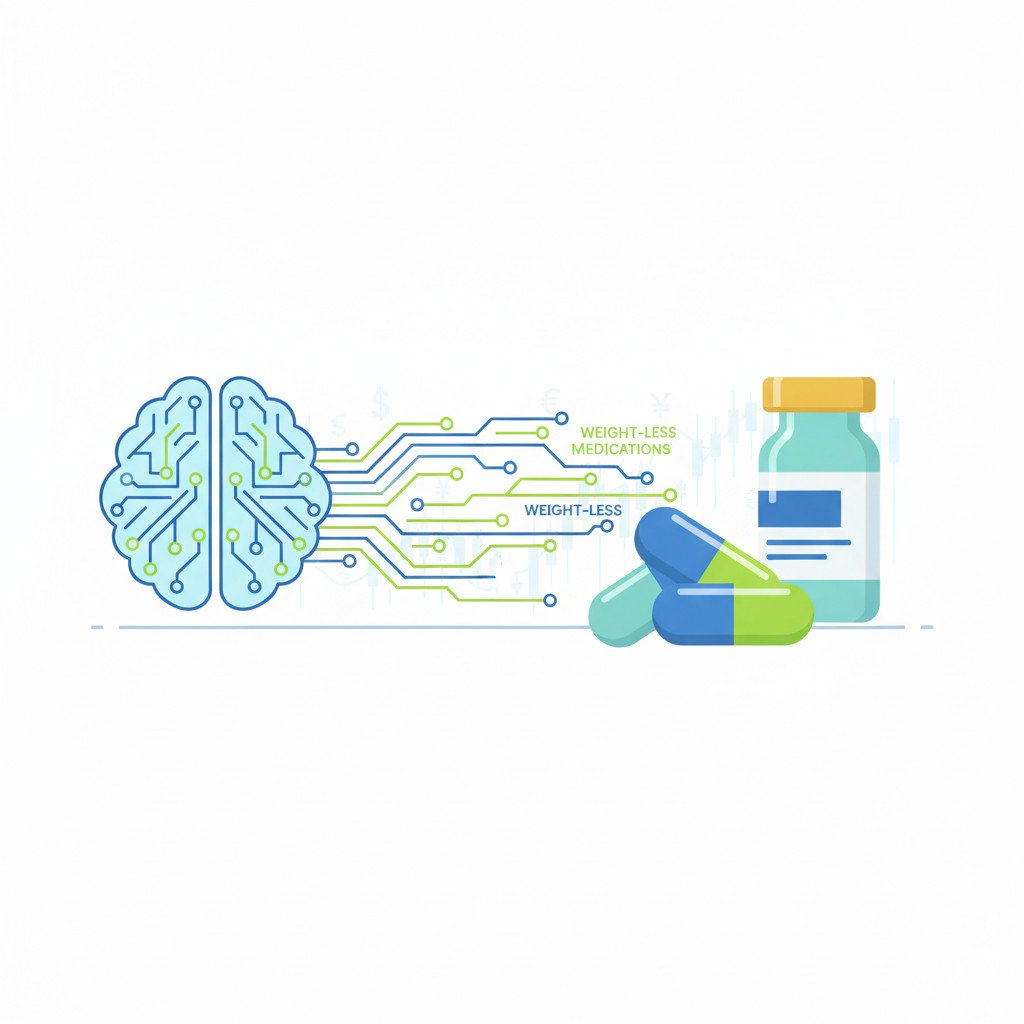
weight-loss drugs and AI economics intersect: an overview
AI economics now shapes how companies research, price, and sell weight loss therapies. Machine learning helps identify molecular targets faster. As a result, firms reduce time to clinical candidate and change investment timelines. Eli Lilly became the first healthcare company to reach a trillion dollar valuation which illustrates market appetite for these therapies and related tech.
How AI drives drug discovery and development in weight loss drugs and AI economics
AI accelerates discovery through pattern recognition and simulation. Consequently, researchers run virtual screens and optimize molecules at scale. Meanwhile, model audits and benchmarks such as SWE Bench affect how investors judge AI driven startups. The quote “We do fail… a lot.” reminds us that models and trials still face many setbacks.
AI driven discovery and improved forecasting feed directly into market dynamics and pricing outcomes. Better demand signals can compress lead times and reduce perceived scarcity which pressures list and net prices. At the same time, stronger predictive evidence of patient response can expand payer coverage for specific cohorts and shift reimbursement terms.
Implications for investors
- Expect greater valuation sensitivity to proprietary data and model performance rather than to single late stage assets
- Favor companies with demonstrable real world evidence pipelines and scalable data infrastructure
- Prepare for higher short term volatility as markets adjust to new forecasting signals and regulatory updates
Policy considerations
- Require transparency on model inputs and validation to ensure equitable access and explainable decisions
- Mandate post market surveillance that links AI driven predictions to real world safety and effectiveness data
- Encourage coverage policies that balance cost control with pathways for clinically validated patient access
Takeaway: Stakeholders should align AI capability with governance and real world evidence to realize efficiency gains while managing access and pricing risks.
Comparing traditional and AI-driven models: weight-loss drugs and AI economics
Below is a clear comparison of traditional economic models versus AI-driven approaches in the weight-loss drug market. The table highlights differences in efficiency, cost, speed, and market reach. As a result, readers can quickly see where AI delivers gains and where risks remain.
| Feature | Traditional model | AI-driven model | Economic impact |
|---|---|---|---|
| Efficiency | Manual target selection and lab screening | Automated target discovery and virtual screening | AI raises throughput and lowers per-target cost |
| Cost of R&D | High upfront lab and trial costs | Lower discovery costs but higher data infrastructure spend | Short term savings; long term shift in capex to data platforms |
| Time to clinical candidate | Years of iterative chemistry and testing | Months to a candidate with in silico work | Faster pipelines reduce time to market and burn rate |
| Clinical trial design | Fixed, often large trials | Adaptive trials using predictive enrollment models | Trials become more efficient and less wasteful |
| Predictive forecasting | Historical sales and simple models | Real-time demand forecasting with ML | Better inventory and pricing decisions reduce waste |
| Manufacturing and supply chain | Capacity scaled by forecasts | Dynamic scaling guided by AI predictions | Lower stock outs and improved working capital |
| Pricing strategy | List prices and manual negotiations | Dynamic pricing and payer segmentation via AI | More targeted rebates and margin pressure management |
| Marketing reach | Broad campaigns and sales reps | Personalized outreach and programmatic ads | Higher conversion at lower marginal marketing cost |
| Personalization of therapy | Limited stratification | Patient-level prediction of response | Higher value care, but potential equity concerns |
| Regulatory risk | Regulatory delays and fixed submissions | Faster iterations but complex model explainability needs | Possible speed gains, yet new compliance costs |
| Valuation dynamics | Valuations tied to late-stage assets | Valuations linked to AI capability and data moats | Greater volatility; AI hype can inflate multiples |
| Patient access | Payer coverage limits and prior auth | AI can identify cost-effective cohorts for coverage | Could expand access or entrench disparities |
This table clarifies how weight-loss drugs and AI economics shift capital, operating models, and risk profiles across the industry.
Weight Loss Drugs and AI Economics
Weight-loss drugs and AI economics have rapidly reconfigured pharmaceutical incentives, clinical pipelines, and capital allocation. AI accelerates target discovery and improves trial design. It sharpens demand forecasts, so firms shorten development cycles and lower discovery costs. However, safety, access, and regulatory explainability remain central concerns, particularly for pregnant and postpartum patients. Investors react to both clinical data and model capability, which produces valuation swings across the sector.
EMP0 (Employee Number Zero, LLC) helps firms capture AI-driven growth ethically and securely. Their automation and AI toolset supports molecular discovery workflows, demand forecasting models, and compliant deployment inside client infrastructure. EMP0 integrates secure data pipelines, custom models, and automation to reduce time to insight while preserving control.
Contact and profiles include Website, Blog, Twitter/X @Emp0_com, Medium medium.com/@jharilela, and n8n n8n.io/creators/jay-emp0. Therefore, stakeholders should pair innovation with clear governance and equitable access plans. This balance will shape future social outcomes broadly.
Frequently Asked Questions (FAQs)
What does “weight-loss drugs and AI economics” mean?
It refers to how new weight-loss therapies and artificial intelligence reshape costs, pricing, and market behavior. AI speeds discovery, improves forecasting, and changes valuation models. Therefore, it affects who pays, who benefits, and how fast markets move.
How does AI change drug development timelines?
AI accelerates target identification and virtual screening. As a result, teams reach clinical candidates faster. This shortens timelines and lowers some discovery costs. However, clinical trials and safety reviews still require time.
Will AI make these drugs cheaper for patients?
AI can reduce development and supply costs, which could lower prices. Yet, price outcomes depend on payers and market competition. Insurers may still impose utilization controls, so access may remain unequal.
What are the main risks tied to rapid AI-driven adoption?
Rapid adoption raises safety, equity, and regulatory risks. For example, pregnant and postpartum patients face unclear outcomes. In addition, investors may overvalue AI capability, creating market volatility.
How should policymakers and businesses respond?
They should combine innovation with strong governance. Therefore, regulators must require transparency and real-world monitoring. Meanwhile, firms should deploy secure, explainable AI and plan equitable access.