
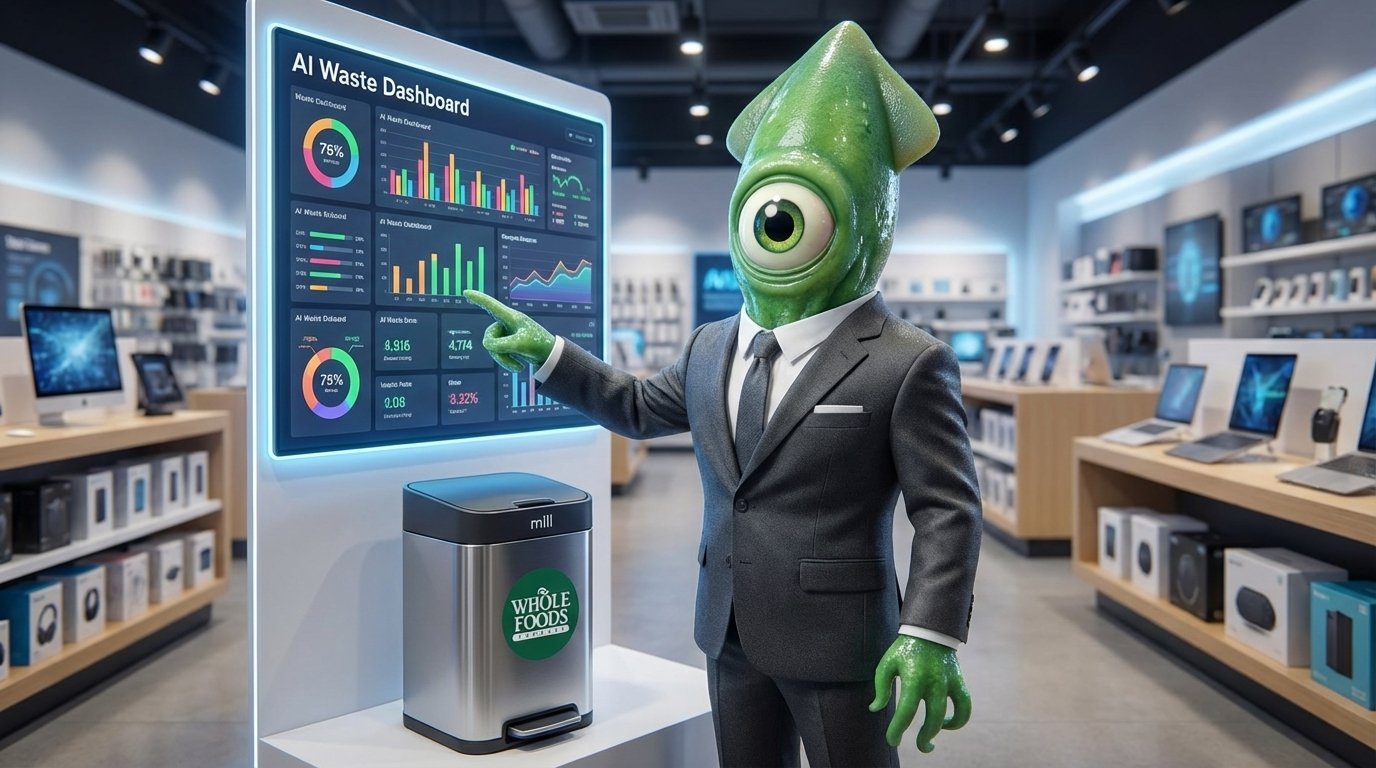
Mill closes deal with Amazon and Whole Foods: AI-powered expansion into commercial and consumer markets
Mill closes deal with Amazon and Whole Foods and it changes the game for food-waste tech. This milestone proves that Mill’s commercial-scale bin can scale to national grocery chains. As a result, Whole Foods will deploy Mill bins across stores beginning in 2027. This will cut landfill fees and create feed streams for egg producers.
Mill built momentum by selling the Mill at home unit first and gathering data. Therefore, the company now pursues enterprise customers with proof points, waste analytics, and sensor data. The strategy diversifies revenue, moves beyond a single customer, and prepares Mill to enter municipal and other commercial markets.
AI sits at the heart of Mill’s growth plan because it enables smarter sorting and shrink reduction. Advances in large language models accelerated product development with fewer engineers, and this approach speeds commercialization. Ultimately, this deal signals a leap forward for AI-enabled commercial and consumer solutions that scale quickly.
Mill closes deal with Amazon and Whole Foods: AI-powered food waste bin features
Mill closes deal with Amazon and Whole Foods and the product details matter for scale. The commercial-scale Mill food waste bin grinds and dehydrates produce waste. As a result, stores cut landfill fees and lower hauling costs. Because the output can feed egg producers, the system creates circular value from waste.
The bin combines sensors and AI to minimize shrink and rescue sellable items. Mill uses computer vision and sensor data to judge shelf life. Therefore, the system flags items that belong back on shelves. This reduces product loss and trims overhead for produce teams.
Mill closes deal with Amazon and Whole Foods: commercial deployment and operational impact
Whole Foods will deploy the commercial bin starting in 2027, which signals enterprise validation. As a result, Mill moves from household proof points to grocery-wide operations. The rollout scales waste analytics and real-world data collection.
Key features and operational benefits
- Grinds and dehydrates produce waste, reducing landfill fees and hauling expenses
- Creates feed for egg producers, converting costs into revenue streams
- AI with sensors detects shelf life and recommends restocking, lowering shrink
- Real-time waste analytics provide insights for procurement and pricing
- Faster product development thanks to large language models, which reduced engineering needs
Ultimately, the deal demonstrates how AI-enabled commercial solutions scale rapidly. Therefore, Mill positions itself to expand into municipal and other commercial markets.

| Company | Initial Product | Expansion Product | Strategy Purpose | Outcome |
|---|---|---|---|---|
| Mill | Mill at home food waste bin | Commercial-scale food waste bin for grocery chains and municipal pilots | Build proof points and data, then pursue enterprise customers | Whole Foods rollout in 2027, reduced landfill fees, new revenue legs |
| Apple | iPod | iPhone | Diversify beyond one product to avoid concentration risk | Created dominant mobile platform and massive recurring revenue |
| Nest | Smart thermostat | Cameras and broader smart home devices | Extend product ecosystem to increase stickiness | Acquired by Google; stronger hardware and subscription opportunities |
| Search engine | Cloud services, Android, hardware and AI tools | Leverage core data advantages to enter new markets | Multiple revenue streams and resilience against single-market shocks |
Therefore, you can see why adding new revenue legs matters. As a result, the examples show faster scaling and resilience.
Mill’s enterprise sales strategy and future growth plans
Mill uses a hands-on enterprise sales playbook that turns household proof points into enterprise momentum. The company invites senior leaders at potential customers to try the product at home. ‘Hey, try Mill at home, see what your family thinks.’ This tactic builds empathy and excitement, and it shortens buying cycles.
Because Mill began with consumers, it collected usage data and refined product design. Therefore, the team shows real-world metrics to procurement and operations teams. As a result, the approach reduces pilot friction and demonstrates measurable ROI.
Key elements of Mill’s enterprise strategy
- Executive trialing: encourage senior leaders to use Mill at home to generate advocacy
- Data-led sales: leverage waste analytics, sensor telemetry and shrink reduction metrics
- AI enablement: use models to speed product iteration and deliver actionable shelf-life insights
- Operational fit: design bins for store workflows to cut landfill fees and hauling costs
- Circular value: transform waste into feed for egg producers to offset operating costs
Looking ahead, Mill plans to add more legs to the stool by expanding beyond groceries. ‘We’re continuing to add more legs to the stool and adding more diversity to the business.’ Mill will pursue municipal contracts and other commercial sectors. Ultimately, the strategy builds resilience, creates new revenue streams, and scales AI-enabled solutions across markets.
Conclusion
Mill closes deal with Amazon and Whole Foods and the agreement proves a powerful thesis: AI plus product diversification scales. Because Mill combines sensor-driven computer vision with LLM-enabled development, the company reduces shrink, cuts landfill fees, and generates circular revenue from waste. Therefore, the Whole Foods rollout beginning in 2027 validates the strategy and accelerates enterprise adoption.
Emp0 aligns with this tech-forward growth model as a leader in AI and automation for sales and marketing. Emp0 builds secure, client-hosted growth systems that integrate data, orchestration, and AI. For more, visit Emp0 online: Emp0 and read our insights at Emp0 Insights. Follow Emp0 on X at Twitter and on Medium at Medium. Explore our n8n creator page at n8n Creator Page.
Ultimately, Mill’s path from Mill at home to grocery-scale bins shows why businesses must add new legs to the stool. As a result, AI becomes the growth enabler that shortens development cycles and widens market reach. Looking ahead, Mill and companies like Emp0 demonstrate how intelligent systems drive resilient, diversified revenue and faster scaling.
Frequently Asked Questions (FAQs)
What does “Mill closes deal with Amazon and Whole Foods” mean for Mill?
It means Mill earned enterprise validation and scale. Whole Foods will deploy Mill’s commercial bins starting in 2027. As a result, Mill moves from consumer proof points to grocery-wide operations. Therefore, the company gains large-scale data and recurring revenue opportunities.
How does Mill’s AI-powered food waste bin reduce shrink and landfill fees?
The bin uses sensors and computer vision to judge shelf life. Because AI flags items that can return to shelves, teams rescue sellable produce. The unit also grinds and dehydrates waste, which cuts hauling costs. Ultimately, stores lower landfill fees and capture circular value like feed for egg producers.
Why did Mill start with a consumer product first?
Mill built the Mill at home product to gather real usage data and brand loyalty. Consequently, the team refined hardware and analytics before selling to enterprises. This approach reduces pilot friction and shows measurable ROI to buyers.
How does Mill sell to enterprises and shorten buying cycles?
Mill asks senior leaders to try the product at home. “Hey, try Mill at home, see what your family thinks.” This tactic builds empathy and internal advocacy. In addition, Mill uses waste analytics and sensor telemetry to prove savings.
What are Mill’s growth plans beyond grocery chains?
Mill plans to add more legs to the stool by pursuing municipal contracts and other commercial sectors. As a result, the company diversifies revenue and builds resilience. Therefore, AI remains the core enabler of faster product development and broader market reach.