

Amazon 30-minute delivery (Amazon Now): Convenience, Speed, and Limits
Amazon 30-minute delivery (Amazon Now) has redefined how quickly shoppers get essentials. This ultrafast service promises groceries, diapers, and electronics in half an hour or less. Because time is scarce, consumers welcome immediacy and convenience. However, Amazon pairs speed with dense micro fulfillment centers and a network of drivers. As a result, the pilot blends automation, local inventory, and flexible delivery labor. Yet the model raises questions about cost, inventory efficiency, and scalability.
In this article we examine the innovation behind the pilot and its practical limits. We will compare Amazon’s approach with competitors, explain operational trade offs, and review real world outcomes. Finally, readers will get clear takeaways to judge whether ultrafast delivery suits their market and customers. Expect case studies from Seattle and Philadelphia pilots. Also, we highlight operational metrics like pick time and leave time from hubs. Ultimately, the goal is clear improvement in the last mile. Read on for evidence.
What is Amazon 30-minute delivery (Amazon Now)?
Amazon 30-minute delivery (Amazon Now) is an ultrafast service that promises essentials in roughly half an hour. Launched as a pilot in parts of Seattle and Philadelphia, the program targets urgent needs. Because it sits between same day delivery and instant retail, it aims to change expectations for quick shipping and fast delivery.
Key features and functions
- Local micro fulfillment facilities hold a curated selection of thousands of items. This reduces travel time and speeds pick and pack.
- Dynamic inventory and tight assortment keep commonly ordered goods on hand, such as diapers and electronics.
- Flexible delivery labor uses Amazon Flex drivers who pick up from nearby hubs and usually leave within two minutes.
- Tiered pricing gives Prime members lower fees, while non Prime customers pay more for the service. See Amazon’s announcement for full details.
- Real time tracking shows progress from pick to doorstep, and customers can tip drivers via the app.
How the process works visually
- Customer orders through the Amazon app and chooses the 30 minute option. This confirms item availability in a nearby hub.
- Staff or automation picks and packs the order immediately, because speed is critical.
- An Amazon Flex driver accepts the delivery, drives a short route, and aims to leave the hub fast.
- The driver drops the order at the door and marks delivery in the app, which updates tracking for the customer.
For independent coverage and early reviews see TechRadar and Amazon Flex operations.
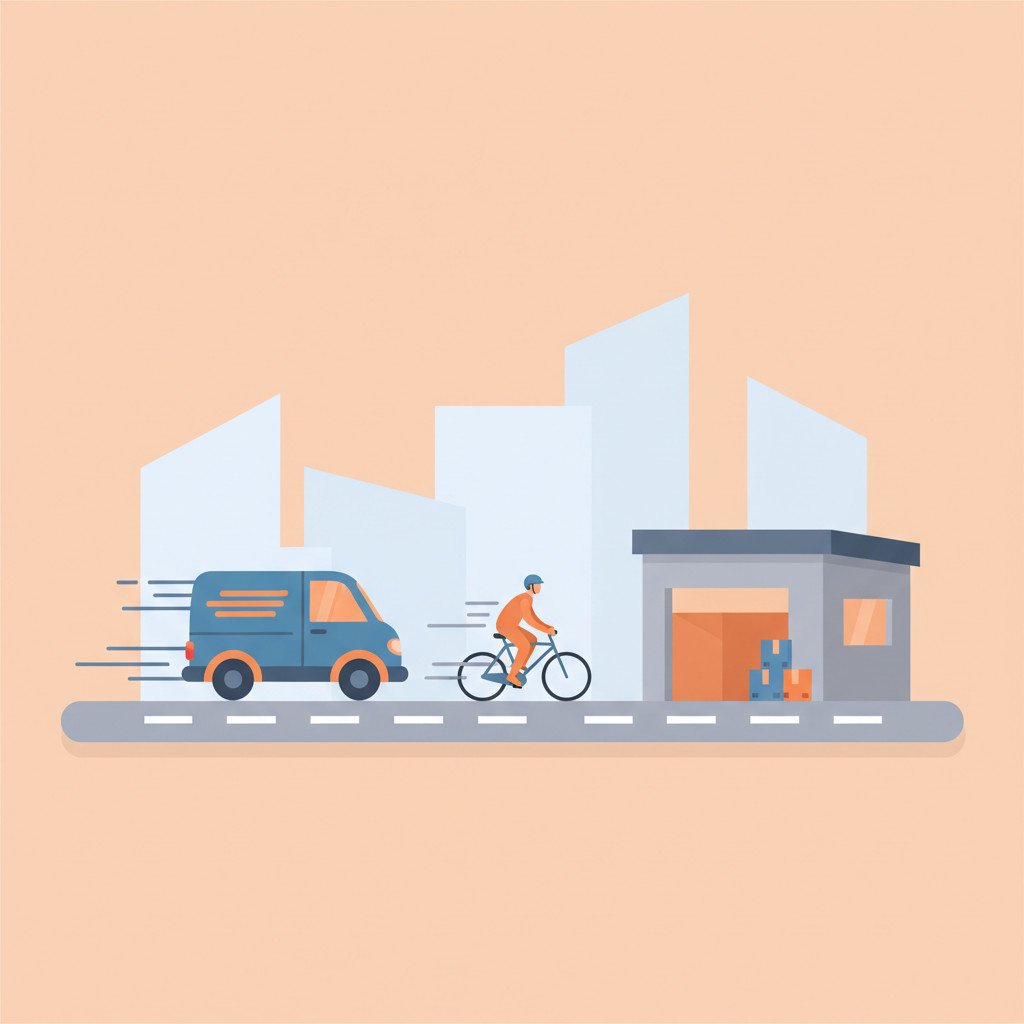
Benefits of Amazon 30-minute delivery (Amazon Now)
Amazon 30-minute delivery (Amazon Now) delivers clear customer value. Because speed solves urgent needs, shoppers enjoy instant convenience. Early pilots in Seattle and Philadelphia show the service ships thousands of everyday items in half an hour or less. For details from Amazon, see this article.
Key benefits
- Instant convenience and higher conversion rates. Rapid delivery converts impulse buys into sales. Therefore, merchants can see larger baskets and more frequent orders.
- Improved customer satisfaction. Fast delivery reduces friction and increases repeat purchases because customers get what they need quickly.
- Local inventory and micro hubs cut travel time. As a result, pick and pack times fall and quick shipping becomes practical.
- Flexible labor reduces peak costs. Amazon Flex drivers and gig couriers scale up and down, which supports same day delivery efforts.
- Competitive differentiation. Because few retailers match 30-minute speeds, the service can win market share for time sensitive items.
For independent early reviews, see this TechRadar article.
Challenges for Amazon 30-minute delivery (Amazon Now)
However, ultrafast delivery faces hard trade offs. Rapid shipment requires dense infrastructure and steady driver supply. Analysts warn these costs complicate long term scale and profitability. For discussion, see Supply Chain Dive.
Major challenges
- Capital and operational expense. Micro fulfillment centers and local inventory increase overhead and inventory carrying costs.
- Inventory fragmentation and stockouts. Because stock sits closer to customers, assortment tightness forces trade offs between variety and availability.
- Labor constraints and leave time pressure. Drivers aim to depart hubs within two minutes, which stresses packing and routing systems.
- Limited geographic reach. For example, Walmart uses 4,600 plus stores to reach most U.S. households rapidly, showing how scale matters; see this AP News article and this Walmart corporate update.
- Environmental and traffic impact. More localized trips reduce distance but can increase total vehicle miles if density stays low.
In short, Amazon Now boosts convenience and customer loyalty. Yet scalability and economics remain the central limits, and thus the model may suit dense urban areas more than broad national coverage.
Amazon 30-minute delivery (Amazon Now) compared to other services
Below is a concise comparison of Amazon Now and common alternatives. The table contrasts speed, cost, coverage, and customer satisfaction. Use the links for deeper reading.
| Service | Typical speed | Typical cost per order | Coverage | Customer satisfaction notes and sources |
|---|---|---|---|---|
| Amazon 30-minute delivery (Amazon Now) | 30 minutes or less in pilot cities | Variable premium fee; Prime members often pay less | Limited to pilot cities such as Seattle and Philadelphia | High convenience scores in early reviews. See Amazon announcement and TechRadar review |
| Instacart | As fast as 15 to 60 minutes depending on option and market | Typically starts around $3.99 plus variable fees; membership reduces costs | Broad coverage via retailer partners across the U.S. | Fast in many urban areas, though times vary by store and demand. See Instacart |
| Walmart (store delivery and Walmart+) | Under three hours to most households; some orders arrive in minutes | Often lower fees; Walmart+ reduces or removes delivery fees | Very broad: 4,600 plus stores reach most U.S. households | Strong coverage and value. See reporting on reach: AP News and Walmart |
| FedEx SameDay and UPS Express Critical | Same day, often 2 to 12 hours depending on service | High premium pricing for urgent shipments | Nationwide and international options | High reliability for urgent B2B shipments. See FedEx SameDay |
Overall, Amazon Now leads on raw speed in pilot areas. However, other players win on coverage or cost. Therefore, companies should match strategy to density and demand.
Conclusion
Amazon 30-minute delivery (Amazon Now) demonstrates what ultrafast logistics can achieve. Because it combines micro hubs, automation, and on-demand drivers, it solves urgent customer needs. However, the pilots also expose limits in cost and scale for national rollouts. Operationally, micro fulfillment centers cut travel time but raise inventory costs. As a result, the model makes most sense in dense, urban markets. Retailers seeking similar speed must weigh investment against margin pressure.
EMP0 helps businesses bridge that gap with AI and automation tools. For example, EMP0 automates order routing, demand forecasting, and personalized marketing. Therefore, teams can optimize inventory at micro hubs and improve conversion. Visit EMP0 for details: EMP0 and read the blog at the blog. Also explore automation workflows at automation workflows to see practical examples.
Ultimately, ultrafast delivery creates real customer value, but systems must be smart and efficient. Consider pilots in focused geographies and use AI to manage supply and demand. EMP0 supports sales and marketing automation that makes those pilots practical and measurable.
Frequently Asked Questions (FAQs)
What is Amazon 30-minute delivery (Amazon Now)?
Amazon 30-minute delivery (Amazon Now) is an ultrafast option for everyday items. It delivers groceries, diapers, and small electronics in roughly thirty minutes. The service uses micro fulfillment hubs and Amazon Flex drivers. Because orders come from nearby inventories, delivery time drops dramatically.
Where is this fast delivery available?
The pilot launched in parts of Seattle and Philadelphia. However, availability remains limited to select urban neighborhoods. Amazon expands only where density and demand justify micro hubs. Therefore, many suburbs and rural areas do not yet see the service.
How much does quick shipping cost and who pays less?
Costs vary by city and demand. Prime members often receive lower fees and faster access because Amazon bundles benefits. Non Prime customers can still use the option but often pay a premium. As a result, pricing reflects speed and inventory proximity.
How does 30-minute delivery compare with same day delivery?
Thirty-minute delivery beats same day delivery on speed and urgency. Same day services cover broader areas and more item variety. However, same day usually wins on cost and coverage because it leverages larger store networks. In short, pick the option that fits your customer density and margin model.
Is Amazon Now scalable and profitable long term?
Analysts remain skeptical about broad scale profitability. Micro hubs raise inventory and operating costs, and labor remains a constraint. Yet the model can work in dense urban corridors where orders concentrate. Therefore, businesses should pilot in targeted areas and use automation to optimize costs.