

Welcome to the Era of the AI-Powered Operating System
Welcome to the era of the AI-powered operating system, where intelligence runs daily operations and decision loops.
Across industries, teams now stitch AI tools into every workflow, and therefore companies move faster than before. Because AI copilots, autonomous agents, and intelligent automation reduce friction, teams ship value with speed. As a result, leaders ask different questions: “What AI tools should we buy?” and “Which business outcomes matter most this quarter?”
AI changes work from the ground up. “AI isn’t the next chapter of digital transformation. It’s the operating system of the modern company.” This shift means data as fuel, AI literacy for every employee, and AI workflows that scale. In practice, marketing uses AI to produce campaigns in minutes, sales uses AI to analyze pipelines, and developers build features with AI-first processes. The real advantage comes from using AI with intention, discipline, and speed.
This introduction sets an optimistic, practical tone. Read on to learn how to turn AI pilots into enterprise strategy and make AI the default mode of work.
STEP Framework: Blueprint for the AI-powered operating system
The STEP Framework is a simple model any organization can use to scale AI quickly and responsibly. In short, STEP gives leaders a practical path to make AI the default mode of work. Because AI is becoming the operating system of modern firms, STEP turns pilots into workflows and then into strategy.
Self: Build personal AI fluency
Self focuses on individual skills and habits. For example, employees use AI copilots to draft proposals and summarize meetings. Offer short training modules, playbooks, and sandbox environments. Benefits include:
- Faster decision making and fewer routine tasks.
- Higher AI literacy across roles.
- Clear guidelines for safe tool use.
Developers also benefit from internal AI platforms. For more on internal AI platforms, see MIT Sloan’s piece on Intuit’s GenOS: Intuit’s AI Innovation.
Team: Equip departments with AI workflows
Team means department level workflows. For instance, marketing can produce campaign variants in minutes. Sales can use personalized AI copilots to analyze pipelines. Consider autonomous agents as staff to handle routine tasks. Research on using AI agents as employees explains ROI and deployment patterns: AI Agents as Employees.
Key features:
- Role specific copilots and templates.
- Measurable business outcomes per workflow.
- Rapid prototyping and feedback loops.
Enterprise: Align strategy, governance, and data
Enterprise covers governance, platforms, and data readiness. Invest in data infrastructure and clear policies. Large investments accelerate change, as with Salesforce’s major AI bet: Salesforce AI Investment.
Practical steps:
- Define KPIs tied to revenue and cost.
- Build a single catalog of trusted data assets.
- Create cross functional AI governance.
Productivity: Make AI the default mode of work
Productivity makes AI routine. Automate handoffs, approvals, and reporting. Robotics and intelligent automation can free frontline staff for higher value work. Learn how robotics reshape services here: Everyday Robotics in Services.
Outcomes:
- Faster cycle times and lower operational cost.
- Elevated team output and creativity.
- Continuous improvement driven by data.
STEP creates a repeatable path from AI pilots to enterprise strategy. As a result, companies move faster and gain durable advantage. Remember, AI isn’t optional. It’s the operating system of the modern company.
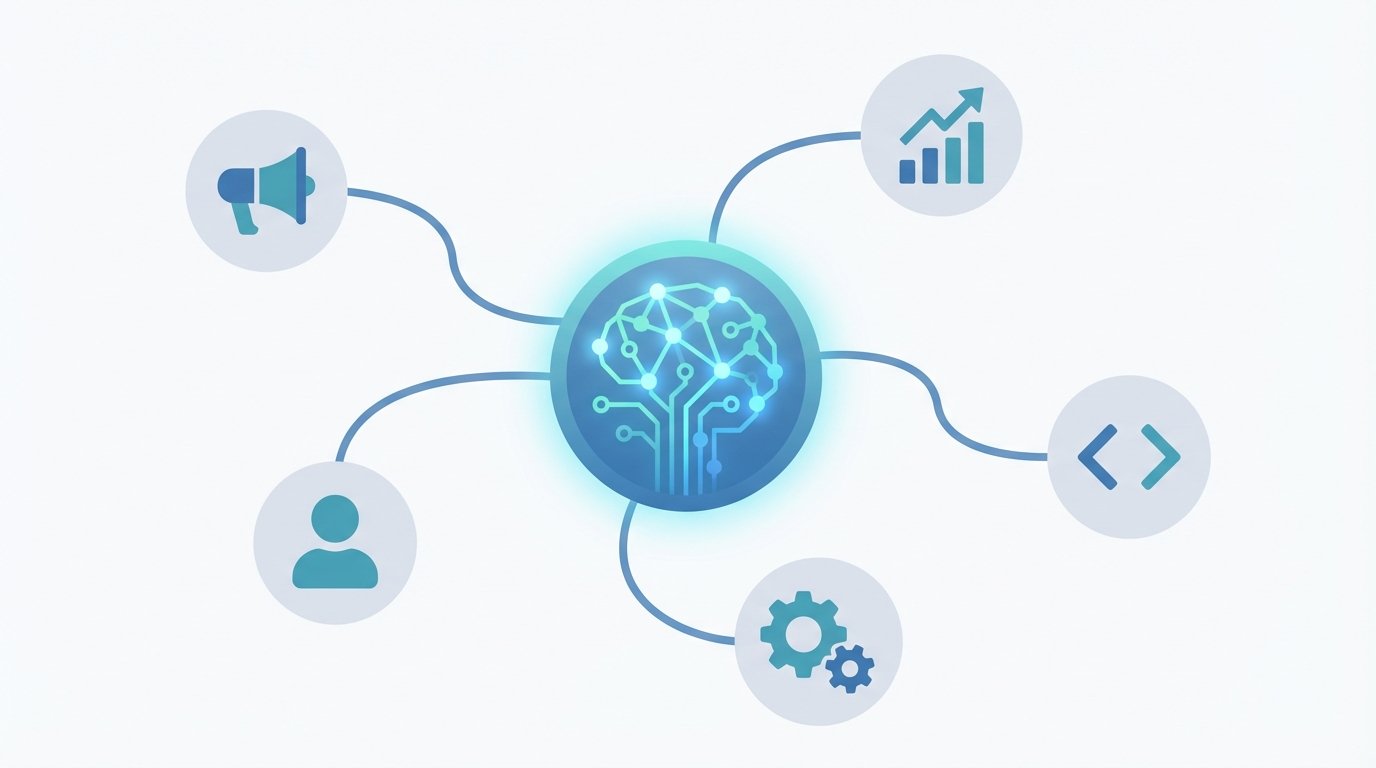
AI-powered operating system in practice: adoption by function
AI adoption looks different across teams, yet all contribute to the same operating system. Because tools connect to data, teams run faster and learn more. As a result, companies move from pilots to AI workflows and then to strategy.
| Function | Common AI Tools and Workflows | Business Outcomes | Example Applications |
|---|---|---|---|
| Marketing | Content generation models, creative copilots, personalization engines, automated A B testing | Faster campaign creation, higher engagement, lower customer acquisition cost | Campaign briefs in minutes, personalized email sequences, dynamic ad creative |
| Sales | AI copilots, pipeline analytics, lead scoring, conversational agents | Shorter sales cycles, higher conversion rates, scaled outreach | Deal summaries, next best action suggestions, auto enriched leads |
| Development | Code copilots, automated testing, model assisted design, CI CD automation | Faster delivery, fewer bugs, accelerated experimentation | Scaffold features with AI, auto generate tests, AI pair programming |
| Leadership | Strategy copilots, decision dashboards, scenario simulators, KPI alerts | Faster decisions, data informed strategy, better governance | Executive briefs, risk assessments, prioritized OKRs |
| Operations | Intelligent automation, robotic process automation, scheduling agents | Lower operational cost, faster processing, improved SLAs | Invoice processing, supply chain alerts, automated approvals |
| Customer Support | Virtual agents, knowledge retrieval, sentiment analysis, response generation | Faster resolution, higher NPS, reduced cost per ticket | Auto triage, draft responses, 24 7 virtual assistants |
This table shows how AI workflows and AI copilots turn tools into outcomes. It also highlights that data as fuel and AI literacy power every function. Remember, marketing teams use AI for campaigns in minutes, sales teams use personalized AI copilots, and developers adopt AI first workflows to build faster.
Strategic Advantages of the AI-powered operating system: intention, discipline, and speed
Adopting an AI-powered operating system gives companies a decisive edge. Because AI automates routine work, teams focus on higher value tasks. As a result, organizations move faster and learn more. The real competitive advantage isn’t simply using AI. It’s using AI with intention, discipline and speed.
Leaders who act quickly win. Also, leaders who use AI will replace those who don’t. Therefore, AI is not optional but core to strategy. AI rewards speed. However, speed without governance creates risk. Thus, combine rapid experiments with clear guardrails.
Key advantages include:
- Faster time to value. AI shortens cycles and reduces manual work.
- Better decisions. AI surfaces insights from data, then guides actions.
- Scaled personalization. AI tailors experiences across customers and segments.
- Higher productivity. Teams do more with less friction and fewer handoffs.
- Competitive resilience. Firms adapt faster to market shifts and shocks.
- Measurable outcomes. Track revenue, cost, and customer metrics tied to AI.
For example, marketing runs campaigns in minutes and sales uses AI copilots for pipeline analysis. In practice, developers deploy AI-first workflows to ship features faster. Therefore, move pilots to workflows, and workflows to strategy. The STEP Framework helps teams scale responsibly.
Act with intention. Start small, measure results, and standardize winning workflows. Then, scale with governance and data readiness. Finally, remember that speed wins when paired with discipline and clear metrics. AI isn’t optional. It’s inevitable.
AI is the inevitable operating system for modern companies.
The STEP Framework gives a clear path from pilots to enterprise strategy by building Self, Team, Enterprise, and Productivity layers. As a result, organizations gain speed, discipline, and measurable outcomes.
EMP0 acts as a full-stack, brand-trained AI worker delivering AI and automation solutions that multiply client revenue. We deploy secure AI-powered growth systems under client infrastructure to protect data, ensure governance, and accelerate results.
Work with EMP0 and you get tailored AI copilots, automated workflows, and governance baked in. Visit EMP0 to learn more, read our blog at our blog for deeper guides, or explore integrations at integrations.
Act now. Start small, measure fast, and scale responsibly. Leaders who adopt AI with intention and speed will outperform those who do not. Because AI is the operating system of the modern company, your business cannot wait.
Use the STEP Framework. Use EMP0 to operationalize AI. Reach out to begin a pilot this quarter and convert experimentation into measurable revenue. Lead with purpose and speed.
Frequently Asked Questions (FAQs)
What is an AI-powered operating system?
An AI-powered operating system embeds AI into daily operations. It connects tools, data, and workflows. As a result, teams automate tasks and make faster decisions. In short, it runs the company with intelligence and scale.
What are the main benefits of AI workflows?
AI workflows speed up delivery and reduce routine work. Therefore teams focus on high value outcomes. Benefits include:
- Faster campaign creation and personalization
- Shorter sales cycles with AI copilots
- Faster development with AI-first workflows
How do I implement the STEP Framework?
Start with Self to build personal AI fluency. Then equip Teams with role specific workflows. Next align Enterprise with data, governance, and KPIs. Finally, make Productivity the default mode of work. Measure results and iterate rapidly.
Are AI deployments secure and compliant?
Yes when you use strong governance. For example, keep models under client infrastructure. Also define data access rules and audit trails. Finally enforce testing and monitoring to reduce risks.
Why choose EMP0 as a partner?
EMP0 acts as a full-stack, brand-trained AI worker. It builds secure AI-powered growth systems under client infrastructure. As a result, clients multiply revenue while keeping data safe. Visit EMP0 to learn more.