

AI Productivity and Agentic Coding: Transforming Business Workflows
AI productivity and agentic coding are rewriting how businesses design workflows and ship software. They combine generative AI, automation, and autonomous agents to accelerate routine work. As a result, teams reduce cycle times and free people for higher value tasks. However, the gains depend on data platforms, cloud infrastructure, and deliberate retraining.
This article explores how AI productivity and agentic coding reshape workflows and boost efficiency. We look at real use cases, from automated code generation to multi-agent research pipelines. In addition, we weigh economic claims and practical limits for scaling these systems. Therefore readers learn how to prioritize projects, invest in infrastructure, and train teams.
By the end, you will have clear next steps for adopting agentic workflows safely. Overall, this piece merges analysis, technical guidance, and strategic frameworks for executives. We also highlight tools such as AI coding assistants and interleaved thinking agents. Finally, we offer actionable recommendations for leaders who want measurable productivity gains.
AI productivity and agentic coding: core concepts and mental models
AI productivity and agentic coding describe a shift from manual steps to autonomous workflows. In practice, they pair large language models, automation, and lightweight agents. As a result, teams automate repetitive tasks and surface smarter decisions faster.
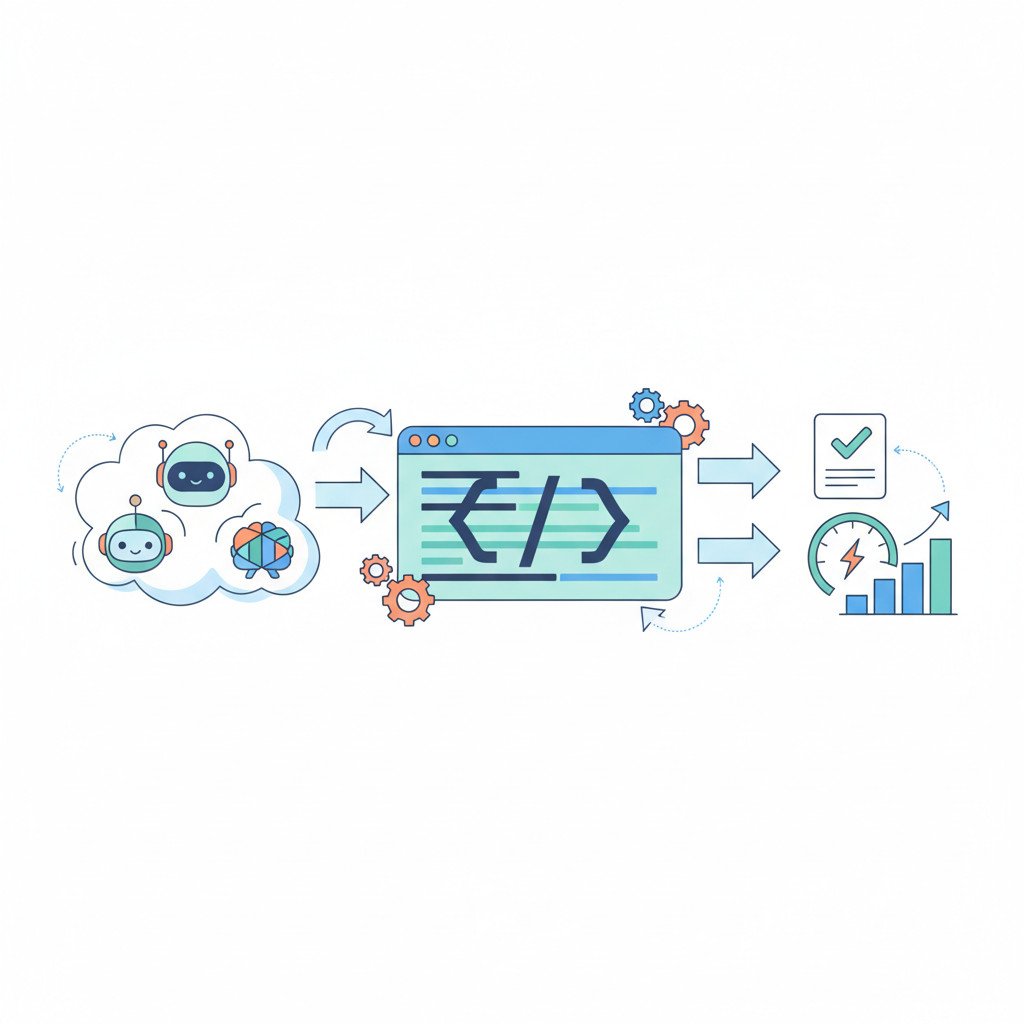
Think of AI productivity tools as a digital assembly line. Visualize code suggestions flowing like conveyor belts, while agents act like robotic arms. They pick up tasks, test changes, and hand results back to humans for final approval. Therefore development cycles shorten and feedback loops tighten.
Agentic coding frameworks add a brain to that assembly line. They orchestrate Plan Act Reflect loops and enable interleaved thinking. For example, an agent can run tests, read failures, and self-correct immediately. This makes the system adaptive, rather than purely reactive.
Key building blocks
- Models and copilots: LLMs power suggestions, refactors, and documentation. They supply contextual reasoning and code patterns.
- Orchestrators and agents: Small autonomous programs coordinate steps. They manage retries, scheduling, and error handling.
- Data and infra: Reliable data platforms and cloud compute let agents act at scale. Without them, gains remain partial. For more on pipeline design, see this article.
How they work together
- Agents use model outputs as hypotheses. Then they execute commands and validate results.
- Humans supervise higher level goals, because governance matters. For a discussion on labor effects and strategy, see this discussion.
- These systems also change debates about intelligence and control. For background on AI mode and AGI implications, see this background.
In short, AI productivity and agentic coding fuse fast iteration with automated judgment. As a result, organizations can reduce toil and reallocate human creativity to harder problems. For research on AI and broader productivity trends, see the MIT Technology Review at this review.
Benefits and use cases of AI productivity and agentic coding
AI productivity and agentic coding unlock measurable gains across teams and systems. As a result, organizations automate repetitive tasks and speed delivery. Therefore developers spend more time on design and less on grunt work.
Key benefits
- Increased efficiency and throughput: Agents parallelize routine work, so build pipelines run faster. For example, DevOps pipelines that use automated agents cut release cycles from days to hours.
- Fewer manual coding errors: Copilots catch common bugs and suggest fixes, reducing regressions. Consequently testing teams find fewer defects in staging.
- Faster deployment and time to market: Automated CI/CD agents run builds, tests, and rollbacks. As a result, features reach users sooner.
- Smarter workflows and decision making: Agents synthesize logs and telemetry into insights. For instance, finance teams use agentic workflows to reconcile transactions quickly.
- Cost savings and better resource allocation: Automation lowers operational waste and frees staff for high value work.
- Improved developer experience: Inline suggestions and refactors shorten context switches and boost focus.
Real world use cases
- Software and tech: Autonomous test agents, code review copilots, and auto-remediation bots accelerate releases.
- Finance and fintech: Automated compliance checks and reconciliation agents speed audits.
- Manufacturing and logistics: Predictive maintenance agents reduce downtime by flagging anomalies.
- Healthcare: Clinical documentation assistants reduce administrative load, so clinicians focus on patients.
In short, these systems combine automation with adaptive judgment. However, firms must invest in data, infrastructure, and training to realize gains.
Comparison of AI productivity tools and agentic coding platforms
| Tool or Platform Name | Key Features | Use Cases | Pricing Model |
|---|---|---|---|
| GitHub Copilot | Inline code suggestions; context aware completions; IDE integrations | Pair programming; faster feature builds; test scaffolding | Per user subscription; team plans and trials |
| OpenAI (ChatGPT, GPT-4o APIs) | Natural language code generation; multi turn reasoning; API access | Prototyping; automation scripts; code review assistants | Usage based APIs plus ChatGPT subscription and enterprise contracts |
| Anthropic Claude Code | Code focused LLM; safety and guardrails; explainers | Secure code generation; refactors; documentation | API usage and enterprise pricing; tiered plans |
| Cursor | AI powered IDE assistant; local execution; code search | Debugging; exploratory coding; developer onboarding | Freemium model with paid tiers for teams |
| MiniMax-M2 | Agentic optimization; interleaved thinking support; efficient inference | Scale agentic coding workloads; CI agents; low cost inference | Hardware and software bundles; cost efficient workload pricing |
| LangGraph / LangChain | Multi agent orchestration; connectors and pipelines; workflow templates | Research pipelines; end to end automation; agent orchestration | Open source core; hosted services and enterprise plans |
Conclusion
AI productivity and agentic coding are changing how businesses operate. They automate routine work and sharpen decision making. As a result, teams move faster and focus on strategic tasks.
EMP0 helps companies capture these gains safely and at scale. Their solutions center on sales and marketing automation, and they deploy secure AI systems to grow revenue. For example, EMP0’s Content Engine automates content creation and personalization. In addition, the Marketing Funnel product ties messages to measurable pipeline outcomes. Their Sales Automation tools run lead scoring, sequence management, and outreach at scale. Together these products form a growth stack that reduces manual work and improves conversion rates.
EMP0 also builds proprietary AI tools and custom agentic workflows. Therefore teams get turnkey automation and the flexibility to integrate with internal systems. To learn more, visit EMP0’s website and read the blog at EMP0’s blog. You can also explore integrations at n8n integrations.
In short, AI productivity and agentic coding offer real business value. With EMP0’s growth systems, firms can multiply revenue while keeping control of data and governance.
Frequently Asked Questions
What is AI productivity and agentic coding?
AI productivity and agentic coding pair generative models with autonomous agents to automate workflows. Models generate code and explanations. Agents execute tasks, run tests, and adapt based on results. As a result teams reduce routine work and speed delivery.
What business benefits can organizations expect?
Expect increased efficiency, faster deployment, and fewer manual errors. Teams gain smarter workflows that surface insights from logs and telemetry. Therefore staff shift from maintenance to strategic work and innovation.
Which industries benefit most right now?
Software development, finance, manufacturing, logistics, and healthcare gain early value. For example DevOps uses autonomous test and remediation agents. Finance uses reconciliation and compliance agents to speed audits.
What challenges should teams plan for?
Data quality, cloud infrastructure, and retraining are crucial. Governance and security also demand attention. Moreover many projects fail without clear goals, metrics, and executive sponsorship.
How should companies start implementing agentic workflows?
Begin with small, high impact pilots and clear success metrics. Instrument systems to measure results and learn quickly. Then scale using robust data platforms, governance, and training programs. Also involve stakeholders early to manage change.