DeepMind’s Gato AI: The Dawn of the Generalist Agent
The world of artificial intelligence is changing fast. Foundational models now dominate the landscape because they handle complex data well. These systems learn from vast datasets to perform many tasks. Recently, coding focused AI has shown great promise in automation. One major breakthrough stands out in this field. It is DeepMind’s Gato AI. This model represents a shift toward general purpose intelligence. Most AI systems specialize in only one area. For example, a model might only play games or write text. However, DeepMind’s Gato AI uses a single set of weights for diverse actions.
It can play Atari games or control a robot arm. It also captions images and chats with users. Therefore, this multi modal capability is a huge step forward. Such generalist agents simplify AI learning significantly. They reduce the need for many niche models. As a result, automation becomes more efficient across industries. This introduction explores why Gato marks a turning point for the future of tech. You can read the technical details at the DeepMind Gato publication.
The Architecture and Training of DeepMind’s Gato AI
DeepMind’s Gato AI represents a major leap for a generalist agent in modern technology. This system uses a transformer sequence model to handle many different data streams at once. For instance, it processes images and text tokens through the same neural network layers. Consequently, the model learns to associate diverse inputs with specific actions in real time. This approach creates a very versatile system for AI learning across many domains.
The Transformer Model in DeepMind’s Gato AI
The core of DeepMind’s Gato AI consists of 1.2 billion parameters. Because of this large scale, it can capture complex patterns across many different tasks. Each input becomes a sequence of tokens for the model to analyze carefully. Therefore, the architecture remains consistent whether the task is text or vision.
Most traditional models require distinct structures for different jobs like playing games or chatting. However, this multi modal AI uses one set of weights for every single function. As a result, it achieves a high level of efficiency during inference on many devices. Developers can find the research paper on the arXiv server at this research paper to learn more about the math.
DeepMind’s Gato AI and Training Datasets
Engineers at DeepMind, a subsidiary of Google, trained the model using a vast range of information. They included data from simulated environments and real world scenarios found in robotics labs. For example, Gato studied thousands of hours of gameplay to master many Atari titles. Additionally, it learned robot control by observing expert demonstrations in physical settings.
Furthermore, this broad training allows it to navigate 3D worlds with surprising ease and speed. Because it sees so many types of data, it adapts to new instructions very quickly. Thus, the system becomes a true general purpose tool for complex automation.
Multi Task Capabilities of DeepMind’s Gato AI
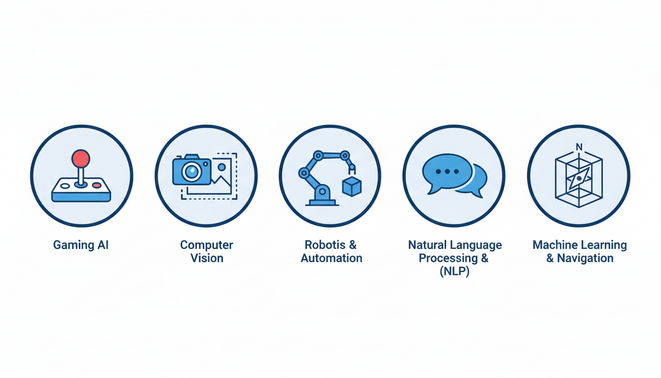
- Versatile robot control for stacking blocks and physical manipulation tasks
- Accurate captioning of images using advanced natural language processing logic
- High performance gaming across many Atari titles with a single set of weights
- Effective dialogue systems for following human instructions in complex settings
The model shows incredible flexibility when switching between these activities. Since it does not need fine tuning for each new task, it saves a lot of time and compute power. While other models focus on narrow skills, this one seeks broad mastery of the world. This breakthrough suggests that foundational models will soon power every robotic system in the future. Therefore, DeepMind’s Gato AI serves as a blueprint for future generalist agents.
Evidence of Practical Applications for DeepMind’s Gato AI
The capabilities of DeepMind’s Gato AI show a massive shift in how researchers build intelligent systems. This model proves that a single neural network can master hundreds of distinct tasks simultaneously. According to the research team, “With a single set of weights, Gato can engage in dialogue, caption images, stack blocks with a real robot arm, outperform humans at playing Atari games, navigate in simulated 3D environments, follow instructions, and more.” This flexibility demonstrates the power of a generalist agent in a field often limited by narrow specialization.
Mastery in Robotics and Manipulation
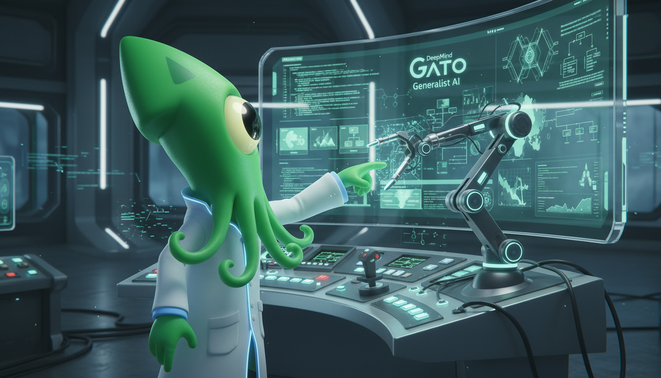
One of the most impressive feats involves robot control in physical space. DeepMind’s Gato AI operates a physical Sawyers robotic arm to stack blocks with high precision. Usually, robots require specific programming for every new motion or object type. However, Gato uses the same weights it uses for text to guide these physical movements.
- It processes joint torques and sensory data as tokens.
- The system predicts the next motor action based on visual feedback.
- Gato generalizes skills from simulation to the real world.
As a result, the model bridges the gap between digital reasoning and physical action. This advancement could lead to more versatile industrial robots that learn new tasks without needing manual updates.
Excellence in Gaming and Simulation
DeepMind’s Gato AI also excels in complex gaming environments. It outperforms human players across many Atari 2600 titles by identifying visual patterns and reacting instantly. Furthermore, it navigates through simulated 3D environments with clear spatial awareness. This ability shows that the transformer sequence model understands logic and strategy at a deep level.
The system treats every game pixel and button press as part of a continuous stream. Because it perceives these inputs uniformly, it switches between games without losing efficiency. Therefore, gamers and developers see a glimpse of future AI that can adapt to any digital interface.
Generalization Across Domains
The true value of DeepMind’s Gato AI lies in its multi modal nature. It handles image captioning and natural language dialogue within the same framework. For instance, it can describe a scene and then answer questions about it immediately. This behavior mimics human intelligence more closely than previous narrow models.
Moreover, the model follows complex instructions to complete sequences of actions. Consequently, it represents a step toward universal assistants that help with both office work and physical chores. This general purpose approach simplifies the AI learning process for everyone. You can explore more about these foundational models at the official Google DeepMind blog at Google DeepMind Blog.
Comparison of DeepMind’s Gato AI with Traditional Models
DeepMind’s Gato AI marks a huge change in how we build smart systems. Because it uses one network for everything, it works differently than older models. Traditionally, developers created unique models for every specific problem. For example, a specialist model might only play one game. In contrast, DeepMind’s Gato AI handles hundreds of tasks at once. It can chat with users while it moves a robot arm. This versatility is due to its multi modal design. Therefore, it changes how we think about automation. As a result, developers can build more flexible robots. Additionally, this table highlights why this model is a foundational breakthrough.
| Attribute | DeepMind’s Gato AI | Traditional Specialist AI |
|---|---|---|
| Core Functionality | Generalist agent performing many tasks | Narrow focus on a single job |
| Input Processing | Multi modal handling text and vision | Specialized for one data type only |
| Parameter Usage | Single set of weights for all jobs | Different models for each activity |
| Training Scope | Simulated and real world environments | Limited to specific datasets |
| Flexibility | Switches between tasks seamlessly | Requires retraining for new tasks |
You can find the full research at the DeepMind Gato publication. This general purpose approach helps machines learn much faster. Because the system shares knowledge across many domains, it becomes very efficient. As a result, it reduces the need for constant human supervision. Thus, it paves the way for advanced artificial general intelligence.
Conclusion: The Impact of DeepMind’s Gato AI
DeepMind’s Gato AI marks a pivotal moment in the history of foundational models. Because it uses one set of weights, it proves that a single network can master many skills. For instance, the system moves from gaming to robot control without any extra training. This multi modal flexibility simplifies how machines learn and interact with the world. As a result, developers no longer need to build many narrow systems for every small task. Finally, this breakthrough accelerates the path toward artificial general intelligence.
DeepMind’s Gato AI uses a transformer sequence model with 1.2 billion parameters to achieve these results. However, its true power lies in how it handles various data types uniformly. Therefore, the system bridges the gap between digital reasoning and physical action. For example, it can describe an image and then play a game. Moreover, this multi task mastery allows for faster automation across many industries. Consequently, the technology serves as a foundation for future robotics and logic.
EMP0 leads the way in deploying these advanced AI and automation solutions for business growth. Because we understand the potential of generalist agents, we help companies integrate foundational models. For instance, our Content Engine uses smart algorithms to generate high quality text. Additionally, our Marketing Funnel tools help you find and keep the right customers. As a result, our Sales Automation features handle repetitive tasks for your team. Therefore, we ensure that your business stays competitive in an evolving market.
The rise of DeepMind’s Gato AI signals a new era for technology and productivity. You can stay updated on these breakthroughs by visiting our blog at our blog. Finally, embracing these general purpose models will define the next decade of innovation. Because the landscape is changing, now is the time to optimize your systems. Thus, join us as we build the future of intelligent automation together.
Frequently Asked Questions (FAQs)
What is DeepMind’s Gato AI?
DeepMind’s Gato AI is a groundbreaking generalist agent. Most AI systems today are very specialized. For example, a system might only translate languages.
In contrast, Gato is a single neural network that performs hundreds of tasks. It uses a transformer sequence model with 1.2 billion parameters. Because of this design, it handles diverse inputs like text and images.
Consequently, it represents a huge step toward artificial general intelligence. You can read the research details at this link for more information. This model marks a foundational breakthrough in automation.
What are the multi modal capabilities of DeepMind’s Gato AI?
The model is multi modal because it processes different data streams together. It converts every input into a sequence of tokens. For instance, pixels from a game and words from a chat are treated the same.
Therefore, the same set of weights can make decisions for both. This approach allows the system to switch between playing Atari and captioning photos. As a result, the model acts like a human brain that learns various skills.
Specifically, it eliminates the need for separate models for each task. This helps developers build more versatile systems.
What sources of data were used for training?
DeepMind trained the model on a massive variety of datasets. They included data from simulated environments and real world robotics labs. For example, the model learned from millions of text tokens and image pairs.
It also studied expert trajectories from many Atari titles. Thus, the system gained a wide range of experience during its training phase. Because the data is so diverse, the agent generalizes well to new challenges.
Moreover, this broad training makes the model very robust in different scenarios. You can find more updates at the official site here to see their progress. The diversity of data is key to its success.
Why is a generalist agent better than a specialist model?
A specialist model is limited to one narrow scope. However, DeepMind’s Gato AI is a generalist agent. It uses a single set of weights for every task it performs. Therefore, it is much easier to manage and deploy in complex environments.
Additionally, knowledge from one task often helps the model perform better in another. For instance, visual understanding helps with robot control. Consequently, this model saves a lot of compute power during the training process.
Specialist models often require massive resources for every new function. This generalist approach makes AI learning more accessible.
What are the best business applications for DeepMind’s Gato AI?
Businesses can apply this technology to various automation projects. For example, it can power industrial robots that handle multiple factory roles. Additionally, it improves customer support systems by combining chat and visual recognition.
Because the model is flexible, it scales easily across different departments. Companies can use it for content creation or sales automation. As a result, it helps firms grow faster by reducing manual work.
You can explore more about these solutions at this link to see how we help businesses. We focus on deploying the latest tools for growth.