
data centre cooling technology: meeting AI’s heat and energy challenge
Data centre cooling technology must evolve to match the surge in AI compute and heat density. Energy efficiency and environmental sustainability now drive cooling design, because large language models and similar AI workloads raise both power draw and thermal loads.
Innovative cooling approaches like liquid cooling, two-phase systems, and microfluidics promise gains, however they also bring risks such as refrigerant leakage and PFAS concerns. As a result, operators seek closed-loop water systems, PFAS-free refrigerants, and subsea or immersion solutions to cut water use and power usage effectiveness.
Research into pore-filled membranes and nanometre-scale microfluidic channels suggests passive or more efficient heat transfer is possible. Therefore, cooling must be reliable, scalable, and safe while reducing carbon footprints and operational costs.
In short, the rapid rise of LLMs makes advanced, sustainable cooling technologies essential for future AI data centres. Stakeholders must innovate urgently.
Liquid Cooling
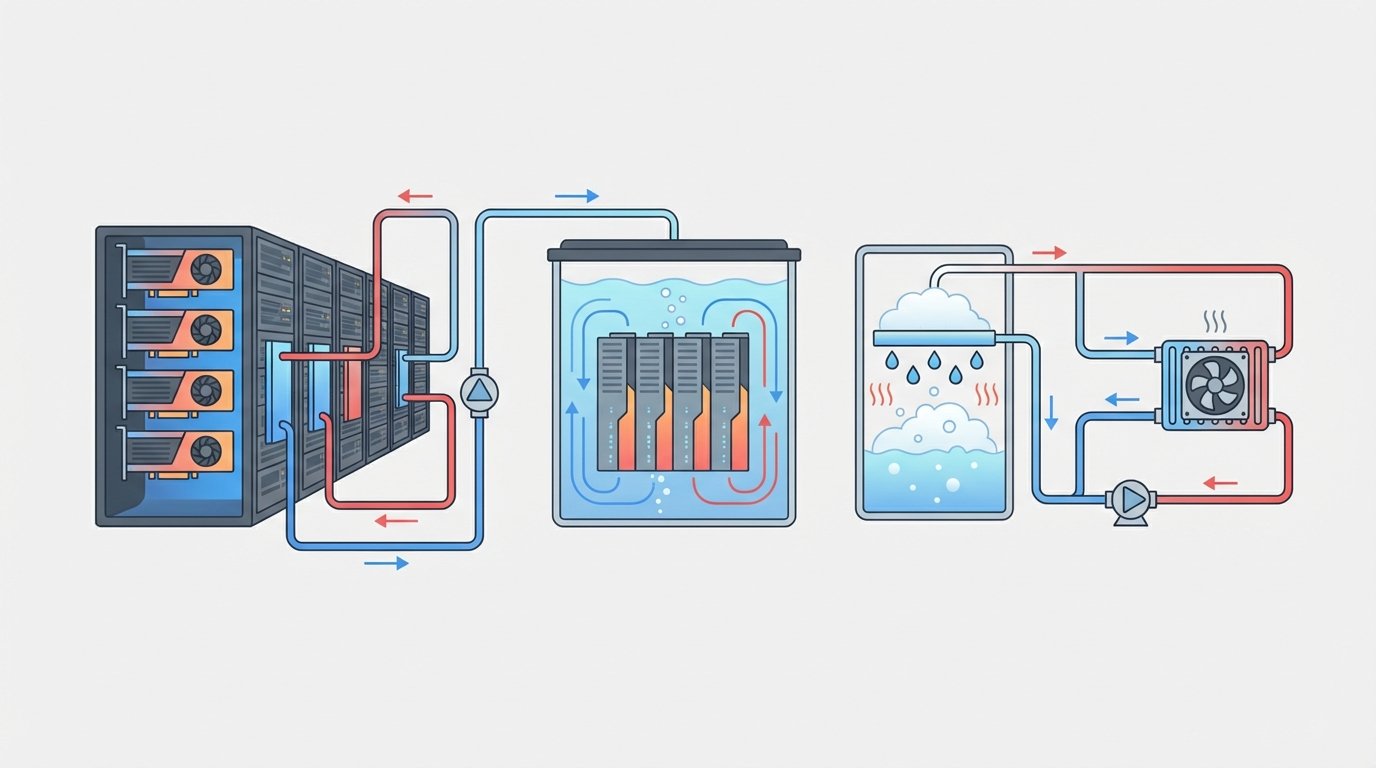
Liquid cooling routes coolant directly to hot components using cold plates or channels. For example, Iceotope claims its liquid cooling can cut cooling-related energy use by up to 80% because liquid moves heat far more efficiently than air. As a result, operators reduce fan power and improve PUE. Many deployments use closed-loop water systems to limit water loss and contamination.
Two-Phase Cooling
Two-phase cooling leverages boiling and condensation to absorb heat at constant temperature. This method can deliver high heat flux removal, so it suits dense AI racks. However, some two-phase designs used PFAS-containing refrigerants, and vapour escape creates safety and environmental risks. Consequently, vendors now explore PFAS-free refrigerants and sealed immersion approaches to lower risk.
Subsea and Immersion Solutions
Subsea data centres like Microsoft’s Project Natick tested underwater deployment and recorded PUEs near 1.07 while requiring zero freshwater. Therefore, subsea and immersion systems can cut water use and enable passive heat rejection. Yet, deployment challenges remain, including retrieval, marine impact, and operational learning. To scale AI workloads sustainably, organisations must pair advanced cooling with energy-efficient infrastructure planning.
For guidance on deploying enterprise AI reliably, see Enterprise AI Infrastructure Models and for broader tech and incident trends, see Technology News and AI Trends.
External references: Iceotope Iceotope and Project Natick Project Natick.
| Technology | Energy efficiency | Environmental impact | Operational risks | Scalability |
|---|---|---|---|---|
| Liquid cooling | High. Direct heat transfer via cold plates and liquid channels reduces cooling energy and fan use. | Lower overall PUE and reduced electrical cooling loads. Closed-loop water options limit water loss and contamination. | Leak risk, plumbing complexity and pump maintenance require robust monitoring and preventive maintenance. | Highly scalable at rack and pod level and integrates with phased deployments and heat reuse strategies. |
| Two-phase cooling | Very high. Boiling and condensation remove large heat fluxes at near constant temperature. | Efficient, but some legacy refrigerants contained PFAS. Modern designs move toward PFAS free refrigerants. | Containment and refrigerant management are critical to avoid vapour escape and chemical hazards. | Well suited to extreme GPU densities, though it needs sealed systems and regulatory clearance. |
| Subsea and immersion | Very low PUE potential. Passive seawater heat rejection can approach PUE near 1.07 as observed in Microsoft’s Project Natick. | Eliminates freshwater use but may have local marine impacts that require study and permitting. | Complex retrieval, maintenance cycles and logistical challenges increase operational risk. | Suited to coastal scale where seabed access and regulation permit, offering large passive heat rejection. |
| Closed loop water systems | Efficient when paired with heat exchangers and heat reuse, reducing cooling energy. | Reduces water consumption compared with open systems and supports responsible fluid choices. | Corrosion, scaling and pump failures demand water chemistry control and monitoring. | Mature and widely deployable. Easily integrates with chillers, heat reuse and existing infrastructure. |
Note: This table summarizes typical trade offs and general characteristics. Actual performance and environmental effects depend on workload, site conditions, power density and regulatory context. Use liquid cooling for dense GPU racks, two phase for extreme heat flux removal, subsea immersion for coastal deployments that prioritise low freshwater use, and closed loop water for mature, broadly deployable infrastructure.
Summary for accessibility and semantic SEO:
This table compares liquid cooling, two phase cooling, subsea immersion and closed loop water systems across energy efficiency, environmental impact, operational risks and scalability. Keywords and related terms include liquid cooling, immersion cooling, two phase cooling, PFAS free refrigerants, closed loop water, microfluidics, heat reuse and PUE. Screen reader friendly description: each row maps a cooling approach to expected efficiency, ecological considerations, operational hazards and typical scalability to help stakeholders choose based on density, site constraints and sustainability goals.
Environmental and operational challenges
Cooling AI data centres raises acute environmental concerns. AI energy demand grows rapidly, and therefore cooling systems face higher continuous loads. Large language models and dense GPU arrays produce intense heat that pushes systems to their limits. As Sasha Luccioni warns, “If you have models that are very energy-intensive, then the cooling has to be stepped up a notch.” Consequently operators must plan for sustained peak cooling, not intermittent peaks.
Refrigerant safety and chemical risk matter. Two-phase systems sometimes use PFAS-containing refrigerants. However vapour escape can create health and environmental hazards. Many vendors now explore PFAS-free refrigerants to reduce such risks. Closed systems and strict containment reduce hazards, but they add complexity and cost.
Water use and PUE are critical metrics. Subsea and immersion approaches lower freshwater need. Yet on land, water cooling loops and closed-loop water systems still consume resources. Research highlights the scale of energy and water use in data centres, and policy groups call for stricter oversight. For context on AI energy demand and water implications, see this article.
Operational failures highlight fragility. A notable cooling outage caused CME Group trading disruption, showing risk to critical infrastructure. Reporting on that event notes cascading effects across markets, underscoring how cooling incidents cause systemic harm. See this news report.
Finally, experts emphasise operational learning. Alistair Speirs said fewer human operators changed procedures, reducing some errors. Jonathan Ballon describes liquid patterns, noting, “We will have fluid that comes up and [then] shower down, or trickle down, onto a component.” These insights show progress, yet they also show how complex systems must balance efficiency, safety, and resilience.
Conclusion
Advancing data centre cooling technology is essential to keep AI growth sustainable. AI workloads and large language models increase power draw and thermal density. Therefore cooling must become more efficient and environmentally responsible while remaining reliable.
Recent breakthroughs offer cautious optimism. Liquid cooling, two-phase systems, and passive microfluidic ideas can cut energy and water use. However challenges persist. Refrigerant safety, water management, and operational fragility still demand rigorous design and oversight. Consequently the sector must pair innovation with strict safety and environmental standards.
EMP0 is a US-based AI and automation company that supports efficient AI deployment and responsible growth. If you want practical solutions and operational guidance, visit EMP0’s website at EMP0. For automation workflows and integrations, see EMP0’s n8n profile. Together, industry and vendors can scale AI while reducing environmental footprints and protecting critical infrastructure.
Frequently Asked Questions (FAQs)
What are the main types of data centre cooling technology?
Liquid cooling routes coolant to hot components using cold plates or immersion. Two-phase cooling uses boiling and condensation for high heat flux removal. Subsea and immersion systems use seawater or dielectric fluids for passive heat rejection. Closed-loop water systems recycle cooling water and limit losses.
How do cooling choices affect the environment?
Cooling impacts power use and water consumption. For example, liquid and two-phase systems can reduce PUE and energy use. However some refrigerants raise chemical risks. Subsea solutions cut freshwater use but require marine impact studies. Therefore operators must balance efficiency and ecological risk.
Do large AI models increase cooling demand?
Yes. Large language models and dense GPU training use far more energy than typical chatbots. As Sasha Luccioni warned, highly energy-intensive models need stepped-up cooling. Consequently operators must plan continuous, high-capacity cooling rather than occasional peaks.
Are refrigerants and fluids safe?
Some two-phase designs used PFAS-containing refrigerants, and vapours can escape. As a result vendors shift to PFAS-free refrigerants and sealed immersion. Proper containment and monitoring reduce health and environmental risks.
What trends will shape the future?
Expect growth in liquid microfluidics, passive pore-filled membranes, and heat reuse systems. In addition, closed-loop water and PFAS-free choices will expand. Ultimately, innovation must pair efficiency with safety and regulatory compliance.