

This week in gear: Android updates, camera launches, and implications for consumer tech brings big news
Most notable is the Android update and Sony A7 V release, which promises change. Therefore, for tech fans and photographers, these updates matter.
Android 16 brings richer customization like custom icon shapes, cohesive themes, extended dark mode, overhauled parental controls, and AI-powered notification summaries. The A7 V adds a 33 MP partially stacked CMOS sensor, the BIONZ XR2 processor with an AI processing unit, up to 7.5 stops of IBIS, improved autofocus at 30 frames per second, and advanced video features such as 7K oversampled 4K at 60 and 4K at 120 in Super 35.
Enthusiasts should expect both immediate practical upgrades and deeper shifts in how devices compete, therefore influencing camera choice, smartphone ecosystems, content creation workflows, and purchase priorities worldwide.
Sony priced the A7 V at $2,899 with preorders at Adorama and B&H Photo, and Pixels will get Android 16 features first.
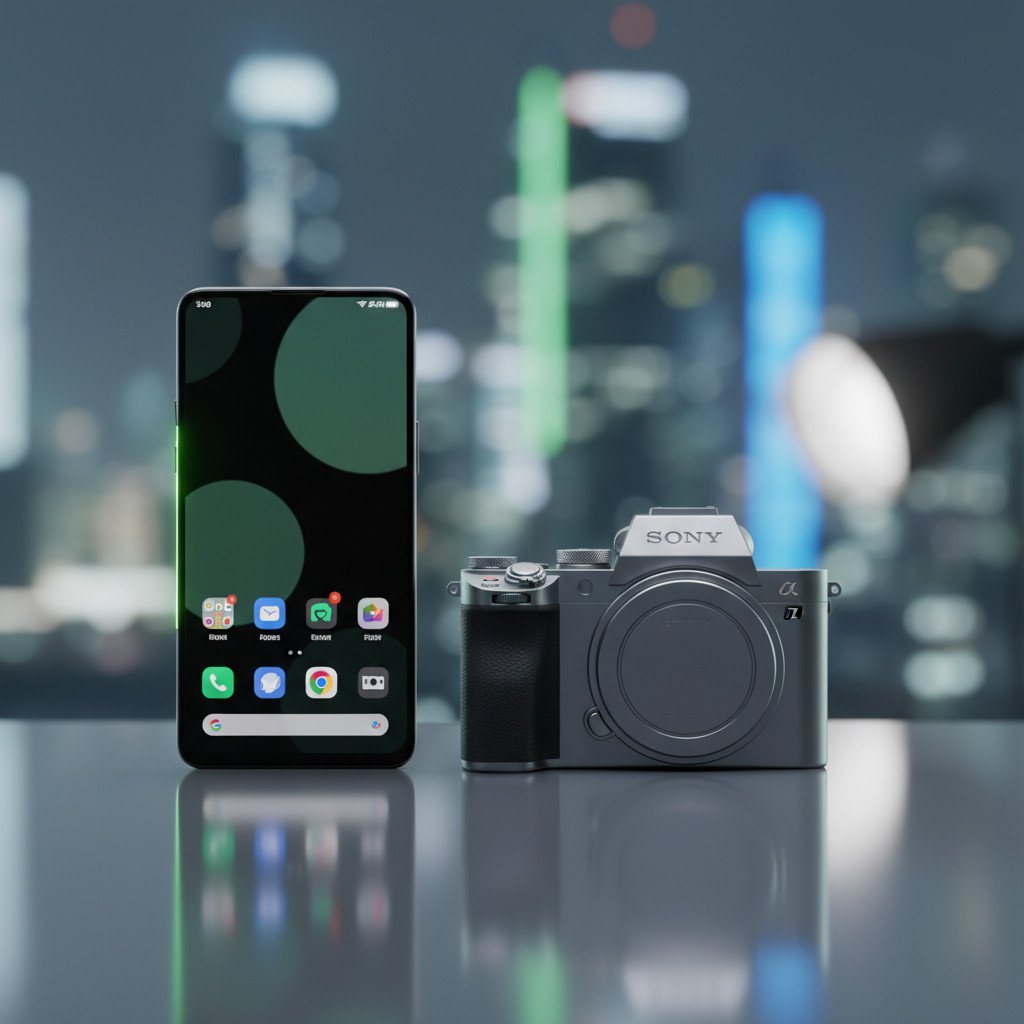
Android update and Sony A7 V release: What Android 16 brings
Android 16 packs meaningful upgrades that improve customization, privacy, and daily convenience. Because Google focused on personalization, you can now create custom icon shapes and cohesive themes. As a result, dark mode can extend to apps that lack their own dark theme. For full technical notes, see Google’s Android 16 overview: Android 16 overview and the announcement: Android 16 announcement.
Key Android 16 features and benefits
- Custom icon shapes and cohesive theme controls make the home screen feel unified. This boosts visual consistency and reduces clutter.
- Extended dark mode reduces eye strain and can save display power on OLED screens.
- Overhauled parental controls give granular screen time, downtime, and app rewards for kids. This helps families balance device use.
- AI-powered notification summaries provide TL;DRs for long chats and group threads. Related alerts group automatically and low-priority notices can be silenced.
- Expressive Captions add emotion tags for YouTube captions, improving accessibility and context for viewers.
- Configurable AutoClick reduces mouse strain; Guided Frame adds clearer framing hints in camera apps.
- Voice Access can launch directly to Gemini, enabling faster voice-first workflows.
Android update and Sony A7 V release: Impact on users and creators
These improvements reshape interaction and content creation. Pixel phones will get features first, then other devices follow. Because notifications become smarter, users focus on what matters. Developers gain flexible theming and accessibility tools. Moreover, Guided Frame and camera-app tweaks hint at tighter phone-to-camera workflows, complementing cameras like the Sony A7 V. For official Sony updates, see Sony’s press area.
Quick Spec Comparison of the Sony A7 V and Its Predecessors
| Model | Sensor | Processor and AI | Stabilization (IBIS) | Dynamic Range | Continuous Shooting | Autofocus | Video | Connectivity | Launch Price |
|---|---|---|---|---|---|---|---|---|---|
| Sony A7 V (2025) | 33 MP partially stacked full-frame CMOS | BIONZ XR2 with dedicated AI processing unit | Up to 7.5 stops | Up to 16 stops (Sony claim) | Up to 30 fps with full autofocus | Advanced AI subject and eye detection, improved tracking | 7K oversampled 4K/60; 4K/120 fps in Super 35; no open gate | USB-C, Wi-Fi, Bluetooth, dual card slots (CFexpress/SD) | $2,899 (preorder at Adorama and B&H Photo) |
| Sony A7 IV (2021) | 33 MP full-frame CMOS | BIONZ XR | Around 5 to 5.5 stops | Strong dynamic range for its class | Up to 10 fps | Real-time Eye AF and subject tracking, reliable AF performance | 4K up to 60 fps (10-bit 4:2:2, Super 35 for 4K60) | USB-C, Wi-Fi, Bluetooth, dual card slots (CFexpress/SD compatible) | $2,499 (launch) |
| Sony A7 III (2018) | 24.2 MP full-frame CMOS | BIONZ X | Around 5 stops | Excellent for everyday shooting | Up to 10 fps | Fast hybrid AF system with wide coverage | 4K up to 30 fps (oversampled from Super 35) | USB-C, Wi-Fi, Bluetooth, dual SD card slots | $1,999 (launch) |
Notes: The table focuses on headline specs and practical differences. The A7 V advances autofocus, stabilization, and video in measurable ways. Meanwhile, A7 IV marked a major generational step over the A7 III in resolution and video capability.
Android update and Sony A7 V release: What makes the A7 V special
Sony’s A7 V brings camera-grade innovations that matter for pros and enthusiasts. Because Sony combined a new 33 MP partially stacked sensor with the BIONZ XR2 and an AI unit, image quality and speed improve. The camera delivers stronger low-light performance and faster processing. As a result, photographers get more usable shots and quicker workflows.
Key features and technical highlights
- Sensor and processor: 33 MP partially stacked Exmor sensor plus BIONZ XR2 with onboard AI for smarter subject detection and noise control.
- Stabilization and range: in-body image stabilization up to 7.5 stops and about 16 stops of dynamic range for richer highlights and shadows.
- Autofocus and shooting speed: up to 30 frames per second with full AF/AE and advanced AI subject and eye detection for people, animals, and vehicles.
- Video capability: 7K oversampled 4K at 60 frames per second and 4K/120 fps in Super 35, supporting 10-bit color profiles and cine-friendly gamma options.
- Connectivity and media: dual card slots with CFexpress support, USB-C, Wi-Fi 6E, and fast tethering for studio and field work.
Practical impact for shooters
For professionals, the A7 V reduces retakes because autofocus and IBIS are more reliable. Moreover, hybrid shooters gain a single body that handles both high quality stills and serious video. For enthusiasts, the improved tracking and stabilization make creative techniques simpler to nail.
Wider context and adoption
The A7 V reshapes Sony’s lineup by narrowing choices between stills-first and video-first models. Reviewers praise its balance and usability, see TechRadar’s full review and hands-on notes at PetaPixel. Therefore, expect this model to influence camera buying and content creation workflows across studios and social creators.
Conclusion
The Android update and Sony A7 V release mark a clear shift in consumer tech. Together they raise the bar for personalization, AI features, and imaging performance. For creators and brands, that means richer content and new touchpoints. As a result, workflows change and audience expectations rise.
EMP0 helps businesses turn these changes into measurable gains. Using AI and automation, EMP0 connects device-level features to sales and marketing systems. For example, smarter Android notifications can trigger tailored campaigns through automated workflows. Moreover, camera improvements like the A7 V’s autofocus and 7.5-stop IBIS let brands create higher-value visual assets faster. EMP0’s solutions automate tagging, cropping, and distribution, so teams publish polished content without delay. Learn more at EMP0’s website and the company blog. The n8n creator page shows automation examples.
Therefore, businesses can adopt new tech quickly and maintain momentum. With the right automation, teams scale creative output and improve conversion rates. We expect these platform and camera changes to open new revenue paths.
Frequently Asked Questions (FAQs)
When will Android 16 be available?
Pixel phones receive updates first, and other manufacturers follow over weeks and months. Therefore, check your device maker for exact timing.
Which devices get Android 16 features first?
Google Pixel devices get the new features first. Third-party phones will roll out later, depending on carrier and maker.
When does the Sony A7 V ship and how much does it cost?
The A7 V is available for preorder at Adorama and B&H Photo for $2,899. Shipping dates vary by retailer, so confirm at checkout.
What are the A7 V’s standout features?
It adds a 33 MP partially stacked sensor, BIONZ XR2 with an AI unit, up to 7.5 stops IBIS, 30 fps AF, and 7K oversampled 4K/60 plus 4K/120 Super 35.
How do these updates benefit creators and businesses?
Better phone notifications and camera quality speed content workflows. As a result, automation tools can publish content faster and boost marketing performance.