

AI Hype Correction, ROI Velocity, and Leadership in AI Deployment
AI hype correction, ROI velocity, and leadership in AI deployment must guide our view of AI today. The gap between hype and reality is wide. Too often companies chase headlines instead of value. However, enterprise leaders need a pragmatic lens. This piece contrasts the post-hype phase with measurable outcomes. It focuses on speed-to-deployment, ROAI calculations, and time-to-value. Because deployment time often defines return, we highlight ROAI’s role. We also explain common adoption challenges enterprises face.
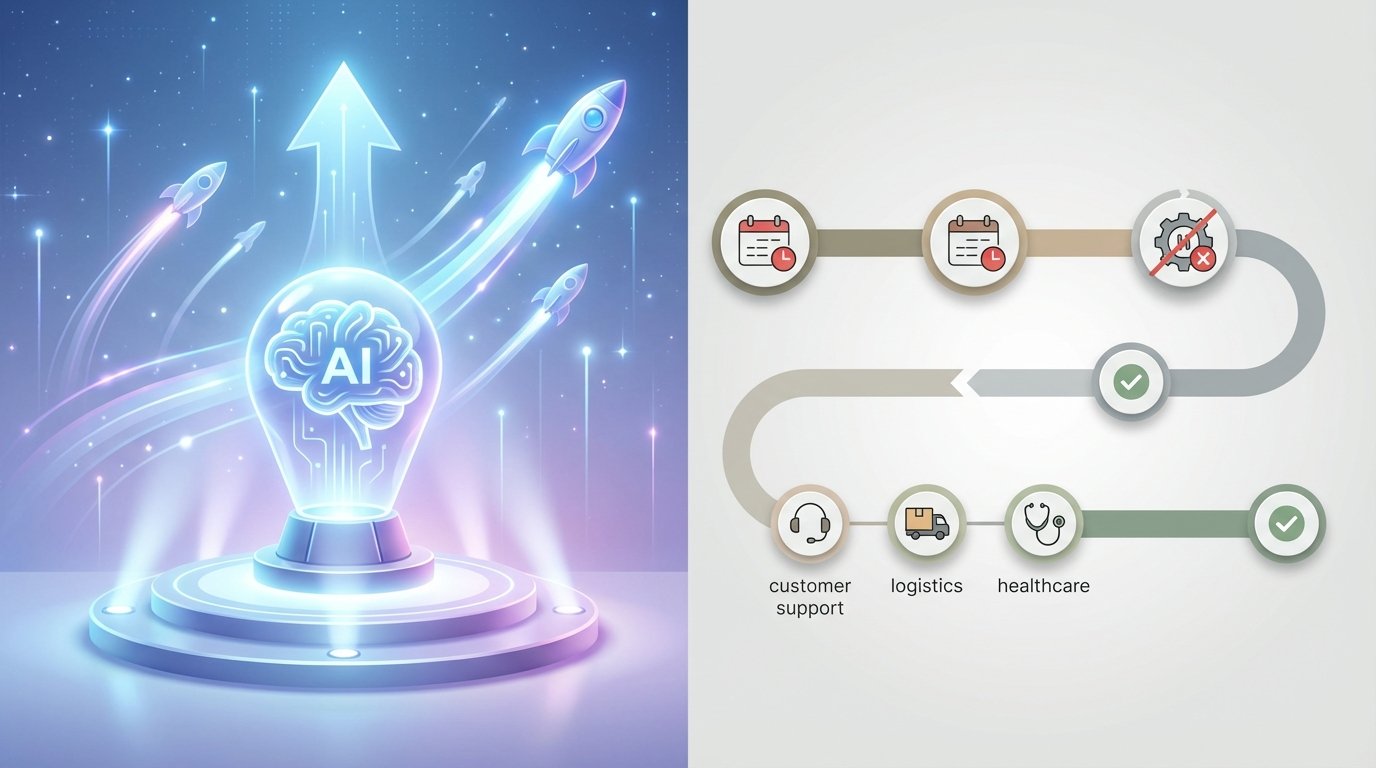
For example, many projects stall before production. As a result, teams lose momentum and funding. The blog presents four deployment patterns and practical steps leaders can take. It argues that executive ownership beats pure IT outsourcing. Therefore, we map leadership behaviors that accelerate wins. Finally, we preview case examples from customer support, logistics, and healthcare. Together these ideas aim to reset expectations and show how to capture real value. We prioritize practical guidance over hype. Read on for frameworks and leader checklists.
AI hype correction, ROI velocity, and leadership in AI deployment: Hype versus reality
The era of dazzling AI demos met a sobering post-hype phase quickly. However, real deployments rarely mirror launch-day headlines. On average, enterprises take about eight months to move from prototype to production. Moreover, nearly half of AI initiatives never reach production at all. For evidence of stalled projects, see this analysis of pilot failure rates: CIO Analysis of AI Pilot Failure Rates.
Many leaders ask the right question: what remains when the wow factor fades? “You can’t help but wonder: When the wow factor is gone, what’s left?” For that reason, teams must measure time-to-value, not just model accuracy. Because deployment time compounds return, ROAI depends on speed as much as outcome. In practice this means calculating ROAI as Traditional ROI multiplied by speed-to-deployment.
Consider vivid examples. A customer support chatbot that shores up ticket routing may show promise in weeks. Conversely, an enterprise-wide predictive model can sit in pilots for nearly a year. As a result, business leaders often lose confidence and cut funding. For broader context on adoption drivers and barriers, see IBM’s enterprise adoption write-up: IBM Enterprise Adoption Write-up.
Practical takeaways follow. First, accept that AI breakthroughs do not equal instant value. Second, prioritize quick wins that remove internal bottlenecks. Third, insist on executive ownership to maintain momentum. Finally, treat AI as infrastructure that amplifies human judgment, not as magic that replaces it.
AI hype correction, ROI velocity, and leadership in AI deployment: Introducing ROAI
Traditional ROI calculations focus on outcome and dollars. However, AI changes the equation. Because deployment speed multiplies value, leaders need a metric that includes time. ROAI fills that gap and aligns AI ROI with speed-to-deployment and time-to-value.
ROAI = Traditional ROI × Speed-to-Deployment Factor
Put simply, ROAI amplifies return when teams deploy fast. For example, imagine a workflow that yields 100 percent ROI over a year. If a team deploys it in one month instead of twelve months, the speed factor equals twelve. Therefore ROAI becomes 100 percent × 12, or twelvefold effective return.
Concrete comparisons help. A customer support automation that reduces handle time by twenty percent can reach measurable savings in weeks. Conversely, a cross-enterprise predictive model may stall for eight months. As a result, long timelines often erode projected value and stakeholder trust. See research on AI pilots and production rates: AI Pilots Research. For practical adoption patterns, read this HBR piece on realistic AI use cases. Additionally, IBM’s adoption note shows enterprise deployment drivers: IBM’s Adoption Note.
Use ROAI as a decision tool. First, prioritize projects with fast time-to-value. Second, measure speed-to-deployment alongside accuracy. Third, assign executive sponsors to keep momentum. Finally, treat AI as infrastructure that amplifies human judgment, not as a one-off experiment.
| Pattern | Description | Typical deployment speed | Associated risks | Expected business outcomes |
|---|---|---|---|---|
| Removing internal bottlenecks | AI applied to automate repetitive tasks and clear process jams. Focus on operations and workflow efficiency. | Weeks to two months | Risk of local optimization without systemic change. Cultural pushback possible. | Faster cycle times, lower cost, improved staff productivity and time to value |
| Revenue teams see gains fastest | Sales and marketing embed AI for lead scoring and personalization. These teams measure direct dollar impact. | Weeks to three months | Overfitting to short term metrics. Sales process misalignment if not integrated. | Higher conversion rates, larger deal sizes, quicker ROAI and measurable lift |
| AI becomes a product line | Companies package AI features into customer offerings. Product teams validate market fit. | Three to nine months | Market mismatch risk. Regulatory and model maintenance costs. | New revenue streams, defensible differentiation, scalable monetization |
| Momentum dissolves resistance | Early wins create trust and spread AI across functions. Adoption snowballs. | Varies; often accelerates after initial wins | Complacency risk and tech debt accumulation. Governance gaps may appear. | Organizational learning, cross functional reuse, faster enterprise scale |
Related keywords and synonyms include AI ROI, ROAI, speed to deployment, time to value, post hype phase, and AI breakthroughs. Use this table to match projects to strategy and to prioritize quick wins that amplify human judgment.
AI hype correction, ROI velocity, and leadership in AI deployment: Conclusion
This article reset expectations about AI by separating sensational promise from achievable outcomes. It emphasizes speed to value because deployment time multiplies return. It also shows that nearly half of initiatives never reach production and that ROAI frames value through speed as well as outcome.
EMP0 supports pragmatic adoption with full stack AI and automation solutions focused on sales and marketing automation. EMP0 deploys solutions securely inside client infrastructure, preserving data control and compliance. The company provides readiness tools and proprietary AI utilities to accelerate time to value. Emp0 offers proofs of concept that demonstrate measurable ROAI in weeks. In addition, EMP0 partners with executive teams to sustain momentum and embed governance.
For more information visit our website at EMP0, read our blog at EMP0 Blog, or explore workflows on n8n at n8n Workflows. Reach out when you are ready to turn pilots into production and to multiply revenue through responsible AI.
Leadership matters because the biggest barrier to AI success is not technical. Therefore pragmatic execution, executive ownership, and fast deployment determine winners.
Frequently Asked Questions (FAQs)
What is AI hype correction and why does it matter?
AI hype correction is the process of resetting inflated expectations about AI. In short, it moves teams from spectacle to substance. Because initial breakthroughs draw headlines, leaders often chase the wrong metrics. However, correcting hype means focusing on time-to-value, realistic use cases, and measurable business outcomes. This matters because many projects stall and lose funding when leaders expect instant transformation.
What is ROAI and how does it differ from traditional ROI?
ROAI stands for Return on AI Investment. It extends traditional ROI by adding a speed-to-deployment dimension. The formula is ROAI = Traditional ROI × Speed-to-Deployment Factor. For example, a 100 percent ROI deployed in one month has a much higher ROAI than the same return delayed twelve months. Therefore ROAI links AI ROI and speed-to-deployment to capture real value.
How can leadership reduce AI failure rates and accelerate wins?
Executive ownership is key. First, assign a senior sponsor to remove blockers and fund early wins. Second, set clear time-to-value targets and track speed alongside accuracy. Third, avoid treating AI as a pure IT project; instead integrate business leaders and domain experts. As a result, teams maintain momentum and improve production rates.
What practical steps shorten time-to-value for AI projects?
Prioritize small, high-impact pilots that remove internal bottlenecks. Use iterative deployment and measure ROAI at each step. Keep infrastructure decisions simple and deploy inside client environments when security matters. Finally, adopt governance that balances speed and control so teams can scale without accumulating tech debt.
Where do enterprises see the fastest returns and what risks should they watch?
Revenue teams and operational automations typically deliver the fastest wins, often in weeks. However, watch for misaligned metrics, overfitting, and governance gaps. Remember that average enterprise deployment takes about eight months and nearly half of projects never reach production. Therefore prioritize quick wins and build momentum deliberately.