
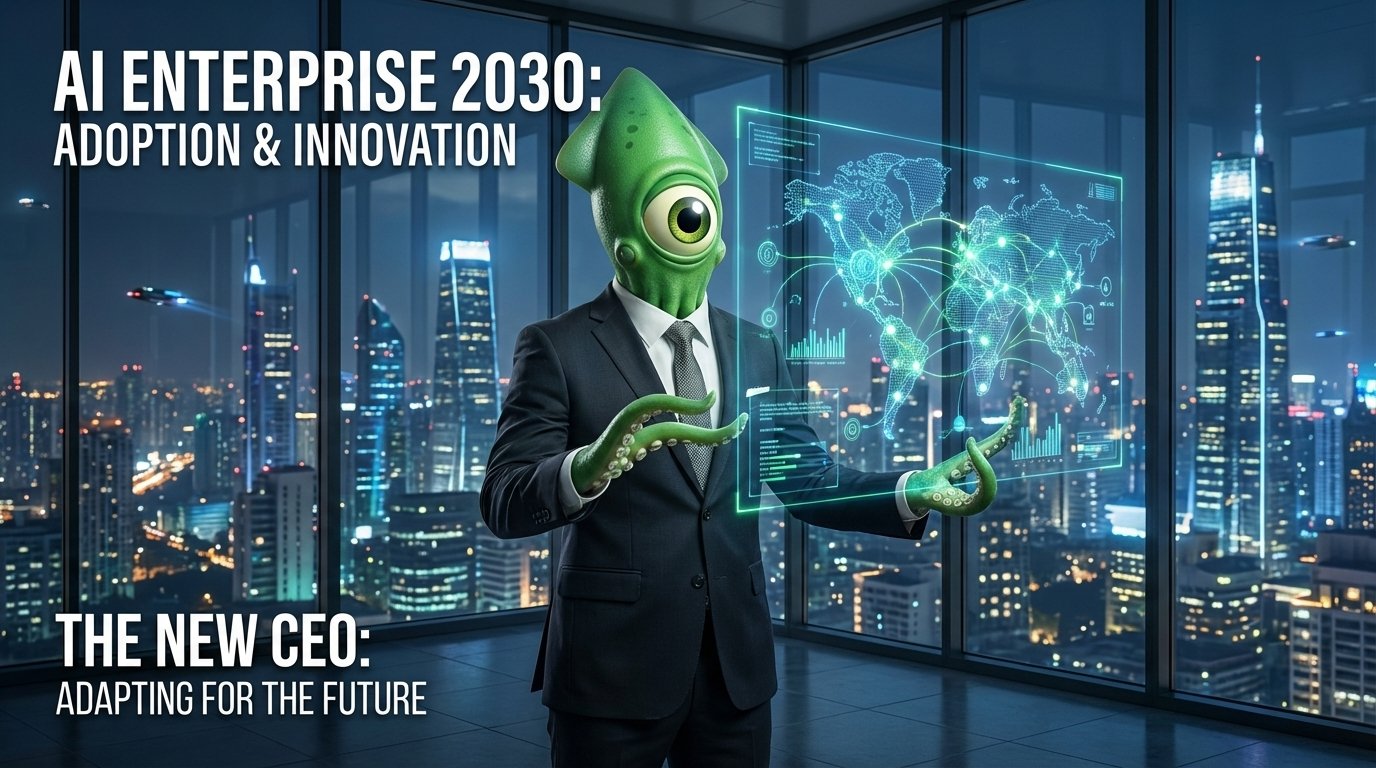
AI by 2030 and enterprise adoption
AI by 2030 and enterprise adoption will redefine how companies create value and compete globally. This article examines that transformation across technology, organization, and markets. We will cover practical enterprise AI use cases such as custom GPTs, automation, and decisioning. We also explore world models, large language models, and the infrastructure they require. Because adoption drives economic impact, firms that scale AI will gain outsized advantages. However, we will balance optimism with caution about inequality, governance, and technical limits.
The analysis draws on adoption metrics, industry case studies, and infrastructure commitments. As a result, readers will get an action framework for pilots, scaling, and governance. Along the way, we highlight trends in AI economy, reinvention of workflows, and skill shifts. By the end, you will understand opportunities, risks, and practical next steps for enterprise leaders. We will reference data on ChatGPT Enterprise adoption and reasoning token growth. Therefore, the piece links strategy to measurable metrics for implementation teams. Finally, we map likely scenarios through 2030, from robotaxis to global AI hubs. Read on to prepare your organization for the next decade of AI-driven change.

Current enterprise landscape and near term trends
Enterprises adopted AI quickly over the last three years. Many teams now use AI tools for automation, code helper functions, and customer support. For example, ChatGPT message volume grew eightfold since November 2024, and 36 percent of U.S. businesses use ChatGPT Enterprise. As a result, organizations report saving 40 to 60 minutes per user per day. However, adoption remains uneven across industries and regions.
AI by 2030 and enterprise adoption: projections
Expect deeper integration by 2030. Firms will move from isolated pilots to platform level deployments. Because infrastructure investments scale capability, large commitments to compute and networking matter. OpenAI and other firms have expanded commitments to support enterprise workloads. Organizations using APIs now consume far more reasoning tokens than a year ago, signaling more complex use cases.
Key trends and signals
- Rapid customization: custom GPTs usage jumped nineteen times this year, and BBVA uses thousands of tailored agents. Therefore, expect bespoke agents inside many firms.
- Cross functional coding: coding related messages rose thirty six percent outside engineering teams, which suggests wide developerization of workflows.
- Infrastructure scale: heavy commitments to infrastructure will lower latency and cost for enterprise AI.
- Productivity gains: three quarters of survey participants say AI lets them do new tasks.
Primary challenges
- Governance and safety remain unresolved, and firms must balance innovation with controls.
- Skills gap: enterprises need retraining programs for hybrid human AI workflows.
- Vendor lock and geography: Silicon Valley may wane before 2030, and new hubs will rise elsewhere.
Evidence and sources
- For executive framing on AGI and AI strategy, see AGI vs AI for Executives.
- On connecting agents to the web and future architectures, see Connecting AI Agents to the Web.
- For usage and growth data on ChatGPT, see ChatGPT Weekly Active Users Growth Impact Analysis.
- Broader industry analysis appears in Financial Times and MIT Technology Review.
Related keywords and semantic terms
AI 2027, custom GPTs, world models, LLMs, enterprise AI adoption, infrastructure commitments, AI economy, automation, digital transformation
AI by 2030 and enterprise adoption: technology mapping
Below is a compact reference table comparing major AI technologies and their enterprise use cases. Use this as a quick guide when planning pilots, scaling, or vendor selection. Because each technology serves different needs, teams should mix and match solutions for best results.
| Technology | What it does | Typical enterprise use cases | Key benefits | Common tools and platforms | Adoption notes and risks |
|---|---|---|---|---|---|
| Machine learning (supervised, unsupervised) | Learns patterns from data to predict outcomes | Demand forecasting, fraud detection, churn prediction | Faster decisions, improved accuracy, cost reduction | TensorFlow, PyTorch, scikit-learn, AWS SageMaker | Requires clean data; model drift needs monitoring |
| Natural language processing (LLMs, NLP) | Understands and generates human language | Chatbots, knowledge bases, summarization, code assistance | Scales support, speeds research, enables automation | OpenAI APIs, Anthropic, Hugging Face, LangChain | Privacy and hallucination risks; needs guardrails |
| Robotic process automation (RPA) | Automates rule based digital tasks | Invoice processing, onboarding, data entry | Quick ROI, reduces human error, predictable savings | UiPath, Automation Anywhere, Power Automate | Best for structured workflows; fragile to change |
| Computer vision | Interprets images and video | Quality inspection, security, inventory tracking | Improves detection, reduces manual checks | OpenCV, AWS Rekognition, Azure CV | Needs varied training images; bias risk |
| Reinforcement learning and world models | Learns via trial and simulation | Robotics, dynamic pricing, logistics optimization | Optimizes complex decisions, adapts to environments | RLlib, Stable Baselines, custom simulators | High compute cost; long training cycles |
| Generative models (images, audio, text) | Creates new content from patterns | Marketing content, design, synthetic data | Speeds creative work, reduces production time | Stable Diffusion, DALL·E, GPT series | IP concerns; content verification needed |
| Knowledge graphs and symbolic reasoning | Connects entities and facts for reasoning | Compliance, semantic search, decision support | Improves explainability, links siloed data | Neo4j, Amazon Neptune, RDF stores | Integration work is often heavy |
Practical takeaways
- Mix technologies because different problems require different approaches.
- Start with high ROI pilots, and then scale platforms and governance.
- Invest in data quality first, because models depend on reliable inputs.
- Plan retraining cycles and monitoring to reduce model drift.
Related and semantic keywords
AI 2027, custom GPTs, LLMs, world models, reinforcement learning, enterprise AI adoption, infrastructure commitments
AI by 2030 and enterprise adoption: impact on growth and competitive advantage
AI adoption boosts growth in three clear ways. First, it raises productivity by automating routine tasks. Second, it improves decision quality with better predictions. Third, it creates new products and services.
Short evidence and examples
- Productivity gains: Participants reported saving forty to sixty minutes per day using enterprise AI tools. Therefore, firms reduce labor costs and increase output quickly.
- Platform scale: With heavy infrastructure commitments, enterprises can run large models at scale. As a result, firms use more complex reasoning tokens and expand AI use cases.
- Custom agents at scale: For example, custom GPT usage rose nineteenfold this year, and BBVA runs thousands of tailored agents. Thus, personalization becomes a competitive edge.
How AI creates differentiation
- Faster innovation cycles: Firms use AI to prototype products and test features faster. Consequently, time to market falls.
- Better customer experiences: Chatbots and summarization tools improve response speed and accuracy. For instance, 36 percent of U.S. businesses use ChatGPT Enterprise, which shows deepening adoption.
- Cost and quality improvements: Computer vision and RPA cut error rates and inspection costs.
Risks that affect advantage
- Governance and safety can slow deployment, and poor controls erode trust.
- Skills gaps mean firms must retrain workers, or they lose potential gains.
- Vendor and geopolitical lock in can limit long term agility.
Actionable steps for leaders
- Start with high ROI pilots that solve clear pain points.
- Invest in data quality and monitoring to avoid model drift.
- Build governance templates that scale as models grow.
Sources and further reading
Conclusion
AI adoption will reshape enterprise strategy, operations, and products through 2030. Across the article we covered current deployments, technology mappings, and growth impacts. We also highlighted challenges in governance, skills, and infrastructure. Therefore, leaders must balance rapid experimentation with robust controls.
Enterprises that scale AI will capture outsized gains. For example, custom GPTs and large model integrations drive personalization and automation. As a result, firms see measurable productivity gains and faster time to market. However, advantage requires investments in data quality, monitoring, and retraining programs.
EMP0 helps businesses convert these opportunities into revenue. EMP0 builds secure AI and automation systems that run inside client infrastructure. As a result, teams keep control over data and compliance while they scale AI-powered growth. Explore EMP0 offerings at EMP0 to learn how EMP0 deploys tailored AI solutions and automation frameworks. You can also discover creator tools and integrations at n8n creator tools.
Start with focused pilots that solve clear business problems. Then expand platforms, governance, and skills. With pragmatic planning, AI by 2030 and enterprise adoption becomes a durable source of growth and differentiation.
Frequently Asked Questions (FAQs)
What is the expected timeline for enterprise AI adoption through 2030?
Enterprise adoption accelerated sharply over the last three years. For example, ChatGPT message volume grew eightfold since November 2024, and 36 percent of U.S. businesses use ChatGPT Enterprise. Therefore, by 2030 many firms will move from pilots to platform level deployments and bespoke agents. Additionally, geographic shifts mean innovation hubs will expand beyond Silicon Valley.
What concrete benefits can enterprises expect?
AI delivers productivity gains, faster decisions, and new offerings. Participants report saving 40 to 60 minutes per day with enterprise AI tools. As a result, firms can reduce costs, speed time to market, and improve customer experience.
What are the main risks and how can they be mitigated?
Key risks include governance gaps, model drift, data privacy issues, and skills shortages. However, firms can reduce risk with monitoring, retraining cycles, and strong access controls. Also implement phased governance and diversify vendors to avoid lock in. Finally, involve legal and ethics teams early.
How should companies start with AI?
Start with high ROI pilots that solve clear business problems. Then scale successful pilots by investing in data pipelines, monitoring, and governance. Invest in staff retraining and cross functional collaboration early. Measure ROI and iterate quickly.
How does EMP0 support enterprise AI adoption?
EMP0 builds AI and automation systems that run inside client infrastructure. As a result, clients keep control of data and compliance while they scale. EMP0 supports pilots, platform builds, integrations, and operationalization. Therefore, it helps firms convert AI experiments into reliable revenue streams. Contact EMP0 to discuss secure deployments and revenue models.