
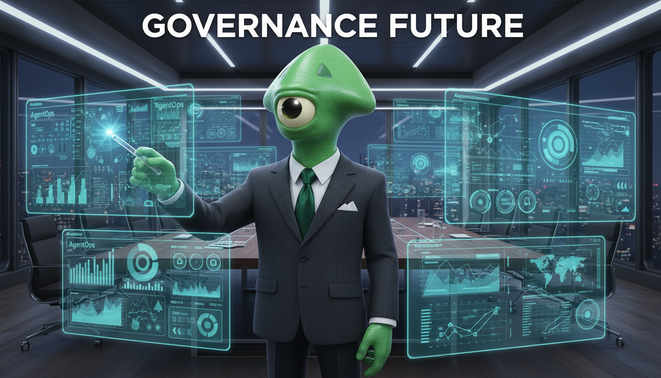
Mastering Agentic AI Governance and Operations (AgentOps) for Enterprise Scale
The G2 2025 AI Agents Insights report highlights a major shift in the corporate landscape. It reveals that 57 percent of companies already have AI agents active in production. This rapid adoption signifies a move beyond simple scripts or basic chatbots. Organizations are now transitioning from static automation to sophisticated LLM powered agent systems. Consequently, business leaders must prioritize Agentic AI Governance and Operations (AgentOps) to maintain control.
This new paradigm requires a structured approach to management. “AgentOps, short for agent operations, is an emerging set of practices for managing the full lifecycle of AI agents in production.” These practices help teams oversee autonomous actors across the enterprise. Furthermore, the goal is to ensure reliability and security during every stage of deployment. Without a solid framework, the risks of erratic behavior and system failure increase significantly. Therefore, enterprises need clear standards to govern these digital workers effectively.
Effective governance provides the necessary guardrails for modern innovation. Companies use these tools to handle complex tasks without constant manual input. However, increased autonomy does not remove the need for accountability. Instead, it demands a more refined operational model to track performance. By mastering these principles, organizations can unlock the true potential of their AI assets. They can scale efficiency while keeping risk levels within acceptable limits. As a result, strategic oversight becomes the foundation for long term success. You can learn more about managing these systems through resources on AI governance and advanced automation platforms.

The Operational Lifecycle: Establishing Agentic AI Governance and Operations (AgentOps)
Operationalizing AI agents at scale requires more than just deployment. Leaders must build a robust framework to manage these digital actors. As one industry expert noted, “Autonomy does not remove accountability, it amplifies it.” Therefore, companies must implement Agentic AI Governance and Operations (AgentOps) to maintain strict oversight. This approach ensures that every autonomous action remains aligned with business objectives. Leading firms often use the UiPath platform to orchestrate these complex tasks.
A successful lifecycle follows a four stage process to ensure system stability:
- Monitoring involves tracking every interaction and decision made by the agent. This step provides a continuous stream of data for review.
- Anomaly detection identifies behaviors that deviate from expected patterns or safety guardrails. Consequently, it acts as an early warning system for potential risks.
- Root cause analysis determines why an agent behaved in a specific way. Because agents process complex data, teams must verify their logic.
- Resolution focuses on fixing the identified problem through code updates or policy changes. This final stage restores the system to its desired state of performance.
Maintaining reliability requires deep visibility into system performance. Organizations use operational telemetry to gather data on agent health and performance metrics. Solutions from Splunk help teams identify issues before they impact the business.
Furthermore, drift detection is essential for managing LLM based systems. Since models change over time, drift detection ensures that outputs remain accurate and safe. Effective oversight relies on these technical tools to provide clear insights. Thus, businesses can scale their operations without losing control of their digital workforce. Organizations often look to Microsoft or AWS for guidance on building reliable AI systems.
Comparative Analysis: Traditional RPA vs. Agentic AI Systems
Organizations often compare older automation tools with modern agentic solutions. Traditional RPA systems follow rigid rules and lack flexibility. However, Agentic AI systems use large language models to handle complex reasoning. As a result, businesses can automate more intricate tasks with greater ease. Therefore, the table below outlines the primary differences between these two approaches. Consequently, leading platforms like UiPath provide further context on Agentic AI Governance and Operations (AgentOps) and these automation trends.
| Parameter | Traditional RPA | Agentic AI Systems |
|---|---|---|
| Decision Making | Deterministic | Probabilistic |
| Role Flexibility | Fixed | Dynamic |
| Maintenance | Script heavy | Self healing |
| Scaling | Linear | Exponential |
Securing the Future: 6 Pillars of Agentic AI Governance and Operations (AgentOps)
Building a secure environment for autonomous systems requires a new approach to cybersecurity. As experts often state, “We are no longer securing static applications. We are securing digital actors.” Therefore, enterprises must adopt a framework that accounts for the dynamic nature of these systems. Agentic AI Governance and Operations (AgentOps) provides the structure needed to protect corporate assets. Leading organizations like Microsoft emphasize the need for responsible development. Furthermore, industry analysts such as Gartner suggest that governance is key to scaling innovation safely.
To ensure secure agentic deployment, businesses should focus on these six essential pillars:
- Identity First: Assign unique identities to each agent to track actions and permissions. This step ensures that every activity is linked to a specific digital entity.
- Tool Segmentation: Limit the tools and data an agent can access. By isolating functions, you reduce the potential impact of a system error.
- Memory Protection: Safeguard the data an agent learns or stores during its tasks. Protecting memory prevents unauthorized access to sensitive information.
- Runtime Guardrails: Implement real time checks to stop agents from performing risky actions. These rules act as a constant safety net during operation.
- Auditability and Observability: Maintain detailed logs of all agent decisions and interactions. High visibility allows teams to monitor health and performance constantly.
- Human Escalation Pathways (HITL): Ensure a human can intervene whenever an agent faces an uncertain situation. Human in the loop processes maintain ultimate control over complex outcomes.
The UiPath 2025.10 release introduces powerful tools to support this framework. For instance, Maestro provides advanced orchestration to manage complex agent workflows effectively. Developers use Studio for unified development, creating a streamlined environment for building agents. Additionally, the IXP handles data integration to provide agents with accurate information. By utilizing these tools, companies can meet high enterprise standards. This comprehensive strategy allows businesses to scale their AI capabilities with confidence and security.
CONCLUSION: Scaling with Confidence through AgentOps
Mastering Agentic AI Governance and Operations (AgentOps) allows businesses to turn potential risks into strategic assets. Effective management ensures that every digital actor operates within defined safety boundaries. Therefore, organizations can innovate faster without compromising on security or control. As a result, strategic oversight becomes a powerful engine for growth rather than a hurdle.
As industry leaders often observe, “Governance does not slow innovation. It unlocks executive trust. Trust accelerates adoption.” Because trust is established, teams feel more confident deploying complex autonomous systems. Consequently, this leads to a significant increase in operational efficiency across the whole enterprise. Furthermore, clear standards provide a roadmap for future technological expansions.
Employee Number Zero, LLC stands as the premier partner for advanced AI and automation solutions. We help clients multiply revenue through powerful growth systems like our Content Engine and Sales Automation tools. Our expertise ensures that your digital workforce remains secure and effective. Additionally, we specialize in deploying brand trained AI workers that align perfectly with your corporate identity.
Take the next step in your automation journey today. Learn how we can transform your operations by visiting our blog. We are ready to help you scale your enterprise with trust and precision.
Frequently Asked Questions (FAQs)
What is Agentic AI Governance and Operations (AgentOps)?
AgentOps is a framework of practices designed to manage the full lifecycle of AI agents in production. It focuses on the continuous monitoring, security, and optimization of autonomous digital actors. Therefore, it ensures that these systems remain reliable and aligned with enterprise goals.
How do AI agents differ from traditional RPA?
Traditional RPA follows deterministic rules to complete repetitive, structured tasks. In contrast, AI agents are probabilistic and use reasoning to handle dynamic, unstructured workflows. Consequently, agents can adapt to changing environments while RPA remains static.
What role does Human-in-the-loop (HITL) play in governance?
Human in the loop processes act as a vital safety mechanism for autonomous systems. When an agent encounters an uncertain or high risk situation, it escalates the task to a human for final approval. This ensures that a person remains responsible for critical business outcomes.
Why is Identity and Access Management (IAM) critical for agents?
Assigning a unique identity to each agent is essential for security and auditability. By using IAM protocols, enterprises can track every action an agent takes and limit its access to specific tools. This reduces the risk of unauthorized data breaches or system errors.
How does AgentOps handle agentic drift?
AgentOps uses constant monitoring and drift detection to track changes in model performance over time. Because LLM outputs can vary, these tools identify when an agent deviates from its intended behavior. Once detected, the system can be updated or retuned to restore accuracy. For broader insights on managing AI, explore AI governance standards.