

AI Self-Questioning and Self-Play Learning: A New Frontier
Artificial intelligence is entering a new era. For years, AI models learned from vast datasets created by humans. Now, a revolutionary approach is emerging where machines teach themselves. This new frontier is defined by AI self questioning and self play learning. This paradigm allows models to generate their own problems and then discover the solutions.
This method marks a significant shift from passive learning. It moves toward active, self directed discovery. Imagine an AI that does not just answer questions but also poses them. It creates its own challenges. It then tries to solve them and learns from both successes and failures. This continuous loop of self improvement could unlock new capabilities. It may go far beyond what is possible with traditional training. The process allows AI to explore complex domains like coding without constant human supervision.
This article explores the exciting world of AI self directed learning. We will delve into the mechanisms behind these intelligent systems. You will see how they question, reason, and refine their own knowledge. We will also examine groundbreaking projects that showcase this technology in action. Finally, we will discuss the profound implications for the future, potentially paving a way toward superintelligence. Join us as we uncover how AI is learning to learn.
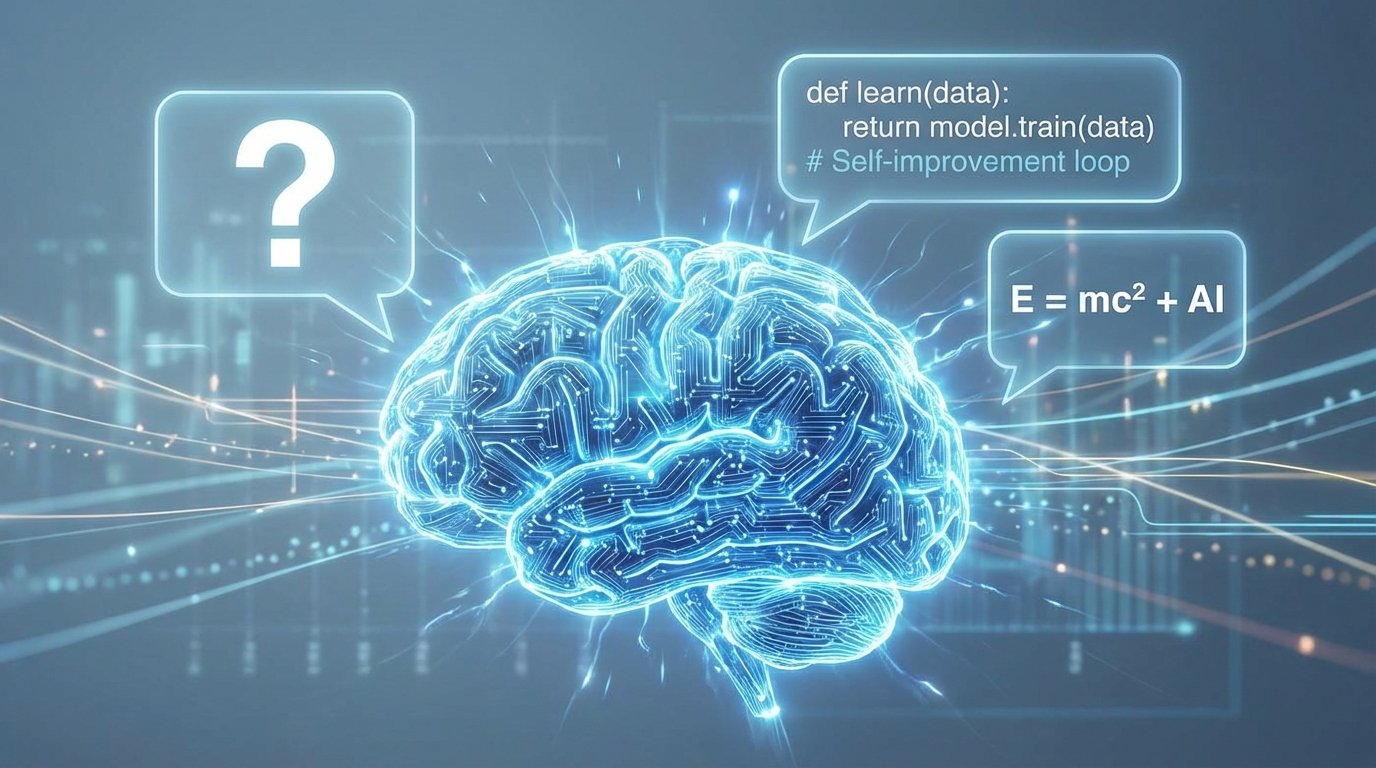
The Mechanics of AI Self-Questioning and Self-Play Learning
At its core, AI self questioning and self play learning represents a paradigm shift from traditional supervised learning. Instead of relying on vast, human curated datasets, this approach empowers an AI model to generate its own curriculum. The model essentially becomes both the student and the teacher, creating its own problems and then working to solve them. This creates a powerful, self contained loop for continuous improvement. The concept of self play gained widespread recognition with DeepMind’s AlphaGo, which mastered the game of Go by playing against itself millions of times. You can read more about it on the official DeepMind website: DeepMind’s AlphaGo Research.
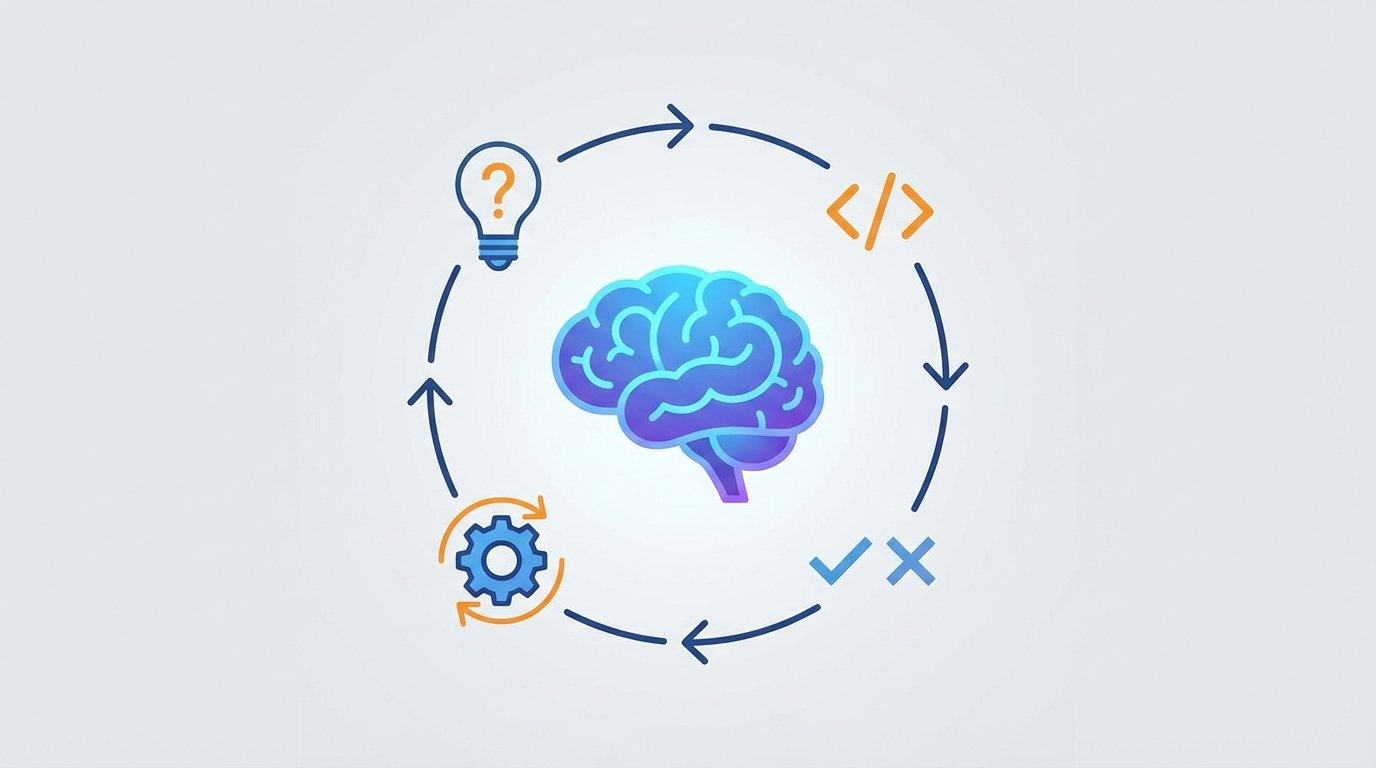
A leading example of this principle in action is the Absolute Zero Reasoner, or AZR. Developed by Andrew Zhao at Tsinghua University and Zilong Zheng at the Beijing Institute for General Artificial Intelligence, AZR uses a large language model to explore the domain of Python programming. The process is elegantly simple yet effective. The model first generates a coding problem that it deems challenging yet solvable. Then, the very same model attempts to write the Python code to solve that problem. The crucial final step is verification; the system runs the code to see if it works as intended. This provides a clear, undeniable feedback signal: success or failure.
This entire process is built on a few key pillars:
- Iterative Refinement: The model learns from every outcome. Successes reinforce correct pathways, while failures provide valuable data on what to avoid. This feedback refines both its problem generating and problem solving abilities over time.
- Adaptive Difficulty: A key insight from the AZR project is that the difficulty of the generated problems scales with the model’s growing power. As the AI becomes more capable, it poses more complex challenges for itself, ensuring it is always operating at the edge of its abilities.
- Automated Verification: The current strength of this approach lies in domains where answers can be easily and automatically checked. Running code, solving mathematical equations, or checking logical proofs are perfect examples. This removes the need for a human expert to constantly validate the model’s work.
This self directed loop of questioning, solving, and verifying allows an AI to build a deep, robust understanding of a subject area, potentially exceeding the knowledge contained in its initial training data.

From Theory to Tangible Results
The concept of AI self questioning and self play learning is rapidly moving from a theoretical curiosity to a proven method for enhancing model capabilities. The most compelling evidence comes from the Absolute Zero Reasoner project itself. When applied to the open source Qwen model, the results were remarkable. Both the 7 billion and 14 billion parameter versions of Qwen showed significant improvements in their coding and reasoning abilities after undergoing the self directed learning process. Most impressively, these models began to outperform counterparts that were trained on high quality, human curated datasets, suggesting that AI generated curricula can be more effective than human instruction in certain domains.
A key aspect of this success is the system’s ability to adapt. As one researcher noted, “The difficulty level grows as the model becomes more powerful.” This ensures the AI is perpetually challenged, fostering continuous and efficient growth. This dynamic is what leads some to believe this is a viable path toward greater machine intelligence. The ultimate goal is clear; as another expert stated, “Once we have that it’s kind of a way to reach superintelligence.”
The momentum is not limited to a single project. The idea is gaining widespread traction, with several major AI labs exploring similar paradigms. Collaborations between Salesforce, Stanford, and UNC have produced Agent0, a project focused on enabling AI agents to improve themselves through autonomous interaction with web and office software. Similarly, a joint paper from researchers at Meta, the University of Illinois, and Carnegie Mellon University explores self play for software engineering. Their work is described as “a first step toward training paradigms for superintelligent software agents.” You can explore their research in more detail in their paper available on arXiv.
To better visualize this burgeoning field, here is a comparison of these pioneering efforts:
| Project Name | Origin/Developers | Model Focus | Key Outcome/Goal |
|---|---|---|---|
| Absolute Zero Reasoner (AZR) | Tsinghua University, BIGAI | Python Coding and Reasoning | Significantly improved Qwen models, outperforming human data sets. |
| Agent0 | Salesforce, Stanford, UNC | General Agentic Tasks | Self improvement in web browsing and common computer tasks. |
| Self Play in Software Engineering | Meta, U of Illinois, Carnegie Mellon | Software Engineering Agents | Develop training for potentially superintelligent software agents. |
These advancements collectively signal a major shift in AI development, where the focus is moving from simply feeding models data to creating systems that can actively seek knowledge and master skills on their own.
| Project Name | Origin/Institution(s) | Model Focus | Key Innovations | Results | Future Directions |
|---|---|---|---|---|---|
| Absolute Zero Reasoner (AZR) | Tsinghua University, BIGAI | Python Coding & Mathematical Reasoning | Single LLM for problem generation and solving; automated code execution for verification. | Enhanced Qwen models (7B & 14B) beyond human-curated data performance. | Extend to complex agentic tasks with harder-to-verify outcomes (e.g., web navigation). |
| Agent0 | Salesforce, Stanford, UNC | General Agentic AI Tasks | Applies self-play to teach agents how to use software and web tools autonomously. | Demonstrates a framework for self-improving agents in practical computer tasks. | Developing robust methods to judge the correctness of an agent’s actions in open-ended tasks. |
| Self-Play for Software Engineering | Meta, U of Illinois, Carnegie Mellon | Superintelligent Software Agents | Theoretical framework for using self-play to train highly advanced software engineering agents. | Considered a foundational step toward training paradigms for superintelligence. | Building scalable training methods for AI that can design and improve complex software systems. |
The Dawn of Self-Taught AI
We are at a fascinating and pivotal moment in the evolution of artificial intelligence. AI self questioning and self play learning represents more than just a new algorithm; it is a fundamental shift toward true machine autonomy. As we have seen with projects like the Absolute Zero Reasoner, we are teaching machines to become the architects of their own intelligence. This approach, where an AI can generate its own curriculum and learn from its own successes and failures, opens a path that is not limited by the bounds of human curated data. The journey is still in its exploratory phase, but the cautious optimism is well founded. The potential for AI to transcend its initial training and solve problems in ways we have not yet imagined is now a tangible possibility, marking a significant step on the long road toward superintelligence.
While the research community pushes these theoretical boundaries, the application of advanced AI is already transforming industries. At EMP0, a US based leader in AI and sales and marketing automation, we are focused on harnessing this power to drive real world business growth. We specialize in deploying full stack, brand trained AI workers that operate securely within our clients’ own infrastructures. These sophisticated AI powered growth systems are designed to do more than just automate tasks; they are built to multiply revenue and create a decisive competitive edge.
To see how these principles can be applied to your business, we encourage you to explore the tools we have built. Discover how the EMP0 Content Engine can scale your brand’s voice, how the Marketing Funnel can optimize your customer acquisition, and how the Retargeting Bot can re engage your audience with precision. This is where the future of AI meets the practical needs of business today.
Follow our journey and explore our work:
Frequently Asked Questions (FAQs)
What exactly is AI self-questioning?
AI self questioning is a learning method where an artificial intelligence model generates its own problems or questions and then tries to solve them. Instead of being a passive recipient of information from human created datasets, the AI actively creates its own learning curriculum. This process allows the AI to explore a domain, identify areas of uncertainty or high potential for learning, and continuously challenge itself to improve its capabilities in a self directed manner.
How is this different from traditional AI training?
Traditional AI training, particularly supervised learning, relies on massive datasets labeled by humans. The model learns by finding patterns in this pre existing data. AI self questioning and self play learning fundamentally changes this dynamic. The AI is not limited by the scope or quality of human data. It can generate a virtually infinite amount of training examples for itself, tailored to its current skill level. This allows it to learn faster and potentially discover knowledge or solutions that were not present in any human provided dataset.
What is the role of ‘self-play’ in this process?
Self play is the mechanism through which the AI learns and refines its abilities. After the AI poses a question (e.g., a coding challenge), it then “plays” against itself by attempting to answer it. The outcome of this attempt, whether a success or a failure, provides a direct feedback signal. This is similar to how AlphaGo learned to master the game of Go by playing millions of games against itself. In the context of coding, the AI writes the code (the “play”) and then the system checks if it works (the “outcome”), using this feedback to improve for the next round.
What are the main limitations of current systems like AZR?
The primary limitation right now is the need for easy and automated verification. Systems like the Absolute Zero Reasoner (AZR) work so well for coding and math because the AI’s proposed solution can be checked automatically and objectively. You can run the code or solve the equation to see if it is correct. This becomes much harder for more complex, open ended tasks like judging the quality of a written essay, assessing a business strategy, or determining if a web browsing agent completed a task correctly. Developing reliable verification methods for these areas is a major ongoing challenge.
Does this mean AI can achieve superintelligence on its own?
While it is a significant step in that direction, achieving superintelligence is still a distant and complex goal. AI self questioning provides a powerful engine for self improvement that could, in theory, allow a model to surpass human knowledge in specific, verifiable domains. Researchers see it as a foundational “first step” toward training paradigms for superintelligent agents. However, extending this capability to general, real world reasoning and overcoming the verification problem are huge hurdles that need to be cleared before we can truly talk about autonomous superintelligence.