

AI Coding and Its Impact on Software Development
AI coding is rewriting how software gets made, and the change feels urgent. Developers now rely on AI coding tools to scaffold features, write tests, and refactor legacy code. However, this revolution brings both big promise and notable hazards.
On the one hand, AI can cut repetitive work, speed up prototyping, and reduce boilerplate. For example, large language models and autonomous agents can generate scaffolding, suggest APIs, and draft unit tests. On the other hand, these models can hallucinate, introduce subtle bugs, and hide technical debt. Therefore, teams must balance speed with scrutiny and embed strong testing, code review, and provenance checks.
This article takes an analytical and cautious tone. First, we examine productivity gains and real-world reports. Next, we analyze failure modes, security risks, and maintainability concerns. Finally, we offer practical guardrails for integrating AI responsibly. To engage visually, consider these suggestions:
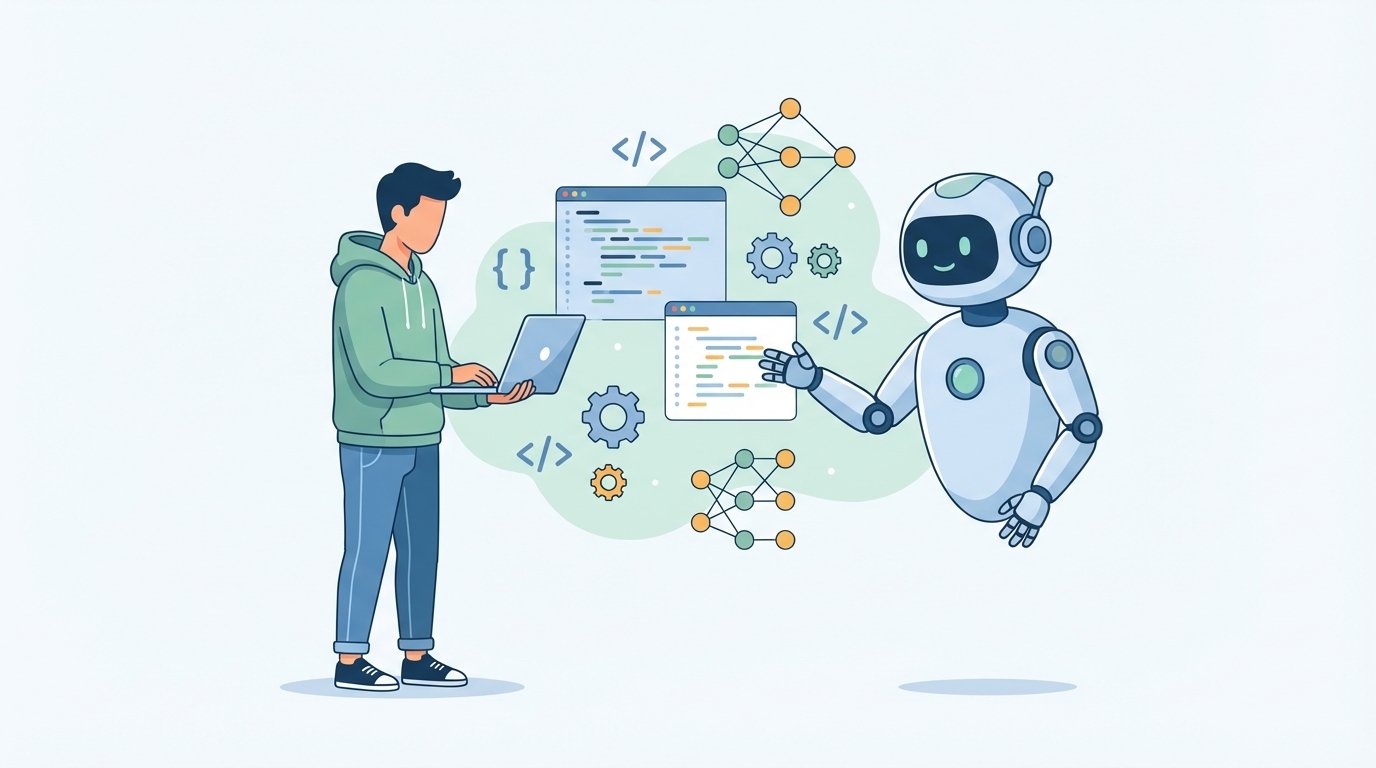
- Visual suggestion: a split-screen image showing a developer pairing with an AI assistant while reviewing code.
- Visual suggestion: an annotated mockup that highlights generated boilerplate and flagged issues.
- Visual suggestion: a simple flow diagram showing code generation, review, testing, and deployment.
As a result, you will get a balanced view of potential and pitfalls in AI coding.
AI coding adoption and real-world numbers
AI coding and AI coding tools have moved from experiment to daily workflow for many teams. For example, the Stack Overflow Developer Survey 2025 reports heavy adoption. See the survey at here and the summary at this blog post. Moreover, Coinbase reports dramatic task speedups for simple tasks. Read the Coinbase coverage at here.
Key statistics and takeaways
- 65 percent of developers now use AI coding tools at least weekly, according to industry summaries. This shows broad uptake.
- Coinbase reported speedups up to 90 percent for simple jobs, such as restructuring code and writing tests. See this article.
- Early benchmarks like SWE-bench improved quickly, with top models solving far more issues year over year.
Measured productivity gains and setbacks with large language models (LLMs)
Studies paint a mixed picture. For instance, METR found a perception gap. Experienced developers thought AI made them 20 percent faster. However, METR’s objective tests showed a 19 percent slowdown. Read the METR paper at here.
Bullet points of studies and observations
- METR: perceived 20 percent speedup, measured 19 percent slowdown. See the paper.
- Stack Overflow 2025: widespread adoption but falling trust. See the survey.
- Coinbase: big wins on simple refactors and test writing. See the blog post.
Quotes that capture the nuance
- “Some projects you get a 20x improvement in terms of speed or efficiency,” says James Liu.
- “AI has this overwhelming tendency to not understand what the existing conventions are within a repository,” says Bill Harding.
Why results vary across teams
First, task complexity matters. Simple, repetitive tasks gain the most from AI. Second, context depth matters. Large language models perform worse inside deep, idiosyncratic codebases. Third, developer workflow affects outcomes. Prompting and review time can offset raw generation speed. Therefore, organizations must measure actual outcomes, not just impressions.
Practical advice for teams adopting AI coding tools
- Instrument workflows and measure real productivity at the task level.
- Use robust test suites and automated checks; see our guidance at here.
- Maintain good test coverage for critical paths; see this resource for test-case strategies.
- Invest in developer training and personal resilience; read about the job market shifts at this article.
In sum, AI coding can deliver real gains for the right tasks. However, evidence shows mixed results. Thus, proceed with measurement, safety checks, and human oversight.
| Study Name | Productivity Change (%) | Code Quality Impact | Key Takeaways |
|---|---|---|---|
| Stack Overflow Developer Survey 2025 | Adoption: 65% weekly use; no single productivity percent | Adoption high; trust falling; quality effects mixed | See survey: Stack Overflow Developer Survey 2025 |
| METR (Early 2025 study) | -19% measured slowdown | Perceived gains but slower task completion; mixed defect profile | Full report: Early 2025 METR Study |
| Mike Judge six-week test (reported analysis) | Median -21% slowdown | AI introduced friction in familiar codebases | Read analysis: Mike Judge Test Analysis |
| Coinbase engineering summary | Up to +90% on simple tasks | Faster refactors and test generation; needs human review | Coverage: Coinbase Engineering Summary |
Caption: The evidence varies sharply. Simple, repetitive tasks often show large speedups. However, complex, context-rich work frequently slows developers down. Therefore measure real outcomes before widescale adoption.
Risks and challenges of AI-generated code
AI coding brings speed, but it also brings real risks. First, technical debt can grow quickly. AI often generates quick fixes and boilerplate. As a result, teams inherit code that hides design tradeoffs. Over time, this disposable code increases maintenance costs.
Code smells and maintainability
Generated code can introduce code smells. For example, duplicated logic and unclear abstractions appear often. Moreover, AI may prefer patterns that differ from a repo’s conventions. As Bill Harding warns, “AI has this overwhelming tendency to not understand what the existing conventions are within a repository.” Therefore, human review remains essential.
Data poisoning and security
AI models can learn malicious patterns. In fact, researchers show a few hundred poisoned documents can add back doors. Consequently, organizations must treat training data as an attack surface. They should harden ingestion pipelines and audit models regularly.
Context limits and hallucinations
Large language models struggle with deep, project-specific context. Thus they hallucinate behavior or APIs. Because of that, subtle bugs slip into production. As James Liu puts it, “Some projects you get a 20x improvement in terms of speed or efficiency. On other things, it just falls flat on its face.” This quote highlights uneven outcomes.
Key actionable precautions
- Enforce strict code review and provenance tracking
- Run comprehensive tests and smoke pipelines early
- Treat generated code as draft rather than final
- Monitor for unusual dependencies and secrets
In short, AI coding offers gains. However, it also creates maintainability, security, and correctness risks. Therefore teams must pair AI with strong engineering guardrails.
CONCLUSION
AI coding promises faster iteration and less boilerplate. However, it also raises real questions about safety and maintainability. For teams, the choice is not binary. Therefore, organizations must pair tools with tests, reviews, and provenance tracking.
On the positive side, AI coding tools and large language models (LLMs) can speed simple tasks. For example, they automate refactors, scaffold APIs, and draft tests. As a result, teams can shift focus toward higher-value work. Yet, studies show mixed outcomes. Some tasks see large wins. Meanwhile, complex projects often need more human oversight.
EMP0, Employee Number Zero, LLC, positions itself as a pragmatic partner in this transition. EMP0 provides a full-stack brand-trained AI worker. In addition, it offers ready-made AI and automation tools that help businesses multiply revenue. Core products include prebuilt automation templates, brand-trained agents, and connector libraries for common APIs. Moreover, EMP0 emphasizes secure deployment. Its approach uses isolated deployment pipelines, access controls, and audit logging to reduce risk.
Looking forward, AI coding will keep evolving. Consequently, success depends on careful measurement, strong guardrails, and human judgment. For now, adopt AI cautiously, measure impact, and prioritize long-term code health.
Frequently Asked Questions (FAQs)
Does AI coding actually improve developer productivity?
Short answer: sometimes. Studies show wide variance. For simple, repetitive tasks AI coding tools often speed work. However, measured tests find slowdowns on complex tasks. Therefore, teams must measure real outcomes on representative tasks.
What are the main risks of AI-generated code?
Technical debt, code smells, and disposable code are common. Models can hallucinate or ignore repo conventions. Moreover, data-poisoning attacks can implant back doors. As a result, always review generated code and track provenance.
How steep is the learning curve for adopting AI coding tools?
Expect a short learning phase for prompts, integrations, and review practices. Initially, productivity may drop because review and verification take time. However, with templates and training, teams often recover and then scale benefits.
Are AI coding tools safe for production?
They can be safe when paired with controls. Use isolated deployments, strict access controls, audit logs, and continuous testing. Also scan outputs for secrets and risky dependencies to reduce supply chain risk.
Will AI coding replace developers?
Not imminently. AI automates routine work but struggles with deep context and architecture. Hence human judgment remains essential. Over time roles will shift toward oversight, design, and high-value problem solving.