
Autonomous vehicles are reshaping how people and goods move across cities and highways. Interest and investment in self-driving tech have surged worldwide. However, high-profile tests, regulation changes, and safety incidents have raised new questions. This introduction sets up an exploration of their impact, core technology, and future paths. Stakeholders from startups to regulators care deeply.
Today companies test robotaxis, driverless trucks, and electric air taxis at scale. Researchers push perception, planning, and simulation faster than before because demand rises. Meanwhile regulators update rules, and agencies investigate reported failures and near misses. Therefore the race now mixes innovation with caution and scrutiny.
In this article we examine autonomy’s technical building blocks, market deals, and policy debates. We analyze business moves from Waymo, Uber, Tesla, and newer startups across multiple sectors. We assess safety records, regulatory shifts, and real-world deployments with critical perspective. Throughout we balance optimism with clear attention to safety, equity, and societal impacts. Read on to understand realistic timelines, commercial bottlenecks, and what comes next.
Core technologies behind autonomous vehicles
Autonomous vehicles combine sensors, AI, and software to perceive and act in the world. They replace human driving with automated perception, planning, and control. Moreover they rely on vast datasets and continuous learning to improve safety.
Key components
- Sensors and hardware
- Lidar for precise 3D mapping and range detection
- Cameras for color, object recognition, and lane reading
- Radar for robust velocity and distance sensing in poor weather
- Ultrasonic sensors for short-range parking and obstacle detection
- GPS and inertial measurement units for localization and dead reckoning
- Perception and computer vision
- Machine learning models detect objects and predict motion
- Computer vision extracts lanes, signs, and traffic lights
- Sensor fusion merges data for a consistent scene view
- Decision making and planning
- Path planning computes safe trajectories
- Behavior prediction anticipates other road users
- Control converts plans into steering, throttle, and brake commands
- Simulation, validation, and safety
- Virtual testing scales scenarios quickly
- Real-world shadow testing collects edge-case data
- Standards guide development, for example SAE levels: SAE levels.
For AI researchers and engineers, learning frameworks matter. See approaches that teach physics from video at Intuitive Physics because they improve scene understanding. Also read how AI reshapes coding and autonomous systems at AI Evolving Work.
Hardware and power efficiency remain critical. For analysis of chiplets and power tradeoffs see Power Chiplets AI Funding.
Visual aid suggestions
- Simple top view diagram showing lidar, camera, and radar placement on a vehicle
- Flowchart that links sensor input to perception, planning, and actuation
- Bar illustration comparing range and resolution of each sensor type
External references
Autonomous vehicles levels at a glance
This table clarifies autonomy levels from 0 to 5. It highlights driver role, sensors, and situational awareness. Use it to compare capabilities and examples quickly.
| Level | Driver involvement | Sensor capabilities | Situational awareness | Typical features and examples |
|---|---|---|---|---|
| Level 0 | Full driver control. No sustained automation. | Basic sensors only; standard cameras, speedometer, ABS. | Driver has full situational awareness. | Manual driving; driver monitors environment. |
| Level 1 | Driver assistance active; driver monitors constantly. | Single automated function: adaptive cruise or lane assist; camera or radar. | Limited awareness for assisted task only. | Adaptive cruise control; lane keep assist. |
| Level 2 | Partial automation; driver must supervise continuously. | Multiple sensors: cameras, radar; sometimes lidar. | Vehicle handles steering and speed in simple conditions. Driver intervenes as needed. | Tesla Autopilot (supervised); combined lane and speed control. |
| Level 3 | Conditional automation; system handles driving in defined scenarios. | High sensor suite: cameras, radar, lidar, precise localization. | System monitors environment but expects handover requests. Driver must be ready to take control. | Limited highway autopilot in controlled conditions; pilot deployments. |
| Level 4 | High automation in geofenced or specific conditions. | Robust sensor fusion; redundant compute and sensing. | Vehicle achieves full situational awareness within its operational design domain. Human not required during operation. | Robotaxis in mapped urban zones; shuttle services. |
| Level 5 | Full automation everywhere and in all conditions. | Complete, highly redundant sensors and communications. | Vehicle maintains full situational awareness universally. No human driver required. | Theoretical goal; no mass deployments yet. |
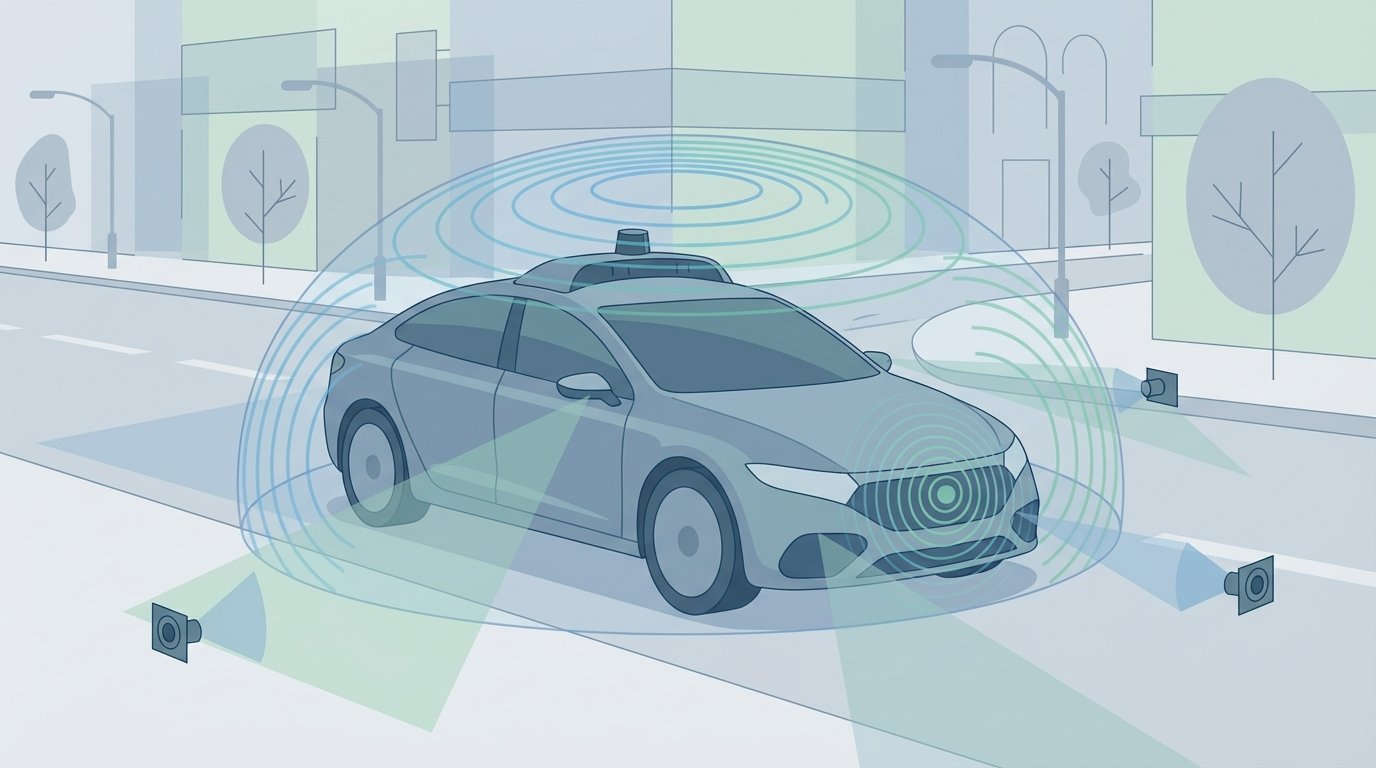
Concept illustration of a driverless car surrounded by sensor waves to visualize lidar, radar, and camera coverage.
Benefits of autonomous vehicles
Autonomous vehicles promise safety improvements, efficiency gains, and new services. For passengers and freight, automation could reduce human errors that cause most crashes. For example, proponents argue that robotaxis and automated trucks will lower injury rates over time. Additionally, automation supports new business models. Investors are backing startups and hardware makers. Heven AeroTech raised $100 million in a Series B, valuing the company at over $1 billion. Beta Technologies reported third-quarter revenue of $8.9 million while scaling partnerships with Eve Air Mobility. Therefore markets show clear commercial interest.
Key benefits
- Safety potential because machines can react faster and avoid fatigue. However systems must be validated extensively.
- Cost reductions in logistics through 24/7 operations and lower labor costs.
- Increased accessibility for nondrivers and older adults.
- Reduced congestion and emissions if fleets optimize routes and vehicle loads.
- New mobility services like robotaxis and last-mile delivery.
Challenges for autonomous vehicles
Deployment faces technology, policy, and social barriers. Many edge cases and rare events still trouble perception systems. Moreover regulators ask hard questions about accountability and safety. The U.S. National Highway Traffic Safety Administration has opened a probe and requested information on reports of robotaxis passing stopped school buses. See the agency letter: NHTSA Agency Letter.
Major challenges
- Safety validation at scale because rare events are hard to test.
- Regulatory uncertainty across states and countries.
- Public trust after incidents involving robotaxis and school buses. Therefore uptake may slow.
- High development and hardware costs, including redundant sensors and compute.
- Cybersecurity and privacy risks from connected fleets.
- Workforce impacts for drivers and related professions.
Industry voices vary. Polls show many expect a tipping point before the end of the decade. As a result stakeholders must balance rapid innovation with cautious oversight.
Autonomous vehicles promise safer roads, lower logistics costs, and new mobility services. However, real-world incidents, regulatory probes, and edge-case failures show hard work remains. Therefore balanced progress and rigorous validation must guide deployment.
EMP0 helps companies convert AI research into production systems for autonomy and logistics. They design AI-powered growth systems that deploy securely under client infrastructure and protect data. To learn more, visit EMP0 Website and read the EMP0 Blog. Also explore practical automation workflows at N8N Automation Workflows.
Business leaders should test responsibly, partner across sectors, and measure outcomes. As a result, teams can unlock new revenue and safer transportation networks. Start the conversation with EMP0 to design scalable, secure AI systems that multiply revenue and accelerate technology-driven growth.
Frequently Asked Questions (FAQs)
What are autonomous vehicles?
Autonomous vehicles are cars, trucks, or drones that drive themselves using sensors, AI, and software. They combine lidar, cameras, radar, GPS, and machine learning to perceive, plan, and act. As a result they can perform driving tasks without constant human control in defined conditions.
Are autonomous vehicles safe?
Safety varies by system and deployment. Companies like Waymo and pilot robotaxi services report progress. However regulators investigate incidents, including robotaxis passing stopped school buses. Therefore robust testing and validation remain essential.
When will robotaxis reach mass adoption?
Predictions vary. In a recent poll, 47.2 percent expected robotaxis before the decade ends, while others said the 2030s. Adoption depends on tech, regulation, and public trust.
How will autonomous vehicles affect jobs and logistics?
Automation may reduce driver roles but create jobs in support, maintenance, and AI operations. Consequently businesses may cut delivery costs and run services around the clock. Businesses must plan reskilling and transition assistance.