

AI-generated content and safety risks in online spaces: The new trust crisis
AI-generated content and safety risks in online spaces are changing how we trust online communities. Because AI can mass-produce posts, comments, and images, noise now drowns out real human voices. As a result, users and moderators face new safety risks and tough choices.
This article maps those safety risks and explains why they matter. First, we look at how AI content spreads disinformation and harassment. Then we explore harms like nonconsensual imagery and manipulated posts.
We also examine the limits of detection tools and moderation systems. However, technology and policy often lag behind attackers. Therefore, platforms and communities must adapt faster.
You will read real examples from platforms like Reddit and tech responses. We will highlight practical steps for safer communities. Finally, we propose actions for readers, moderators, and product teams.
Keep reading to learn how AI-generated content and safety risks in online spaces change trust and safety. Then decide how to act in your community.
Misinformation and manipulation: AI-generated content and safety risks in online spaces
AI tools can flood forums and feeds with plausible-sounding falsehoods. Because AI scales content production, disinformation can spread faster than fact-checks can respond.
Key forms of risk
- Misinformation and fake news that mimic human tone and authority.
- Astroturfing and coordinated inauthentic behavior to sway opinion.
- Propaganda targeted through microsegmentation and persona modeling.
- Spam, low-value content, and vote manipulation that distort visibility and trust.
Evidence shows platforms already remove millions of manipulated posts. For example, Reddit reported over 40 million spam and manipulated content removals in H1 2025: Reddit Transparency Report H1 2025. However, detection remains imperfect, as research shows detectors can be evaded: Research on Detector Evasion. Therefore, misinformation will likely persist unless systems improve.
Privacy, exploitation and harm: AI-generated content and safety risks in online spaces
AI also amplifies personal harm and privacy breaches. As a result, victims face new forms of abuse and exposure.
Major threats
- Nonconsensual imagery and deepfake abuse that violate privacy.
- Child sexual abuse material and exploitation risks amplified by synthetic media; see US National Center for Missing and Exploited Children.
- Personal data scraping and deanonymization used to craft targeted scams.
- Harassment, doxxing, and coordinated attacks using AI-generated personas.
Detection and policy lag behind these harms. Moreover, academic reviews argue the problem needs interdisciplinary fixes: Interdisciplinary Solutions to AI Issues.
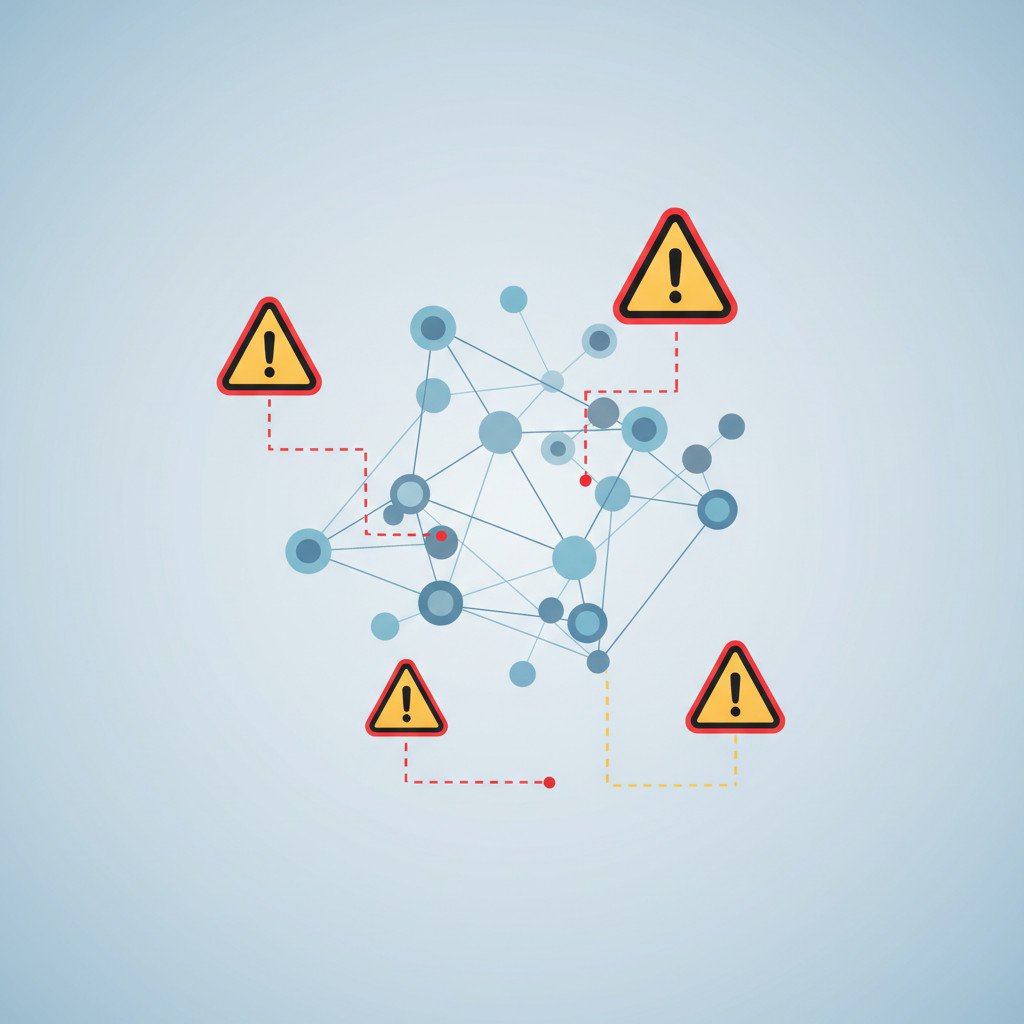
Illustrative image idea
- An abstract AI neural network with cool blue nodes and red warning triangles.
- The image should be minimalist and avoid text, conveying risk and caution around AI systems.
Related keywords: AI-generated content, AI disinformation, AI image generation, AI detection, astroturfing, nonconsensual imagery, moderation.
Safety Risks and Mitigation Strategies
| Safety risk | Typical impact | Mitigation strategies |
|---|---|---|
| Misinformation | False beliefs and eroded trust | Proactive moderation; fact checking; provenance labels; rate limits |
| Bias and discriminatory content | Harm to marginalized users and skewed recommendations | Dataset audits; fairness testing; human review; feedback loops |
| Privacy breaches and data scraping | Doxxing and targeted scams | API limits; data minimization; consent controls; encryption |
| Harmful and violent content | Harassment and incitement; platform risk | Content filters; trained human moderators; clear policies; rapid takedown |
| Nonconsensual imagery and deepfakes | Reputational damage and trauma | Image hashing; reporting workflows; NCMEC collaboration; take-down tech |
| Astroturfing and coordinated inauthentic behavior | Distorted public discourse | Bot detection; account verification; cross-platform signal sharing; transparency reports |
| Spam and low-quality content | User fatigue and reduced signal | Throttling; quality thresholds; community moderation tools; incentive changes |
Evidence and real-world cases: AI-generated content and safety risks in online spaces
Platforms and researchers now document clear harms linked to AI content. For example, Reddit reported over 40 million spam and manipulated removals in the first half of 2025. You can read the transparency report here: transparency report. Because volume matters, moderation teams struggle to keep up.
Journalists and moderators have also raised alarms. A Cornell piece details how moderators call AI content a triple threat to community quality and governance. See the Cornell article at Cornell article. As a result, many volunteer moderators report burnout and growing distrust.
Legal and enforcement actions show the severity of harms. For instance, authorities sentenced a man for producing and distributing AI-generated child sexual abuse images. The Department of Justice documented that case at DOJ case documentation. Moreover, governments have moved to criminalize nonconsensual deepfakes. Time covered the Take It Down Act and related debates: Time article.
Academic research highlights technical fragility. Studies show detection tools can be bypassed through simple paraphrasing or back-translation. See one such paper at academic paper. Therefore, detection alone will not solve the problem.
Investigations also link AI to coordinated misinformation campaigns. News outlets and research teams documented AI or AI-assisted tactics used to fake personas and sway discussion. For example, AP reported legal actions and disputes over scraping and consent in 2025: AP report.
Taken together, these cases and studies show why safety measures matter. They also prove that technical, legal, and community responses must work together.
Conclusion: Safety first for AI-generated content and safer online spaces
AI-generated content has reshaped online conversations and raised real safety concerns. Misinformation, privacy breaches, deepfakes, and coordinated inauthentic behavior erode trust. Because these harms scale quickly, platforms and communities face urgent challenges.
Robust safety measures must combine technical, policy, and human responses. For example, content moderation, provenance signals, privacy controls, and audits help. However, detection tools alone will not suffice. Therefore, designers, moderators, and regulators must collaborate closely. Start by auditing models, training moderators, and setting clear policies.
EMP0 builds secure AI and automation solutions that prioritize safety. They focus on brand-safe AI-powered growth systems and governance tooling. EMP0 combines privacy engineering, auditing, and automation to reduce risk. Learn more at their site EMP0 and at their blog EMP0 Blog. Also see workflows and integrations at n8n Integrations.
In short, safety is achievable when stakeholders act proactively. With clear rules and resilient tools, online spaces can regain trust. Optimism matters because technology can improve safety when guided by good design. Finally, stay informed and help build safer communities.
Frequently Asked Questions (FAQs)
What is AI-generated content and why is it risky?
AI-generated content includes text, images, and audio made by models. Because it scales quickly, it creates risks like:
- Misinformation and propaganda
- Nonconsensual imagery and deepfakes
- Privacy breaches and targeted scams
- Astroturfing and spam
Therefore, the risk is both volume and plausibility.
How can platforms detect AI-generated content?
Platforms use automated detectors, metadata checks, and human review. However, detectors can be evaded. As a result, provenance signals and rate limits help. Human moderators still play a key role.
What can users do to protect themselves?
– Verify sources and cross-check facts
– Limit sharing of private data and images
– Report suspicious accounts and content
– Use strong passwords and privacy settings
These steps reduce exposure and harm.
How should community moderators respond?
Set clear rules and enforce them consistently. Use layered tools: filters, audits, and human review. Also train moderators and publish transparency reports.
Will regulation solve the problem?
Regulation helps, but it will not fix everything. Instead combine regulation, technology, and community action. In short, coordinated effort makes online spaces safer.