
Introduction
Agentic automation and orchestration with UiPath Maestro (UiPath 2025.10) is transforming how enterprises design and run intelligent processes. It combines coordinated AI agents, human workflows, and traditional robots under one orchestration plane. Because teams now mix multiple agent types, orchestration and governance matter more than ever. As a result, organizations can cut cycle times, reduce errors, and scale decision driven work across departments.
Why this release matters
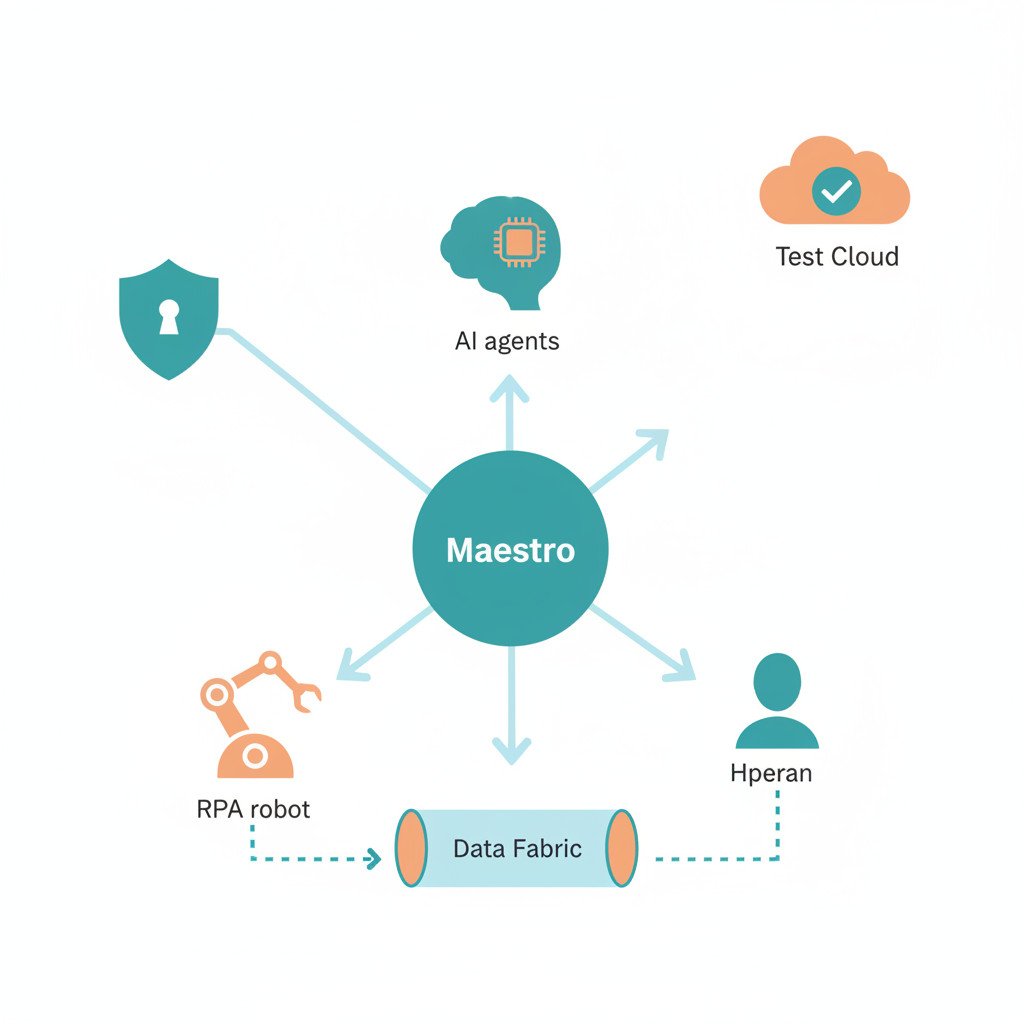
- Unified orchestration that coordinates AI agents, RPA robots, and human tasks
- Studio Web templates and collaborative development for faster iteration
- IXP and Data Fabric to unify live process data across systems
- Test Cloud and Agent Builder to improve agentic testing and reliability
Maestro’s 2025.10 adds practical tooling for enterprise scale. Moreover, it emphasizes iterative process design, model integration, and developer collaboration. It gives product teams prebuilt templates and governance controls so processes stay compliant. Now leaders can choose the right agent for each challenge and measure outcomes in real time. Read on to explore governance patterns, design templates, and implementation best practices.
Key features: Agentic automation and orchestration with UiPath Maestro (UiPath 2025.10)
UiPath Maestro 2025.10 brings a unified orchestration plane for mixed agent landscapes. Because organizations now run AI agents, RPA robots, and human tasks together, Maestro centralizes control, visibility, and policy enforcement. For an official overview see UiPath Agentic Orchestration.
Core innovations and how they improve workflows
-
Unified orchestration and process apps
- Maestro coordinates AI agents, robots, and people from a single canvas. As a result, teams reduce handoff delays and simplify end to end flow control. For release specifics see the 2025.10 notes at UiPath Blog on 2025.10 Updates.
-
Studio Web templates and collaborative development
- Developers and business users can prototype in Studio Web. Moreover, prebuilt BPMN templates accelerate delivery. For example, a finance team can deploy a Copilot agent template for monthly reporting in days rather than weeks.
-
Data Fabric and IXP integration
- Now in preview, Data Fabric unifies live process data across systems. Therefore, agents access trusted inputs and reduce model drift. Learn more on the release hub at UiPath Release Hub.
-
Test Cloud and Agent Builder for reliability
- Test Cloud automates agentic testing at scale, while Agent Builder helps testers author robust scenarios. As a result, organizations catch regressions before production runs.
-
Governance, RBAC, and observability
- Maestro includes role based access controls and audit trails. Consequently, security teams enforce compliance without blocking innovation.
These features combine to make automation more resilient, explainable, and scalable. As a result, businesses gain faster time to value and clearer operational metrics.
Quick comparison of major Maestro releases
Because release cadence accelerated, features now land faster. As a result, teams get more orchestration power and governance controls. The table below highlights key differences and real gains in 2025.10.
| Version | Key features | Performance improvements | Usability enhancements | Orchestration capabilities |
|---|---|---|---|---|
| Maestro 2022.4 | Basic orchestration and robot scheduling. Limited agent hooks. Primarily RPA centric. | Baseline throughput for scheduled robots. Moderate latency under load. | Classic Studio experience. Limited templates and collaboration. | Single domain orchestration focused on RPA jobs and queues. Manual integrations required. |
| Maestro 2023.6 | Added connectors and initial AI agent integrations. Improved logging. | Faster job dispatch and reduced queue wait times. Better telemetry. | Enhanced dashboards and role views. Still desktop centric for many teams. | Simple multi system flows. Basic handoffs between humans and bots. |
| Maestro 2024.5 | Process Apps and Studio Web preview. Case management added. | Elastic scaling for peak loads. Lower end to end latency. | Collaborative editing in Studio Web preview. Expanded template library. | Case oriented routing and conditional flows. Improved visibility across steps. |
| Maestro 2025.1 | Autopilot and broader agent marketplace. Model context introduced. | Improved autoscaling and observability. Reduced failure rates. | More developer tooling and initial agent templates. Faster prototyping. | Model aware routing and agent selection for simple workflows. |
| Maestro 2025.10 | Data Fabric, IXP for live data, Test Cloud, Agent Builder, Studio Web templates. | Unified data reduces model drift and latency. Agentic testing prevents regressions. Higher throughput and reliability. | Collaborative Studio Web with 30 plus BPMN templates. Iterative design and faster time to value. | Unified orchestration of AI agents, RPA robots, and human tasks. RBAC, audit trails, and live process observability enable enterprise scale. |
For more technical details see the UiPath release hub at UiPath Release Hub.
Use cases and orchestration benefits with UiPath Maestro
Agentic automation delivers fast wins across industries because it pairs AI models, robots, and people. Maestro orchestrates these agents end to end. As a result, teams reduce manual handoffs and speed decisions.
Common enterprise use cases
-
Finance and accounting
- Automate close and reporting by combining a Copilot agent for narrative, RPA bots for ledger updates, and humans for approvals. Moreover, Studio Web templates speed deployment and lower implementation time.
-
Supply chain and operations
- Coordinate demand forecasts with a Vertex model, order fulfillment robots, and case management for exceptions. Therefore, Maestro lowers stockouts and reduces expedited shipping costs.
-
Customer service
- Route incoming inquiries to AI summarizers, intelligent bots, or agents based on complexity. As a result, first contact resolution improves while agent workload drops.
-
Healthcare and claims processing
- Triage records with AI extractors, assign human review for edge cases, and audit with RBAC controls. Consequently, compliance improves and claim cycles shorten.
-
IT and security orchestration
- Trigger automated remediation bots, consult a model for threat triage, and log every action for audits. This increases mean time to resolution and strengthens governance.
Why orchestration matters
- Centralized coordination reduces duplicated work and inconsistent data. For example, Data Fabric unifies live inputs across systems to prevent model drift. Learn more.
- Automated testing and reliability cut rollback risk because Test Cloud finds regressions before production. Integrating models such as Google Vertex helps teams use the right agent for each task: Learn more.
- Unified data platforms like Snowflake accelerate insights and feed trusted signals into agents: Learn more.
Each scenario pairs Maestro’s orchestration with data and governance. Therefore, businesses gain scale, traceability, and measurable ROI.
Conclusion
Agentic automation and orchestration with UiPath Maestro (UiPath 2025.10) delivers a unified way to coordinate AI agents, robots, and people. It raises reliability and speed while preserving governance. With Data Fabric, Test Cloud, and Studio Web templates, teams iterate faster and reduce model drift. Moreover, Maestro offers RBAC, audit trails, and observability to meet enterprise requirements. For these reasons, organizations gain measurable ROI through reduced cycle times and fewer errors.
EMP0 is a US based company specializing in AI and automation solutions. They focus on sales and marketing automation. They help clients multiply revenue with AI powered growth systems deployed securely. Also, EMP0 brings hands on experience building agentic automation and operationalizing orchestration at scale.
Explore EMP0’s approach on their website EMP0’s Website. Read their blog at EMP0’s Blog or check the creator profile at Creator Profile.
In summary, combine Maestro’s orchestration with proven partners like EMP0 to accelerate adoption. Therefore, you can turn pilot projects into production impact quickly.
Frequently Asked Questions (FAQs)
What is agentic automation and orchestration with UiPath Maestro (UiPath 2025.10)?
Agentic automation pairs AI driven agents, RPA robots, and human tasks into one coordinated flow. Maestro orchestrates these agents so each executes its role where it adds the most value. As a result, processes become faster, more resilient, and easier to govern.
What new capabilities does Maestro 2025.10 deliver for enterprises?
Maestro 2025.10 introduces Data Fabric, IXP for live data, Test Cloud, Agent Builder, and expanded Studio Web templates. Together, these features reduce model drift, improve reliability, and speed delivery. For full release details see UiPath Release Hub.
How does Maestro integrate external AI models and data platforms?
Maestro supports model connectors and a Model Context Protocol to call external AI services. For example, teams can route tasks to Google Vertex models for predictions. Moreover, Data Fabric and connectors make Snowflake and similar platforms first class data sources. See Google Vertex AI and Snowflake for example integrations.
What governance and security controls does Maestro provide?
Maestro includes role based access controls, audit trails, and live observability. Therefore, security teams can enforce policies and trace every agent decision. In addition, Test Cloud and Agent Builder help validate agent behavior before production runs.
How should organizations start adoption and measure ROI?
Begin with a focused pilot that uses a Studio Web template to reduce setup time. Next, instrument processes with observability and use Test Cloud to verify reliability. Finally, measure cycle time, error reduction, and throughput increases to calculate ROI. For many teams, combining Maestro’s templates with a proven implementation partner accelerates time to value.