

AI’s evolving role in work, coding, and autonomous systems: a fast-moving reality
AI’s evolving role in work, coding, and autonomous systems is rewriting job rules. Because models now speed up engineering tasks, teams can deliver faster and iterate more. However, those gains come with real risks. Engineers report delegating substantial work to tools like Claude, and industry reports warn of skill atrophy and altered collaboration.
This surge matters because it affects both productivity and people. Anthropic and McKinsey studies show wide adoption and mixed sentiment. Dario Amodei’s bold prediction that AI could write all code within a year highlights the pace. Therefore, planners must weigh short-term wins against long-term impacts like job shifts and security gaps.
In this article we unpack evidence from recent studies, industry moves, and real product launches. We examine productivity gains, code-generation outcomes, and the rise of autonomous agents. As a result, you will get a clear view of opportunities, pitfalls, and practical steps teams can take now.
AI’s evolving role in work, coding, and autonomous systems
AI is changing how businesses run daily. Because models now assist with tasks, teams move faster and ship more features. However, that speed brings tradeoffs for skill development and team dynamics.
Key workplace use cases
- Code generation and review. For example, Claude Code can draft functions and fix bugs, freeing engineers for design work. See Anthropic research for internal findings.
- Autonomous agents for ops. Tools like AWS frontier agents can run long jobs and scan for vulnerabilities. As a result, DevOps can automate routine incident responses: AWS frontier agents.
- Knowledge work augmentation. AI drafts briefs, summarizes meetings, and prepares reports. Therefore teams save hours per week and iterate faster.
Benefits for employers and employees
- Productivity gains: teams complete tasks faster and reduce repetitive work. Moreover, product cycles shorten and release cadence increases.
- Cost and focus: firms reallocate human time to strategy and product thinking. However, employers must manage reskilling and oversight.
- Risk reduction in some areas: security agents can catch common vulnerabilities early. Yet, overreliance can cause skill atrophy and fewer mentorship moments.
Implications and recommendations
- Monitor delegation limits. For instance, Anthropic reports engineers delegated up to twenty percent of tasks to Claude.
- Invest in continuous training and code review policies to prevent complacency.
- Balance automation with human checks to manage accuracy, security, and job transitions.
Related reading: AI’s Self-Improvement Revolution OpenAI research overview Risks for startups using AI coding platforms
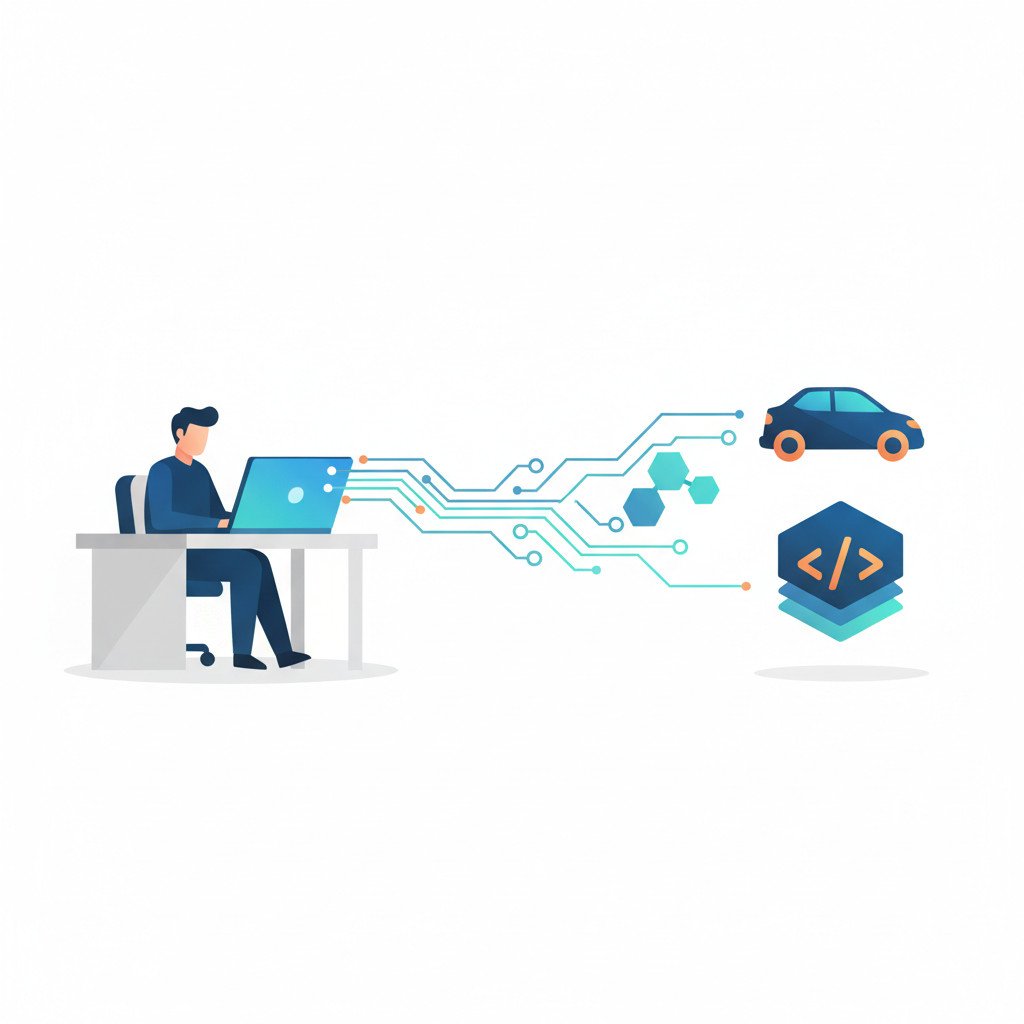
AI’s evolving role in work, coding, and autonomous systems: coding and autonomous systems in practice
AI now embeds itself in developer workflows and autonomous stacks. Engineers use models for synthesis, testing, and system orchestration. However, that integration changes verification, safety, and team roles.
Technical use cases and examples
- Code generation and synthesis. Models draft functions, refactor code, and suggest unit tests. For example, Anthropic’s Claude Code assists engineers with bug fixes and feature scaffolding. See Anthropic’s research.
- Automated code review and security scanning. Agents flag insecure patterns and propose fixes. AWS frontier agents and the AWS Security Agent run long audits and vulnerability checks: Learn more.
- Continuous integration and test generation. AI creates regression tests, simulates edge cases, and improves coverage. Therefore release confidence can rise while manual test effort falls.
- Simulation and real-world validation for autonomy. Waymo uses large-scale simulation and safety analysis to compare crash rates with human drivers. Learn more.
Implications for engineering and operations
- Faster iteration but greater reliance. Teams ship more quickly, yet they must validate AI outputs.
- New roles and skills. As a result, teams need AI-literate reviewers and safety engineers.
- Data and distribution shifts. Models can degrade, so monitoring and retraining matter.
Practical recommendations
- Enforce human-in-the-loop checks for critical systems.
- Track delegation levels; Anthropic found engineers delegated up to twenty percent of tasks to Claude.
- Invest in MLOps, test generation, and security automation to balance speed with safety.
| Impact Area | Description | Benefits | Challenges |
|---|---|---|---|
| Work and workflows | AI automates routine tasks and augments decision-making. It summarizes meetings and drafts briefs. Therefore teams spend less time on repetitive work. | Productivity gains and faster iteration. More time for strategy and product thinking. Reduced admin overhead. | Skill atrophy and fewer mentorship moments. Cybersecurity and accuracy concerns. Potential workforce displacement. |
| Coding and software development | Models generate code, suggest tests, and run automated reviews. For example, Claude Code drafts functions and fixes bugs. As a result, engineers shift toward design and validation. | Faster prototyping and higher test coverage. Reduced bug triage and improved release cadence. Greater developer productivity. | Overreliance on generated code. Hallucinations and brittle outputs. Need for strict human-in-the-loop reviews and MLOps. |
| Autonomous systems and agents | Long running agents and autonomy manage operations without constant input. Examples include Kiro and driverless fleets. They use simulation and real-world telemetry. | 24/7 operations and faster incident response. Better detection of edge cases via simulation. Lower routine human load. | Safety verification and regulatory risk. Behavior shifts in autonomous vehicles. Distribution shifts require continuous retraining. |
| Security, compliance and culture | AI tools scan codebases and enforce policies. They change how teams ask questions and share knowledge. | Early vulnerability detection and automated policy checks. Faster compliance workflows. | False positives, governance gaps, and reduced human oversight. Cultural shifts that reduce mentorship and collaboration. |
| Data governance & compliance | • Focus on AI governance, data lineage, and policy enforcement. • Enables audit trails for models and datasets, improving traceability and accountability. | • Stronger compliance with regulations and internal policies. • Improved data security and privacy controls. • Better risk management and auditability. | • Cross-team coordination and process changes. • Implementing data security and access controls can be costly. • Maintaining provenance and explainability is challenging. |
| MLOps integration | • Integrates model deployment, monitoring, and observability into engineering pipelines. • Automates retraining, versioning, and CI/CD for models. | • Faster model rollout and reliable production behavior. • Improved observability and reduced downtime. • Easier scaling and reproducible workflows. | • Tooling complexity and higher operational costs. • Requires new skills in observability and MLOps. • Risks from model drift and insufficient monitoring if not well instrumented. |
Conclusion: what AI’s evolving role in work, coding, and autonomous systems means now
AI is accelerating productivity while reshaping skills, roles, and safety practices. Teams gain speed through code generation, automated reviews, and long running agents. However, firms must manage risks like skill atrophy, hallucinations, and security gaps. Therefore leaders should enforce human-in-the-loop checks, invest in MLOps and reskilling, and treat AI as a partner rather than a replacement.
Employee Number Zero, LLC (EMP0) helps businesses adopt AI responsibly and grow revenue. EMP0 builds AI powered growth systems, including Content Engine, Marketing Funnel, Sales Automation, and proprietary AI tools. Their platforms combine automation with governance to protect accuracy and security. As a result, clients multiply revenue while reducing operational risk.
Learn more about EMP0 and their resources at EMP0 and the EMP0 blog. Explore automation workflows on n8n.
Frequently Asked Questions (FAQs)
Will AI replace human jobs?
AI will change many roles, but not eliminate human work entirely. Because AI automates routine tasks, employees will shift toward oversight, design, and complex problem solving. However, some repetitive positions may shrink quickly. Therefore organizations must plan reskilling programs and clear career paths. Moreover, leadership should measure human value beyond task completion.
How accurate are AI-generated code and outputs?
Models can produce correct code and useful drafts very fast. But they sometimes hallucinate or generate brittle solutions. As a result, teams must run human reviews, unit tests, and CI pipelines. Also monitor models for drift and regressions over time. The combination of automation and validation improves reliability.
Are autonomous systems safe and regulated?
Autonomous systems improve via simulation and live telemetry, yet safety remains central. For example, companies test agents at scale before deployment. However, regulators and auditors now demand explainability and traceable decision logs. Therefore businesses must document validations and keep humans in critical loops. Still, wide adoption requires clear legal and operational frameworks.
How should companies integrate AI responsibly?
Start with pilots that answer specific business questions. Because pilots expose risks early, teams can adjust guardrails quickly. Invest in MLOps, security scans, and continuous training for staff. Also preserve mentorship and collaboration to avoid skill atrophy. As a result, teams gain speed without sacrificing safety.
What trends should teams prepare for?
Expect faster code generation, smarter autonomous agents, and broader AI adoption across functions. Consequently, demand for AI safety, MLOps, and data governance roles will grow. Thus organizations that pair automation with human oversight will win. Moreover, continuous learning and governance will remain competitive advantages.