

Connected Data Ecosystems for AI at Scale: A New Backbone for Enterprise Intelligence
Connected data ecosystems for AI at scale stitch together fragmented sources into a single, living fabric of truth. They break down silos because they unify APIs, event streams, and knowledge graphs. As a result, models gain timely context and deliver more reliable predictions. In short, they turn raw signals into decision-ready intelligence.
Enterprises that adopt this approach gain speed and resilience. For example, real-time data streaming and API management let teams act on insights instantly. However, many organizations still struggle with inconsistent data flows and tool sprawl. Therefore, integration platforms that provide event-driven architectures and pre-built connectors become critical.
Looking ahead, connected ecosystems will power hyper-personalized experiences and predictive operations. They will also reduce the cost of data ownership and improve governance across cloud, on-prem, and edge. Moreover, by enabling self-healing data pipelines and monitoring, these ecosystems amplify AI value at scale. For organizations aiming to lead, the choice is clear: invest in unified integration now, because the future of enterprise AI depends on it.
This transformation touches every function from finance to retail. For example, connected data flows enable dynamic pricing, predictive inventory management, and personalized marketing at scale. In addition, they unlock faster closing and reporting cycles, as proven by industry cases. Consequently, CIOs and data leaders must prioritize a connected strategy to unlock long-term AI returns.
What connected data ecosystems for AI at scale mean and why they matter
Connected data ecosystems for AI at scale are integrated networks that link data sources, services, and processing layers. In practice, they combine data integration, API management, event-driven architectures, and knowledge graphs. As a result, they create a single, consistent view of business truth. This view feeds models with timely, high-quality inputs and prevents the fragmentation that breaks AI performance.
Why they matter
- They reduce friction because data moves reliably between systems. Therefore engineers spend less time fixing pipelines and more time building models.
- They improve accuracy because models receive consistent, enriched records. Consequently predictions become more trustworthy.
- They accelerate decision velocity since real-time streams and event meshes deliver fresh signals. As a result, teams act faster on insights.
How they support scaling AI solutions
- Unified data integration lets teams onboard new sources quickly. For example, a retail team can connect POS, inventory, and CRM with pre-built connectors.
- Robust AI infrastructure ensures models train and serve at enterprise scale. In addition, it supports governance, monitoring, and lineage for compliance.
- Event-driven patterns and streaming data enable scalable AI systems to react in near real time. Thus use cases such as dynamic pricing and predictive inventory become feasible.
Analogy and real examples
Think of a connected data ecosystem as a city transit network. Buses, trains, and bikes are data flows. Stations act like APIs and connectors. When the network runs smoothly, people reach destinations fast and reliably. Likewise, smooth data flows let AI deliver value at scale.
For proof, consider industry stories. Siemens Healthineers used integration to streamline planning and reporting, gaining faster insights. Moreover Harrods and Vorwerk scaled digital channels and personalization by automating data flows. For background on the integration landscape, see IDC on decision velocity and SAP on integration practices. You can also explore platform comparisons and workflow insights at Zapier vs Gumloop and context on compute shifts in Tesla’s Dojo discussion.
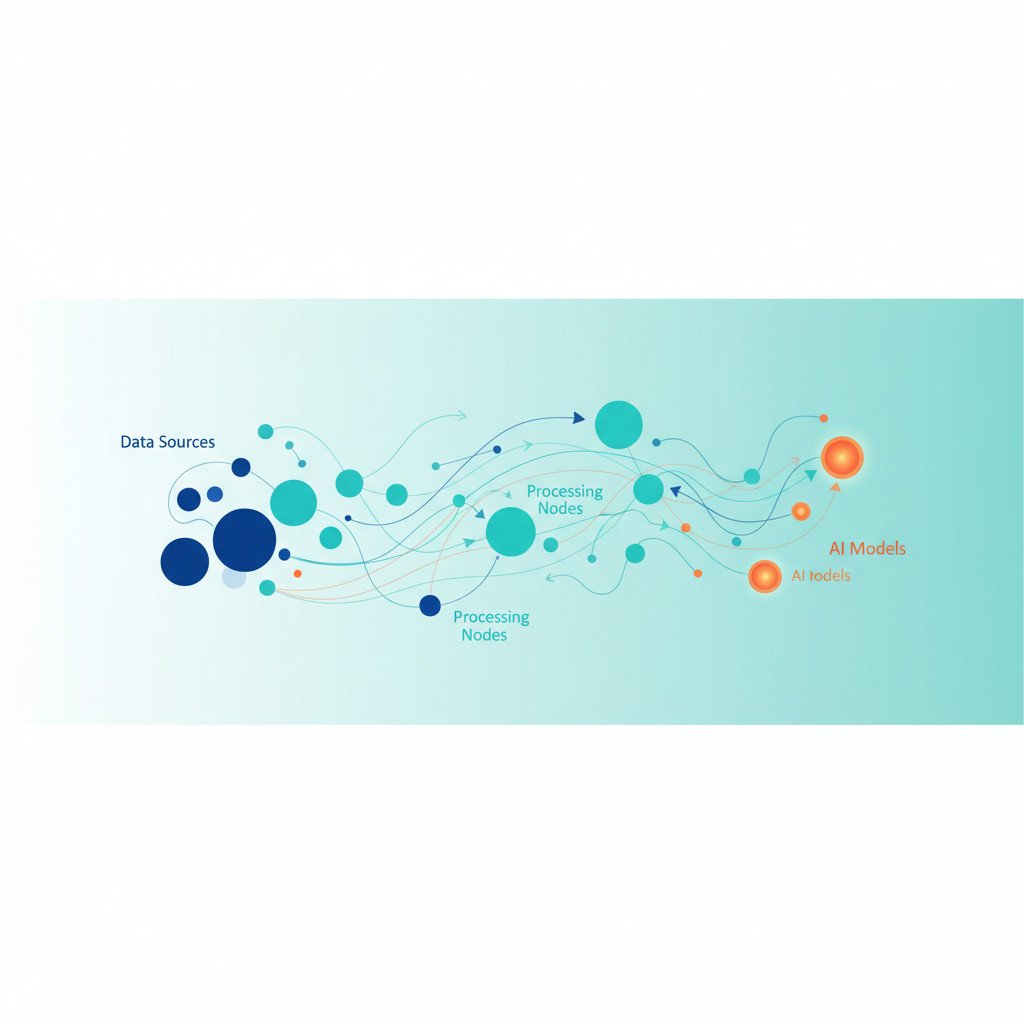
Key components and technologies in connected data ecosystems for AI at scale
A connected data ecosystem blends storage, movement, compute, and governance. Together, these parts form the AI infrastructure companies need. Because AI depends on high-quality inputs, each component must work without friction. As a result, enterprises can scale AI models reliably and quickly.
Core components and how they work
-
Data lakes and data warehouses
- Store raw and structured data for analytics and model training.
- They provide scalable storage on cloud platforms and nearline systems.
- Consequently, teams can run large-batch training and historical analysis.
-
Data integration and pipelines
- ETL and ELT tools unify and transform data across systems.
- Pre-built connectors reduce toil and speed source onboarding.
- For example, retail teams connect POS, CRM, and inventory with minimal code.
-
APIs and API management
- APIs provide standardized access to services and data.
- API gateways enforce security, rate limits, and observability.
- Therefore APIs let apps and models consume consistent, governed data.
-
Real-time data streaming and event-driven architectures
- Streaming platforms move events with low latency.
- Apache Kafka powers many production event streams and is widely used for this purpose (see Kafka).
- Moreover event meshes route events across cloud and edge environments.
-
Cloud infrastructure and hybrid platforms
- Cloud compute scales training and inference on demand.
- Hybrid setups keep sensitive workloads on-prem with secure links to the cloud.
- Thus teams balance cost, performance, and compliance.
-
AI platforms and model serving
- Model registries, feature stores, and serving layers operationalize ML.
- They support versioning, monitoring, and online inference.
- As a result, models move from experiments into reliable production services.
-
Knowledge graphs and semantic layers
- These layers enrich context and connect entities across data sources.
- They boost discovery, search, and explainability for AI results.
-
Governance, metadata, and observability
- Lineage, policy enforcement, and quality checks reduce risk.
- Monitoring and self-healing pipelines detect anomalies and auto-remediate.
Putting the pieces together
When combined, these elements create an end-to-end AI-ready stack. Integration platforms unify connectors, APIs, and event flows. Therefore they reduce tool sprawl and speed AI delivery.
For practical guidance, compare workflow platforms in Zapier vs Gumloop and read about compute shifts in Tesla’s Dojo discussion. For industry context on decision velocity and data challenges, see IDC.
Tools that enable connected data ecosystems for AI at scale
Below is a compact reference to help teams evaluate platforms for data integration, AI infrastructure, and scalable AI systems. Each row lists core features, how well the tool scales, integration ease, and common enterprise uses.
| Tool or Platform Name | Core Features | Scalability | Integration Ease | Typical Use Cases |
|---|---|---|---|---|
| Snowflake | Cloud data warehouse, time travel, secure sharing | Very high, elastically scales storage and compute | High, supports connectors and SQL-based ingestion | Analytics, feature stores, model training data |
| Databricks | Unified analytics, Delta Lake, MLflow integration | High, optimized for large-scale batch and streaming | High, native connectors and Spark ecosystem | Data engineering, ML pipelines, large-batch training |
| Apache Kafka / Confluent | Event streaming, durable logs, stream processing | Very high, built for millions of events per second | Medium, requires setup but many connectors exist | Real-time analytics, event-driven architectures |
| AWS (S3, Glue, Kinesis, SageMaker) | Object storage, ETL, streaming, model training | Very high, wide global footprint and managed services | High, broad native integrations across AWS | Scalable training, inference, streaming pipelines |
| Google Cloud (BigQuery, Pub/Sub, Vertex AI) | Serverless warehouse, pub/sub, AI platform | Very high, serverless scaling for storage and compute | High, strong GCP-native connectors and APIs | Ad hoc analytics, streaming ML, model serving |
| Microsoft Azure (Synapse, Event Grid, ML) | Integrated analytics, event routing, ML Ops | High, hybrid-friendly with enterprise controls | High, strong Azure ecosystem integration | Enterprise BI, hybrid ML, real-time workflows |
| SAP Integration Suite | Pre-built connectors, API management, Event Mesh | High, enterprise-grade for SAP landscapes | High for SAP systems, medium otherwise | Integrating ERP, finance, and operational systems |
| MuleSoft | API-led connectivity, orchestration, security | High, designed for enterprise scale | High, extensive connectors and templates | API management, cross-system orchestration |
Practical notes
- Choose based on existing cloud footprint to reduce friction.
- For real-time needs, prefer Kafka or managed streaming services.
- For analytics-first workloads, Snowflake or BigQuery speed time to value.
- For SAP-centric enterprises, SAP Integration Suite simplifies ERP connectivity and governance.
Together, these tools form the building blocks of connected data ecosystems. Therefore, teams can assemble modular stacks that support production-ready AI at scale.
Benefits of connected data ecosystems for AI at scale
Connected data ecosystems for AI at scale deliver clear business advantages. They improve data quality, reduce time to insight, and enable efficient AI deployment. As a result, teams move from experimentation to production faster. For example, Harrods cut integration times by 30 percent and lowered TCO by 40 percent after streamlining data flows.
Key benefits
- Improved data quality and consistency
- Unified pipelines enforce schemas and validation rules.
- Consequently models train on cleaner, more reliable inputs.
- This reduces bias and improves prediction accuracy.
- Faster insights and decision velocity
- Real-time streams provide fresh signals to models.
- Therefore leaders react faster to market shifts and anomalies.
- As a result, teams capture opportunities earlier.
- Efficient AI deployment and reduced toil
- Pre-built connectors and API-led designs speed integration.
- Data engineers spend less time on plumbing.
- Thus teams focus on model quality and business logic.
- Better personalization and customer outcomes
- Integrated customer signals enable tailored experiences.
- Consequently conversion and engagement often improve.
- Vorwerk’s automation helped it scale digital sales dramatically.
Challenges when implementing connected data ecosystems
Adopting a connected ecosystem brings complexity and cost. Teams must plan for integration, security, and operational overhead. However, understanding these risks lets organizations mitigate them early.
Common challenges
- Data silos and legacy systems
- Older systems often resist standard connectors.
- Therefore architects need adapters or middleware to bridge gaps.
- Security, privacy, and compliance
- Broad connectivity increases the attack surface.
- Consequently governance, encryption, and RBAC must be enforced.
- Infrastructure and operational costs
- Streaming, storage, and compute scale with usage.
- As a result, teams must optimize cost and performance trade-offs.
- Tool sprawl and vendor fragmentation
- Many enterprises juggle multiple integration tools.
- Therefore consolidation and platform choices matter for manageability.
Practical mitigation steps
- Start with high-value use cases and measure outcomes.
- Enforce metadata, lineage, and quality gates early.
- Use hybrid architectures where compliance demands it.
In short, the benefits outweigh the challenges when leaders act deliberately. Consequently, connected ecosystems become a force multiplier for enterprise AI.

Real-world use cases of connected data ecosystems for AI at scale
Connected data ecosystems unlock practical AI outcomes across industries. They turn fragmented signals into actionable decisions. Below are vivid, real examples that show how integration fuels AI at enterprise scale.
Healthcare: faster insights, safer operations
- Siemens Healthineers implemented an integration layer to streamline financial close and reporting. As a result, teams gain near-instant operational insights and flexible planning. Therefore finance and operations leaders can act faster on anomalies. Moreover, connected data reduces reconciliation work and improves forecast reliability.
Finance: smarter risk controls and faster underwriting
- Banks stitch transaction, identity, and third-party data into unified streams. Consequently fraud models run in near real time. As a result, risk teams block threats faster and reduce false positives. In addition, connected pipelines speed underwriting by supplying consistent features to scoring models.
Retail: personalized experiences and operational scale
- Harrods processes two million transactions per day across digital channels. After consolidating flows, the retailer cut integration process times by 30 percent and reduced TCO by 40 percent. Therefore marketing, inventory, and pricing teams deliver personalized offers at scale. Vorwerk also scaled digital sales from 1 percent to 85 percent by automating CRM, inventory, and payment flows.
Automotive and high-performance compute
- For compute-heavy AI, seamless connectivity matters. For background on infrastructure shifts and implications for model training, see the discussion on Tesla’s Dojo and its broader impact. Integration across vehicle telemetry, simulation, and model pipelines enables faster testing and safer rollouts.
Cross-industry orchestration and workflow automation
- Many organizations now blend API-led integration with automation platforms. For comparisons of modern workflow tools and enterprise automation, explore the Zapier vs Gumloop analysis. These platforms reduce implementation time and let teams focus on business logic rather than plumbing.
Why these stories matter
- Each example proves a point: clean connectivity amplifies AI. Therefore companies that invest in connected ecosystems move from pilots to production faster. As a result, they capture revenue, reduce risk, and improve customer outcomes.
Future trends in connected data ecosystems for AI at scale
The next wave of integration will blend AI and data fabric to make connectivity adaptive and autonomous. AI-enabled data fabrics will infer mappings, fix schema drift, and recommend transformations. As a result, engineers will spend less time on repetitive tasks and more time on outcomes.
Federated learning and privacy-preserving architectures will spread model training across locations. Therefore organizations can train on sensitive data without centralizing it. This trend supports regulated industries, and it reduces data movement costs.
Automation will move beyond orchestration into self-healing and intent-driven pipelines. For example, systems will detect anomalies and remediate flows automatically. Consequently uptime improves and model-serving latency falls.
Edge and hybrid architectures will grow because latency matters for real-time use cases. Companies will push models and feature stores closer to users and sensors. At the same time, centralized governance will keep policies consistent.
Knowledge graphs and semantic layers will make context portable across teams. Moreover they improve explainability and feature discovery for ML. As a result, data scientists will assemble richer features faster.
What to watch for
- AI-enabled data fabric vendors that offer automated mapping and metadata synthesis
- Federated learning frameworks with enterprise controls and auditing
- Event meshes and serverless streaming that simplify cross-cloud flows
- Intent-driven orchestration and self-healing pipelines that reduce toil
To stay ahead, pilot one or two patterns quickly. Measure both cost and business impact. Then scale what delivers clear ROI.
Conclusion: make connected data ecosystems your competitive advantage
Connected data ecosystems for AI at scale are no longer optional. They form the infrastructure that turns scattered signals into reliable intelligence. As a result, companies reduce time to insight, improve model accuracy, and scale AI across the business. Moreover, integrated pipelines lower operational toil and drive faster revenue outcomes.
EMP0 helps enterprises build and run these ecosystems securely and effectively. Based in the United States, EMP0 offers a full-stack AI worker that includes integration expertise, pre-built connectors, API management, and automation tooling. Therefore teams move from pilot to production faster. EMP0 also supports model ops, governance, and monitoring so businesses keep control as they scale.
In practice, EMP0 combines engineering skill with plug-and-play components. Consequently clients see measurable gains in personalization, inventory efficiency, and financial reporting. For further reading and case studies, visit EMP0’s website and blog. You can also explore related automation profiles at EMP0’s n8n creator page.
Invest now in connected ecosystems. In short, the future of scalable AI depends on unified, trusted data.